
Kailera Therapeutics Advances Phase 3 Ribupatide Program Supported by Strong Liquidity
The company’s latest quarterly filing details progress in pivotal clinical development alongside a solid cash position that underpins continued R&D investment.
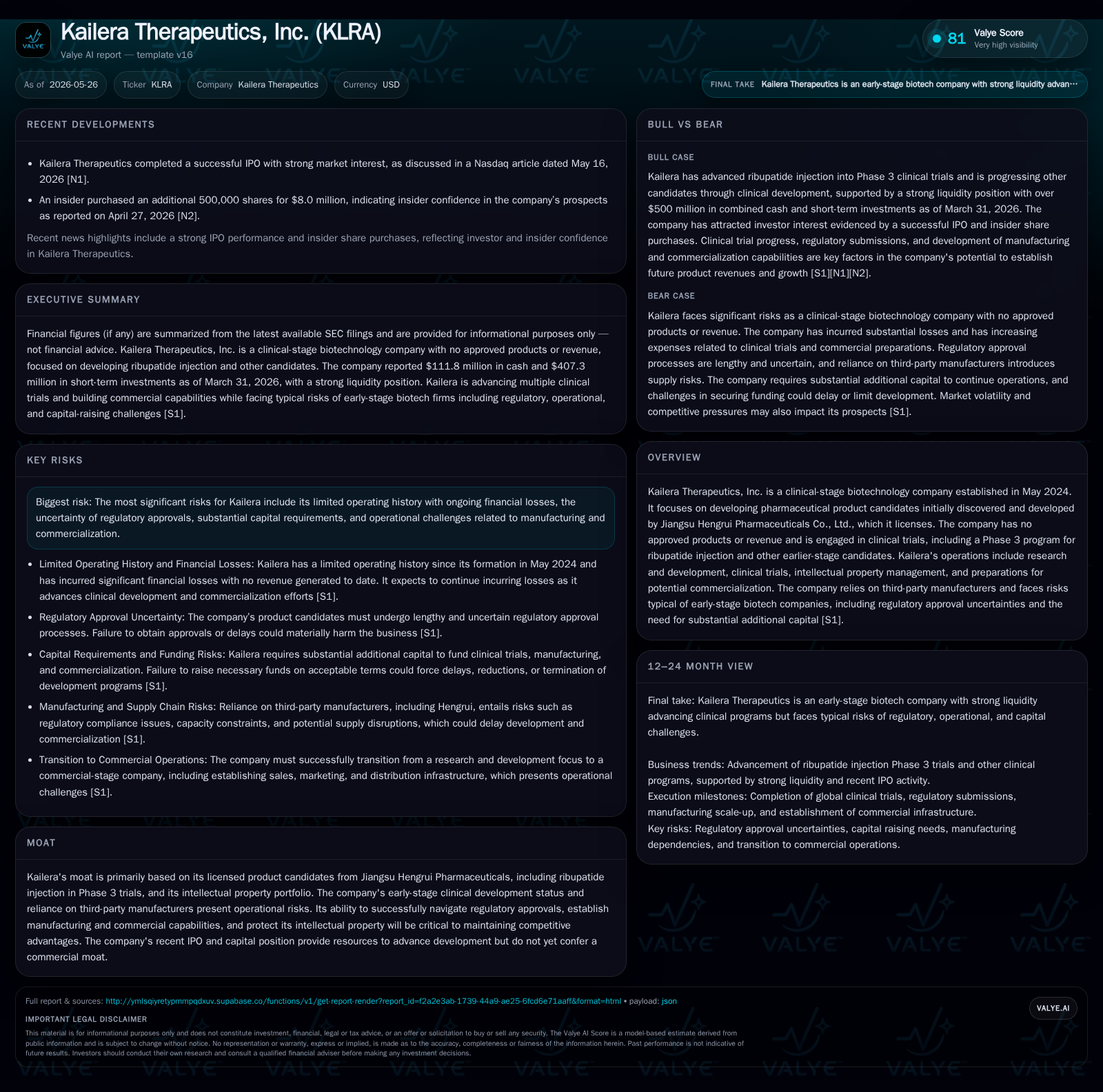
Kailera Therapeutics, a clinical-stage biotech licensing ribupatide and other candidates from Jiangsu Hengrui, reported advancement in its Phase 3 trials for the lead asset in its recent 10-Q. The company remains pre-revenue but holds $111.8 million in cash as of March 31, 2026, supporting ongoing development efforts. Its business model centers on licensing clinical-stage assets and advancing them through regulatory pathways, a capital-intensive process with inherent risks typical in biopharma. Industry challenges include regulatory complexity, reliance on third-party manufacturing, and evolving healthcare regulations. Key growth drivers are successful late-stage trial results and potential NDA submissions, while watchpoints include regulatory uncertainties, supply chain dependencies, and sustained operating losses.
Latest Quarterly Progress
Kailera Therapeutics’ May 26, 2026 Form 10-Q highlights continued advancement of its ribupatide injection program through pivotal Phase 3 trials aimed at demonstrating safety and efficacy necessary for regulatory submissions [S2]. This progression represents a critical phase where positive outcomes could significantly de-risk the development pipeline. The company is focused on executing clinical programs while building operational capabilities to support future commercialization.
Financially, Kailera reported holding approximately $111.8 million in cash and equivalents as of March 31, with a robust current ratio of about 9.7 indicating strong liquidity to fund near-term expenses related to clinical trials and administrative overhead [F1]. Operating losses totaled roughly $84.7 million during the quarter, reflecting substantial ongoing investments typical for an early-stage biotech focused on research and development [F1][S2].
Business Model Overview
Kailera operates an asset-light model centered on licensing product candidates initially developed by Jiangsu Hengrui Pharmaceuticals Co., Ltd., including ribupatide injection [S2]. This strategy allows Kailera to leverage existing discovery efforts while concentrating resources on advancing clinical development and preparing for commercialization.
Currently, Kailera has no approved products or revenue streams; value creation depends entirely on progressing candidates through costly clinical trials toward regulatory approval and market launch either independently or via partnerships post-approval [S2]. The company relies extensively on contract research organizations for clinical execution and third-party manufacturers for drug supply—a common approach in the biotech sector that introduces operational complexities related to quality control and supply chain management.
Industry Context
Kailera competes within a highly regulated biotechnology sector characterized by demanding global regulatory requirements from agencies such as the FDA and EMA. Clinical programs require extensive data packages to meet safety and efficacy standards before approval can be granted.
Competition involves other firms developing immunotherapies or biosimilar injections where differentiation often hinges on proprietary formulations or delivery methods rather than brand strength alone. Intellectual property rights constitute a key barrier protecting Kailera’s licensed assets.
Healthcare reimbursement environments globally add further complexity to commercialization prospects due to pricing pressures and evolving policy frameworks. Ensuring compliance by third-party manufacturers with cGMP standards is critical to maintaining trial continuity and eventual commercial supply reliability.
Growth Drivers
Key growth vectors include achieving positive outcomes in ribupatide’s Phase 3 studies that would enable New Drug Application (NDA) submissions across multiple jurisdictions [S2][N1]. Successful trial data would pave the way for potential market entry revenues while validating Kailera’s platform to support additional licensing or development opportunities.
The company benefits from leveraging Hengrui’s prior discovery work which reduces early-phase costs. Recent IPO proceeds have bolstered capital resources enabling acceleration of late-stage trials alongside incremental hires in regulatory affairs and commercial planning functions [N1]. Future portfolio expansion may emerge through new licensing deals or collaborations designed to diversify risk and scale operations post-approval.
Risks and Watchpoints
Despite progress, Kailera faces several material risks common to early-stage biopharmaceutical companies:
- Lengthy Development Timelines: Patient enrollment challenges or unexpected safety issues could delay trial completion [S2][S4].
- Regulatory Uncertainty: Approval decisions depend on satisfying stringent evidentiary requirements; additional data requests or rejections remain possible [S6][S13].
- Manufacturing Reliance: Dependence on third-party manufacturers introduces risks related to quality compliance or supply interruptions impacting both trials and commercial readiness [S5][S15].
- Compliance Complexity: Adherence to healthcare laws including Anti-Kickback statutes, HIPAA regulations, export controls, and pricing reforms entails significant cost and risk exposure [S4–S7].
- Financial Burn: Continued operating losses necessitate effective capital management; inability to raise funds after cash depletion would impair progress [F1][S2].
- Intellectual Property Litigation: Potential patent disputes could divert resources if litigation arises [S27].
Near-Term Catalysts
Upcoming milestones warrant close attention:
- Release of interim or final Phase 3 ribupatide data will be pivotal for valuation and regulatory planning [S2][N1].
- Regulatory meetings with FDA will clarify submission requirements influencing approval timelines.
- Insider stock purchases indicate management confidence aligning interests with shareholders’ perspectives [N2].
- Monitoring R&D spend relative to cash balances will inform runway visibility.
- Potential new licensing agreements could expand the pipeline beyond current assets.
Financial Snapshot
For the quarter ended March 31, 2026, Kailera reported an operating loss of approximately $84.7 million reflecting intensive R&D activity consistent with its developmental stage [F1]. The cash balance stood at about $111.8 million with a current ratio near 9.7 providing strong liquidity coverage for near-term obligations without immediate financing pressure [F1]. This financial posture supports ongoing Phase 3 trial execution while enabling organizational scaling ahead of anticipated commercialization phases post-regulatory approvals.
This analysis is based solely on publicly available filings as of May 26, 2026. It does not constitute investment advice or research view.
Disclaimer: This is research-only, informational analysis and not investment advice. It may include AI-generated interpretation and general industry context. Always verify important details using primary sources.

Comments