
Apimeds Pharmaceuticals Balances Development-Stage Biotech Risks with New Digital Asset Ventures
Apimeds advances clinical development of its Apitox drug candidate while integrating a digital asset portfolio acquired via merger, facing execution and regulatory challenges.
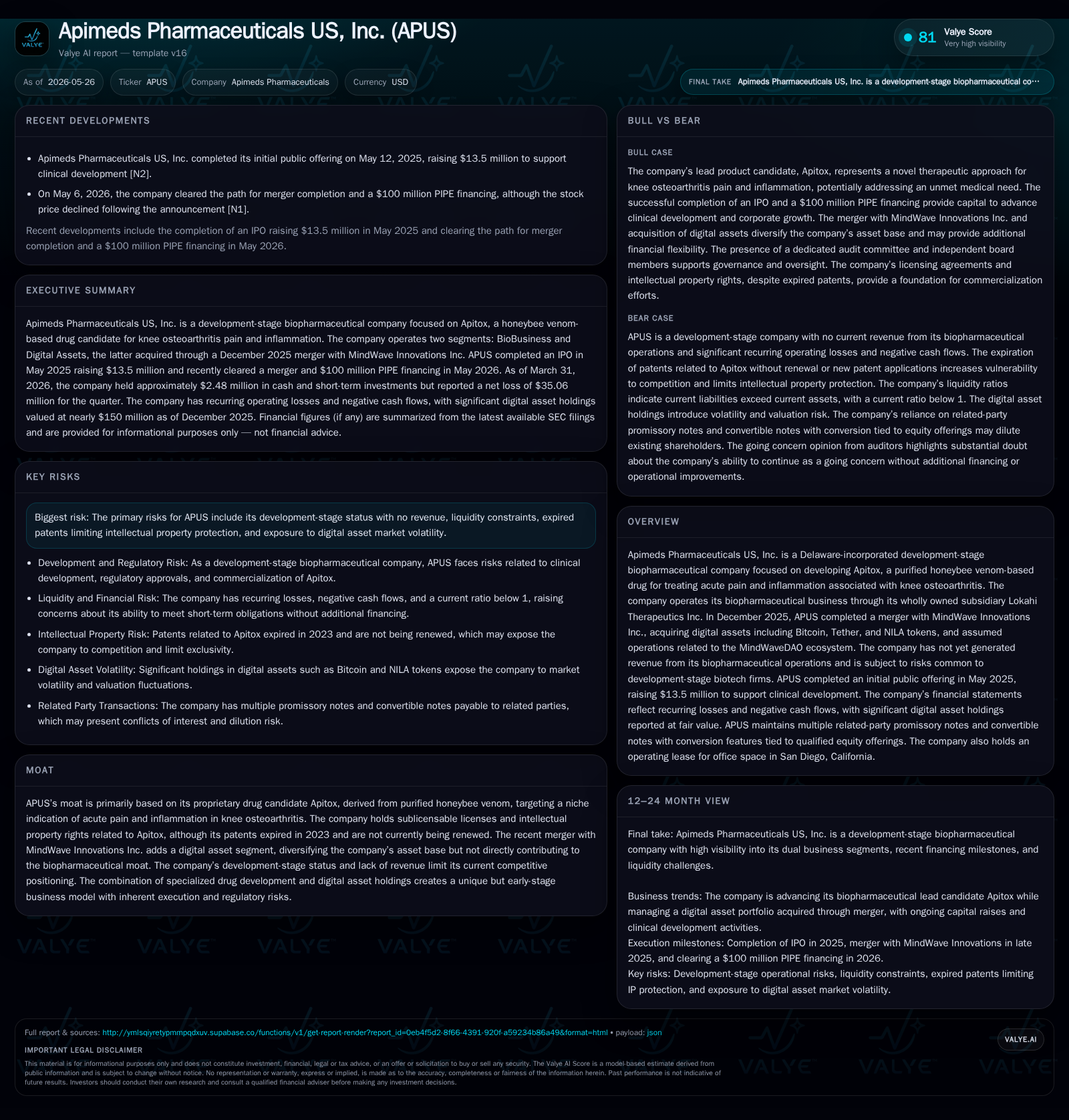
The company’s latest quarterly filing as of May 2026 confirms ongoing clinical and operational progress in developing Apitox, its proprietary honeybee venom-based drug for knee osteoarthritis pain. Concurrently, Apimeds has integrated digital assets from its December 2025 merger with MindWave Innovations, diversifying its asset base but adding market volatility risks. Despite no current revenues and expired patents limiting exclusivity, their sublicensable licensing model and progression in biopharmaceutical trials offer structured growth avenues. Liquidity remains tight with less than $1 million in cash against liabilities slightly exceeding current assets as of March 2026, underscoring the importance of near-term financing and milestone execution.
Latest Quarterly Operating Update and Strategic Developments
Apimeds Pharmaceuticals’ most recent quarterly report filed on May 26, 2026 ([S2]) reaffirms its status as a development-stage biopharmaceutical company focused on advancing Apitox toward commercialization. The filing indicates no material changes to previously disclosed risk factors ([S2]), while an earlier May event filing ([S3]) noted recent board appointments that could influence strategic execution. The quarter reflects continued operating losses consistent with active research and development efforts alongside capital reserves sourced from prior financings.
The company operates through two main segments: its biopharmaceutical business via wholly owned subsidiary Lokahi Therapeutics Inc., and a digital asset segment resulting from its December 2025 merger with MindWave Innovations Inc. This dual structure requires balancing drug development imperatives with managing volatile crypto-asset holdings.
Business Model: Apitox Development Supported by Licensing and Digital Assets
Apimeds’ primary pharmaceutical focus is Apitox—a purified honeybee venom-based drug candidate targeting acute pain and inflammation associated with knee osteoarthritis ([S1]). Commercial prospects depend on successful clinical development followed by direct commercialization or sublicensing arrangements. The company holds a sublicensable license from principal shareholder Apimeds Korea granting U.S. rights for Apitox in exchange for a perpetual royalty equal to 5% of earnings before interest and taxes derived from sales or licenses ([S1]).
Patents covering Apitox expired in 2023 without renewal ([S1]), creating intellectual property vulnerabilities. However, the licensing structure preserves market access rights within the U.S., allowing potential revenue streams despite patent expiration.
Following the merger with MindWave Innovations in December 2025, Apimeds acquired digital assets including Bitcoin (BTC), Tether (USDT), and MindWaveDAO NILA tokens ([S1]). While these assets do not generate core biopharma revenues, they offer financial diversification amid the high-risk biotech development cycle.
Industry Context: Competitive Positioning and Regulatory Challenges
Apimeds occupies a specialized niche within the biopharmaceutical sector focusing on natural toxin-derived analgesics for knee osteoarthritis symptoms ([S1]). Although broader competitors include NSAIDs and biologics for pain management, few directly compete with purified honeybee venom derivatives. The absence of active patents diminishes legal barriers but formulation expertise and licensing agreements may maintain moderate switching costs.
Regulatory approval pathways for venom-based therapeutics carry inherent challenges due to safety considerations associated with animal toxins. Given Apitox’s indication for acute symptom relief rather than chronic disease modification, clinical efficacy endpoints must align closely with FDA requirements for incremental benefit over existing treatments ([S1]). The sector remains high-risk/high-reward depending heavily on robust clinical data outcomes.
Growth Drivers: Clinical Advancement, Licensing Revenue Potential, and Digital Asset Synergies
Key growth catalysts include progression through clinical trial milestones which could catalyze licensing discussions or eventual royalty revenues under the existing sublicense framework ([N1], [S1]). This licensing model enables leveraging third-party commercialization capabilities while limiting capital intensity.
The digital asset segment acquired via MindWave offers ancillary financial upside mainly through realized gains on strategic sales of cryptocurrencies—providing non-core income supporting operational cash flow needs ([S11]). The $100 million PIPE financing closed in early May 2026 represents a critical capital infusion intended to extend the company’s runway across both pharmaceutical development and digital asset initiatives ([N1]). Clinical trial delays or failures would likely erode investor confidence given lack of current product revenue.
Liquidity pressures are notable; as of March 31, 2026 cash resources totaled approximately $980K against current liabilities near $14.6 million—resulting in a current ratio below one (~0.9)—highlighting funding challenges absent additional capital raises ([F1], [S2]).
Digital asset holdings introduce valuation volatility; although prior realized gains exceeded $4 million during fiscal year 2025 ([S11]), market fluctuations could adversely affect reported equity values through mark-to-market adjustments. Regulatory uncertainties surrounding DAO operations add governance complexity risks.
Near-Term Watchpoints: Clinical Data Releases, Capital Raises, Regulatory Feedback, and Governance Developments
Upcoming clinical trial enrollment completions or interim efficacy/safety data will be pivotal indicators for Apitox’s commercial prospects ([N1], [S2]). Progress on executing additional PIPE financing tranches beyond the recently closed $100 million round will be critical for sustaining operations.
Monitoring regulatory communications regarding approval pathways is essential given the stringent safety profile expected for toxin-derived therapeutics ([S2]). Recent board appointments announced in early May may also impact strategic direction and operational momentum ([S3]). Additionally, investor sentiment related to digital asset valuations should be observed as a barometer of risk appetite.
Financial Summary: Tight Liquidity Amid Ongoing R&D Investment Supported by Capital Markets Activity
As of March 31, 2026, cash and cash equivalents stood at approximately $979K compared to current liabilities of roughly $14.6 million—indicating constrained liquidity conditions requiring further financing efforts ([F1], [S2]).
The company's operating model is characteristic of early-stage biotechnology firms reliant on capital markets transactions such as IPO proceeds raised mid-2025 (~$13.5 million net), subsequent PIPE financings including the recent $100 million commitment in May 2026 ([F1], [N1], [S1]). Future viability hinges on investor support prior to achieving self-sustaining commercial revenues.
This analysis is based exclusively on publicly available SEC filings and news sources cited herein. It does not constitute investment advice or forecasts; readers should perform independent due diligence tailored to their analytical requirements.
Disclaimer: This is research-only, informational analysis and not investment advice. It may include AI-generated interpretation and general industry context. Always verify important details using primary sources.

Comments