
Zscaler Advances Cloud-Native Security Amid Shifting Enterprise Priorities
Zscaler’s latest quarterly report underscores strategic enhancements in its Zero Trust platform driven by AI integration amid intensifying cloud security demand.
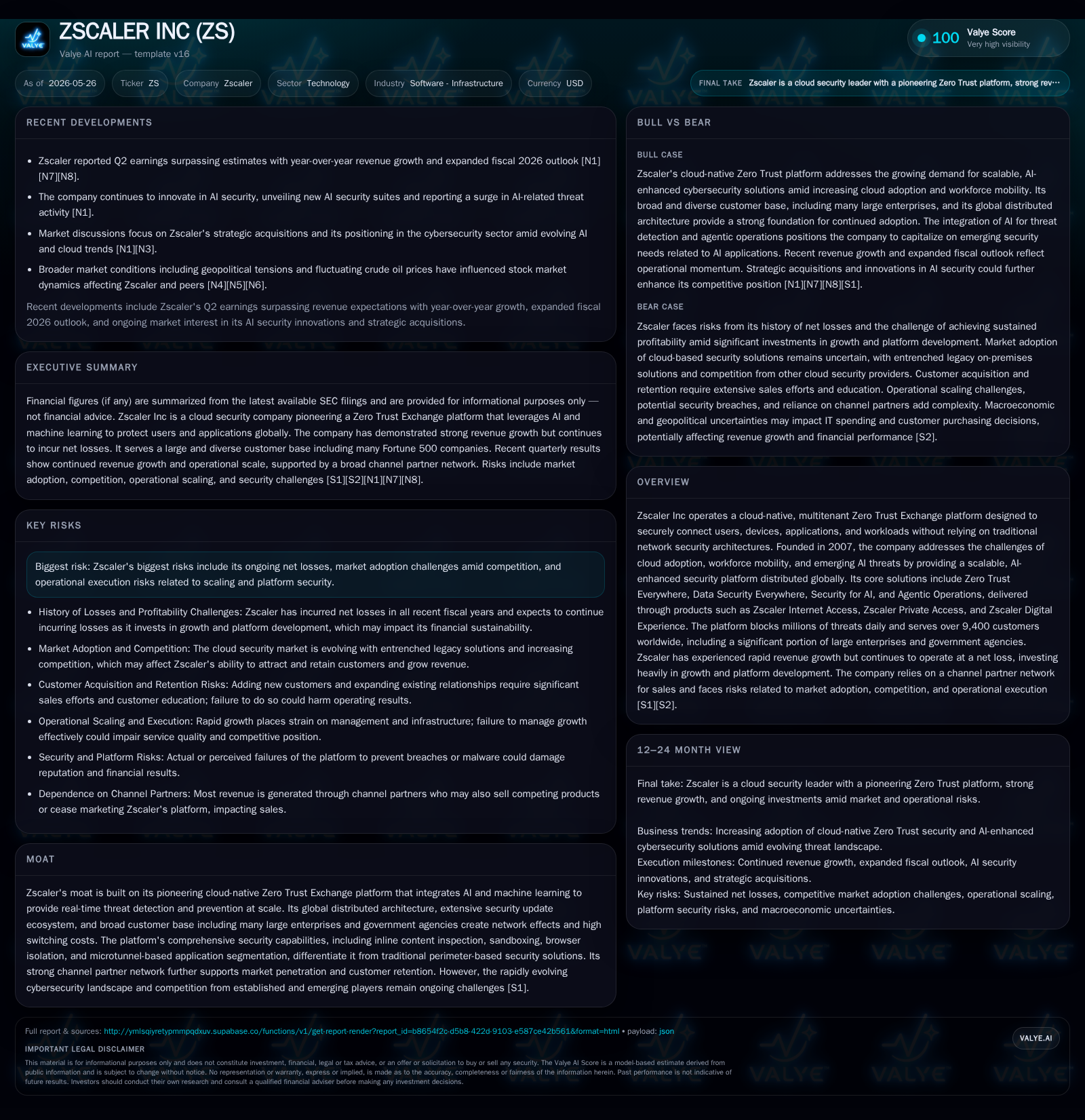
Zscaler’s Q3 2026 filing reveals steady subscription growth with ongoing investments in AI-powered Zero Trust security. The company’s cloud-native Zero Trust Exchange platform continues to serve a broad enterprise and government base, supporting scalable threat mitigation globally. Despite widening net losses reflecting increased R&D and sales spend, Zscaler is positioned to capitalize on structural shifts in cybersecurity driven by cloud migration and emerging AI risks. Key challenges remain around competition, regulatory compliance, and execution efficiency as the firm pursues sustained scale.
Q3 2026 Operating Update and Market Implications
In its latest quarterly filing dated May 26, 2026 ([S2],[S3]), Zscaler reported continued momentum in subscription growth alongside intensifying investment in AI-empowered enhancements to its Zero Trust Exchange platform. While specific revenue figures from the quarter were not detailed here beyond previous fiscal year trends, management commentary from earnings transcripts ([N1]) emphasized expanding enterprise adoption during evolving cyber threats influenced by AI proliferation.
Notably, the company disclosed an ongoing net loss widened this quarter relative to prior periods due to ramped-up spending in research and development as well as sales and marketing functions tailored to scale operations globally ([N6],[S2]). This aligns with Zscaler’s strategic emphasis on fortifying its cloud-native security architecture and bolstering its AI capabilities — critical for maintaining competitive differentiation.
Customer metrics remain robust with over 9,400 paying organizations worldwide across various verticals including heavily regulated sectors such as financial services and government agencies ([S1]), underscoring broad-based trust in the platform despite macroeconomic uncertainties. The company highlighted several new deployments supporting zero trust principles extending beyond traditional network perimeters.
Business Model and Platform Architecture Overview
Founded in 2007 at the dawn of cloud computing evolution ([S1]), Zscaler pioneered a cloud-native multitenant platform—the Zero Trust Exchange—that shifts away from outdated perimeter-based security concepts. Instead of securing networks by gates or appliances, it establishes granular identity- and policy-driven connections on a per-session basis between users or devices and authorized applications or workloads regardless of location.
The primary revenue mechanism is subscription-based recurring fees paid by enterprises for access to its core products:
- Zscaler Internet Access (ZIA): Secure web gateway capabilities facilitating safe cloud internet access.
- Zscaler Private Access (ZPA): Zero Trust Network Access service enabling secure internal application connectivity without VPN.
- Zscaler Digital Experience (ZDX): Monitoring digital user experience to maintain performance visibility.
These are delivered via over 160 public exchanges globally complemented by thousands of private edge deployments ensuring traffic inspection close to end users for latency-sensitive protection ([S1]). The platform integrates advanced inline functions such as sandboxing, browser isolation, granular application segmentation via microtunnels, data loss prevention (DLP), encryption, and AI-powered threat detection.
Revenue growth is driven by expansion within existing customer accounts through seat additions and feature uptake as well as new customer acquisitions predominantly among larger enterprises requiring comprehensive cloud-first security architectures. Strong channel partnerships augment distribution reach while joint sales efforts with direct teams enhance penetration within complex multi-stakeholder IT environments ([S1]).
Competitive Positioning within Cloud Security Ecosystem
Zscaler resides at the forefront of the fast-evolving cloud security sector challenged by an array of competitors ranging from legacy appliance vendors evolving toward hybrid-cloud solutions to pure-play SaaS providers introducing overlapping functional offerings ([S10],[S19]).
Its moat chiefly derives from its early adoption of a zero-trust model delivered entirely via a scalable cloud-native platform endowed with AI/ML-powered real-time intelligence updates that propagate threat mitigations across tenants within minutes—a capability difficult for appliance-centric competitors to replicate at scale ([S1],[S10]). Large enterprise placements including approximately 40% of Forbes Global 2000 companies embed network effects given cross-referenced threat detection benefits creating steep switching costs ([S1]).
Despite this strength, intensifying competition pressures pricing power—as established vendors with broader portfolios attempt commoditization through bundled offerings—and emerging entrants leveraging AI frameworks could capture mindshare or disrupt incumbents if they innovate faster or undercut economically ([S10],[S19]). Channel ecosystem robustness further supports Zscaler’s distribution advantage yet reliance on partner success introduces execution dependencies that must be managed tightly ([S1]).
Sector-Specific Operational Dynamics and Customer Adoption
Enterprise adoption cycles in cybersecurity remain prolonged due to complex stakeholder buy-ins encompassing IT security procurement teams, compliance officers, network architects, and end-user computing groups. Cloud migration velocity coupled with heightened regulatory oversight on data privacy and cybersecurity governance spurs demand for zero trust frameworks where Zscaler specializes ([S5],[S25]).
Subscription revenue growth is influenced by net retention rates fueled through seat expansions as customers adopt ZIA alongside incremental features like ZDX or enhanced data security modules. Usage intensity can vary based on volume of traffic secured across internet-bound sessions or private application tunnels.
However, renewal risk exists if perceived platform efficacy diminishes relative to cutting-edge threats or competitor offerings. Additionally, multi-year contracting cycles create lagged revenue visibility while technology transitions require continuous innovation pace commensurate with shifting attacker techniques ( [S1],[S25]).
Growth Drivers Centered on AI Integration and Zero Trust Demand
Structural tailwinds behind Zscaler hinge importantly on accelerated acceptance of zero trust architectures catalyzed by remote/hybrid work persistence, cloud-first IT infrastructure rearchitecture, and the surge of novel cyber threats linked to AI exploitation attempts documented widely in industry reports ([S1],[N11]). Zscaler’s broadening integration of artificial intelligence into core detection engines improves speed and accuracy of threat identification thereby enhancing value proposition.
Recent acquisition moves such as that of Symmetry Systems signal an intent to deepen data-centric security capabilities aligning with market demands for comprehensive data governance alongside network access control ([N5],[S8]). Continuous product innovation cycles backed by substantial R&D investments aim at expanding addressable market scope while enabling upsell motions within installed base.
Scalable operating leverage potential lies in increasing customer wallet share amidst stable churn supported by sticky multitenant SaaS economics which combined with improved margin profiles from automation enhances long term profitability pathways if execution succeeds ([S1],[N11]).
Risks and Challenges to Sustained Expansion
Alongside opportunity lies significant risks detailed in recent risk disclosures ([S2],[S6],[S25]) affecting future trajectory:
- Financial sustainability: Persistent net losses driven by elevated operating expenses spotlights a challenging path toward profitability necessitating vigilant cost control even as investment continues.
- Competitive dynamics: Escalating rivalry from entrenched IT vendors adopting hybrid-cloud strategies plus startups fueled by cutting-edge AI raise risk of market share erosion or pricing compression.
- Regulatory environment: Expanding regulations governing data privacy (e.g., GDPR-like frameworks) along with emergent rules around responsible AI use impose compliance burdens potentially increasing operational costs or limiting product functionality.
- Execution complexity: Integrating acquisitions entails cultural assimilation risks; scaling channel operations depend on partner performance; any serious service disruption could notably damage reputation given dependence on uninterrupted secure internet connectivity ( [S6],[S25]).
- Intellectual property litigation: Growing intensity in IP disputes across cybersecurity industry adds unpredictability concerning legal costs or restrictions affecting product offerings ([S6],[S20],[S23],[S25]).
Near-Term Monitoring: Execution Milestones and Market Signals
Critical indicators for near-term performance assessment include:
- Renewal rate trends within large enterprise cohorts which reflect satisfaction amid rising competitive alternatives.
- Expansion bookings associated with cross-sell uptake especially integrating recent acquisitions enhancing platform breadth ([N5],[S8]).
- New customer acquisition velocity signaling successful market penetration despite macroeconomic headwinds.
- Product release cadence focusing on delivering meaningful AI-driven feature upgrades sustaining differentiation.
- Channel partner ecosystem health measured through joint sales activity levels contributing materially to pipeline growth.
- Operating expense trajectory vis-à-vis revenue scaling indicating improving leverage potential post investment cycles.
Robustness along these vectors will be essential for validating progression toward sustainable growth anchored on innovation leadership rather than purely volume chase tactics.
Key Financial Metrics and Capital Structure Considerations
As of April 30, 2026, Zscaler held cash & equivalents totaling approximately $982 million against total debt near $1.15 billion measured one year prior at April 2025-end reflecting modest net debt around $168 million designed to fund ongoing expansion needs ([F1]). Current assets stand at about $4.65 billion versus current liabilities near $2.5 billion yielding a comfortable current ratio of approximately 1.86 indicative of solid short-term liquidity ([F1]).
Operating losses persist with an operating income deficit exceeding $128 million noted most recently ending July 31, 2025 highlighting that expenses continue outpacing top-line despite strong revenue growth trends earlier reported across fiscal years ([F1],[S2]). This underscores an aggressive investment stance prioritizing R&D innovation particularly around AI enhancement alongside channel development bolstering market footprint.
Debt maturities appear manageable over medium-term horizons but will require ongoing free cash flow generation improvements or capital raising options if organic profitability timelines extend further [S11]
This analysis is based exclusively on publicly available filings as referenced without offering investment advice.
Disclaimer: This is research-only, informational analysis and not investment advice. It may include AI-generated interpretation and general industry context. Always verify important details using primary sources.

Comments