
Aware Delivers Strategic Upgrades Despite Revenue Volatility in Q1 2026
Aware Inc. navigates rising engineering costs and fluctuating software license sales while seeking growth beyond its government biometric base.
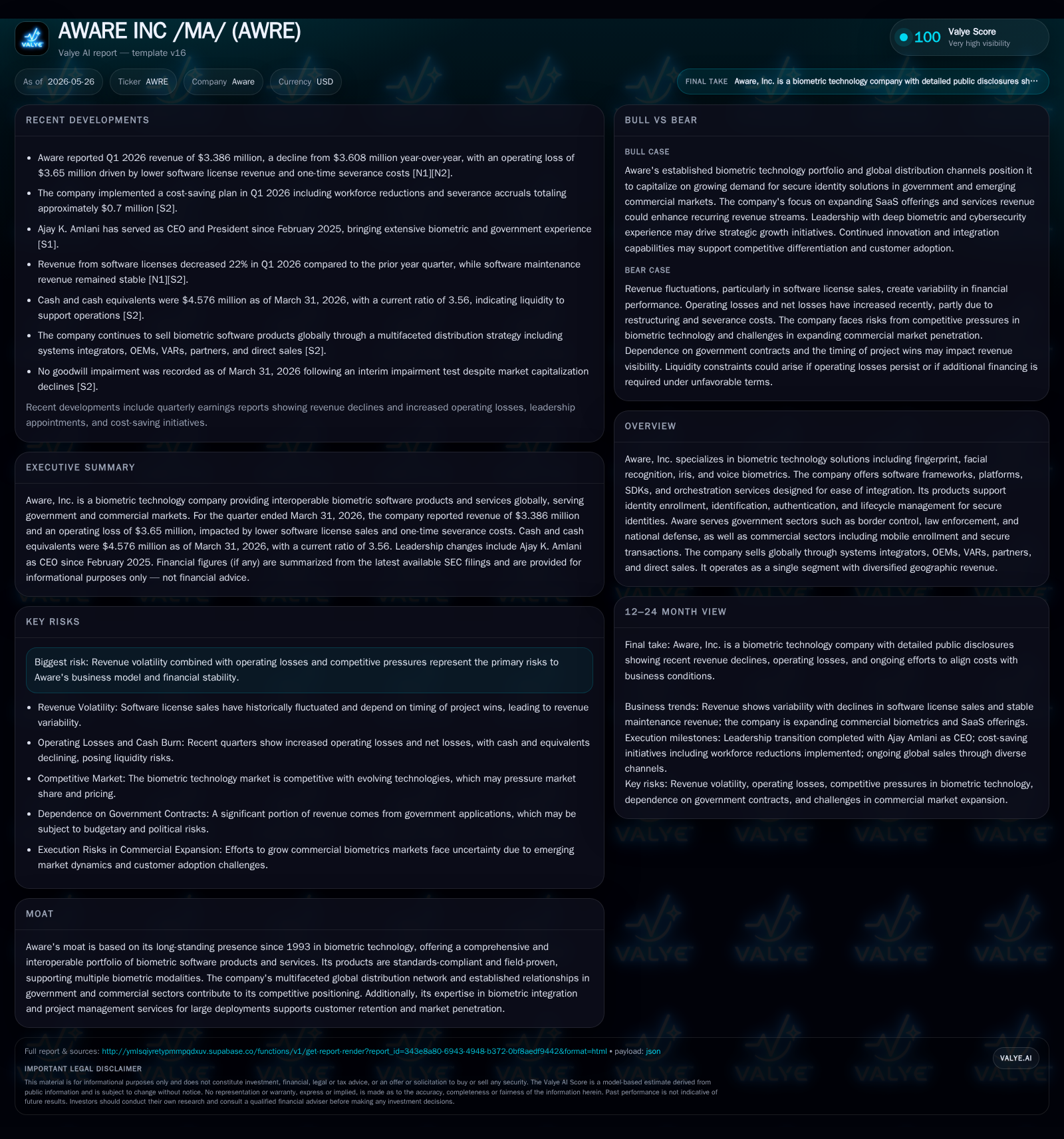
In Q1 2026, Aware Inc. experienced a significant surge in engineering expenses primarily driven by severance related to the CTO termination and expanded headcount salaries, while software license revenues declined due to timing of one-time deals, reflecting ongoing volatility. The company's core business centers on biometric technology solutions for government and emerging commercial markets, leveraging its interoperable software platforms spanning multiple biometric modalities. Competitive positioning rests on its long tenure, standards compliance, and broad global distribution via integrators and OEMs. Growth prospects hinge on penetration into commercial biometric applications, though near-term top-line fluctuations and elevated R&D spending represent critical risks. Liquidity remains solid as of Q1 2026, with management emphasizing operational discipline and selective investment in platform capabilities.
Q1 2026 Operating Update: Engineering Costs Surge amid Revenue Fluctuations
Aware’s latest quarterly filing dated May 1, 2026 reveals a sharp increase in total engineering costs to $3.3 million in the three months ended March 31, up 62% from $2.0 million a year earlier [S2]. This swelling expense footprint consumed nearly all revenue scaled proportionality—97% versus 56% previously—signaling acute near-term margin pressure. The breakdown attributes $0.6 million to one-time severance related to executive turnover including the termination of the company’s chief technology officer (CTO), compounded by an incremental $0.7 million in salary expenses due to prior headcount growth executed in 2025.
Against this cost backdrop, software license revenue declined markedly as fewer one-time perpetual licenses closed during the quarter—a pattern management describes as historically volatile due to dependency on project timing with key clients and integration partners [S2]. This underscores continuing unpredictability inherent within Aware’s licensing model where episodic deal flow drives lumpiness rather than steady subscription income.
Management reaffirms strategic intent to maintain focus on established government biometric markets while accelerating entry into nascent commercial applications that remain difficult to forecast reliably given their emergent nature.[S2] The Q1 operating update thus highlights a pivotal phase where operational investments intended to future-proof product competitiveness coincide with turbulent top-line dynamics.
Aware's Business Model: Securing Identity through Comprehensive Biometric Solutions
Aware Inc.'s business hinges on delivering biometric technology software infrastructure enabling secure identity workflows covering enrollment, identification, authentication, and lifecycle management across multiple modal types including fingerprint, facial recognition, iris scanning, and voice biometrics [S1]
Its portfolio consists primarily of software frameworks, development kits (SDKs), orchestration platforms, and integration services designed for seamless deployment by governments (border control agencies, law enforcement bodies) as well as select commercial verticals such as mobile device enrollment and transaction security systems [S1]
Revenue streams manifest through a mix of perpetual software licenses primarily tied to government projects with some recurring maintenance fees coupled with professional services reflecting project integration complexity. Distribution leverages an extensive ecosystem comprising systems integrators, original equipment manufacturers (OEMs), value-added resellers (VARs), strategic partners alongside direct sales efforts.[S1], [F1]
Standards compliance across leading biometric interoperability protocols combined with proven field deployments build sticky switching-cost barriers facilitating customer retention while supporting multi-modal solutions that enhance upsell opportunities within identity management architectures.
Competitive Positioning in Biometric Technology: Government Roots versus Commercial Expansion
The competitive landscape pits Aware against both entrenched biometric incumbents focused on government contracts and emerging digital identity players vying for fast-growing commercial biometric use cases.[S1] Its moat emanates chiefly from its long-standing presence since 1993 yielding extensive domain expertise underpinned by comprehensive product interoperability across numerous biometric modalities.
Established relationships embedded within government sectors create elevated switching costs owing to mission-critical deployments requiring rigorous validation cycles and certifications—a differentiation difficult for newer entrants without deep sectoral credentials or policy endorsements.[S1]
In contrast, the commercial biometric space is more fluid with diverse competitors delivering point solutions or full-stack identity platforms contending for fintech enrollment or e-commerce authentication niches where adoption curves remain variable.[N3] Here Aware faces pressure to translate legacy competence into scalable platform enhancements faster than rivals embedding AI-driven analytics or cloud-native architectures.
Its global channel breadth through integrators and OEM partnerships aligns with project-based sales cycles common in large-scale government procurements yet must also evolve distribution agility tailored for commercial SaaS-like engagement models.[S1], [N3]
Growth Drivers: Navigating Emerging Commercial Markets and Technology Investment
Aware identifies expansion into mobile biometrics enrollment—targeting seamless user onboarding experiences—and secure transaction authentication relevant in increasingly regulated financial ecosystems as primary avenues for growth.[S3], [S2]
The company recently increased engineering headcount post-2025 hiring initiatives aiming to accelerate platform innovation including modular SDK capability improvements and enhanced orchestration tools supporting complex multimodal deployments [S2]
This R&D ramp reflects strategic prioritization designed to capture emerging commercial contracts which currently exhibit inconsistent booking velocity but demonstrate long-term potential if conversion rates improve.[N2],[S2]
Key performance indicators include new contract win announcements predominantly with commercial partners alongside renewal success rates within core government verticals signaling stable foundational revenues.[N2] Progress hinges on efficient capital allocation ensuring R&D spend translates into differentiated product features that drive partner adoption.
Risks and Constraints: Revenue Volatility, Operating Losses, and Industry Pressures
The company faces material threats stemming from pronounced quarterly revenue swings tied largely to unpredictable timing in securing one-off software license agreements—a source of lumpiness complicating forecasting accuracy.[S2],[N3]
Operating losses continue reflecting intensified investment in engineering functions exacerbated by severance-related nonrecurring charges plus persistent general & administrative costs broadly stable but impactful relative to scale.[F1],[S2]
Competitive risk emerges from pressure exerted by better-funded biometrics providers integrating advanced AI or cloud capabilities potentially eroding price discipline or contracting deal sizes especially within commercial segments.[N3]
Liquidity remains sufficient short term aided by a robust current ratio exceeding 3x yet managing cash burn amid variable top-line performance requires ongoing vigilance to safeguard runway absent dramatic revenue acceleration.[F1],[S2]
Conversion delays in new markets may extend timeframes before technology investments yield meaningful returns while regulatory shifts could modulate demand patterns impacting both government procurement cycles and compliance burdens.
Near-term Watchpoints: Project Timings, Commercial Market Penetration, and ROI on R&D Spend
Critical milestones awaiting scrutiny include clarity on pace whereby pipeline opportunities mature into executable contracts particularly for software licenses underpinning revenue streams.[N2],[S2]
Monitoring sales traction within emergent commercial verticals will provide insight into whether platform enhancements funded through recent engineering additions are resonating effectively with end-users or integrator partners.
Management commentary around margin targets or guidance updates will signal expectations around leveraging cost structure amid investments while progress integrating new engineering leadership post-CTO departure informs execution risk assessment.[N2],[S2]
Subsequent quarterly disclosures should elucidate whether intangible benefits from R&D scale translate swiftly into improved KPIs tied to bookings velocity or contract size expansion beyond government baseline.
Financial Overview: Liquidity, Expense Trends, and Balance Sheet Strength
As of March 31, 2026, Aware holds approximately $4.58 million in cash and equivalents supported by current assets totaling about $24.5 million against $6.87 million in current liabilities yielding a solid current ratio around 3.56 evidencing comfortable near-term liquidity coverage aligned with operating cash requirements.[F1],[S2]
Operational cash burn reached approximately $2.7 million for the quarter linked mainly to these elevated investment activities alongside steady general & administrative spending hovering near $1.7 million per quarter demonstrating disciplined cost containment elsewhere.[S23],[F1]
There are no immediate concerns regarding debt refinancing or covenant breaches noted; however continued revenue variability mandates prudent cash management limiting discretionary spend until clearer visibility emerges around sustainable topline trajectories.
This analysis synthesizes Aware Inc.’s latest filed disclosures alongside industry context without providing investment advice or forecasts. Please reference official filings () for detailed financial data.
Disclaimer: This is research-only, informational analysis and not investment advice. It may include AI-generated interpretation and general industry context. Always verify important details using primary sources.

Comments