
Arm Holdings Accelerates AI Expansion with AGI CPU Amid Geopolitical and Cyclical Industry Headwinds
Arm’s latest quarter reveals growth fueled by AI-driven licensing and production silicon ventures, set against semiconductor cyclicality and regulatory challenges.
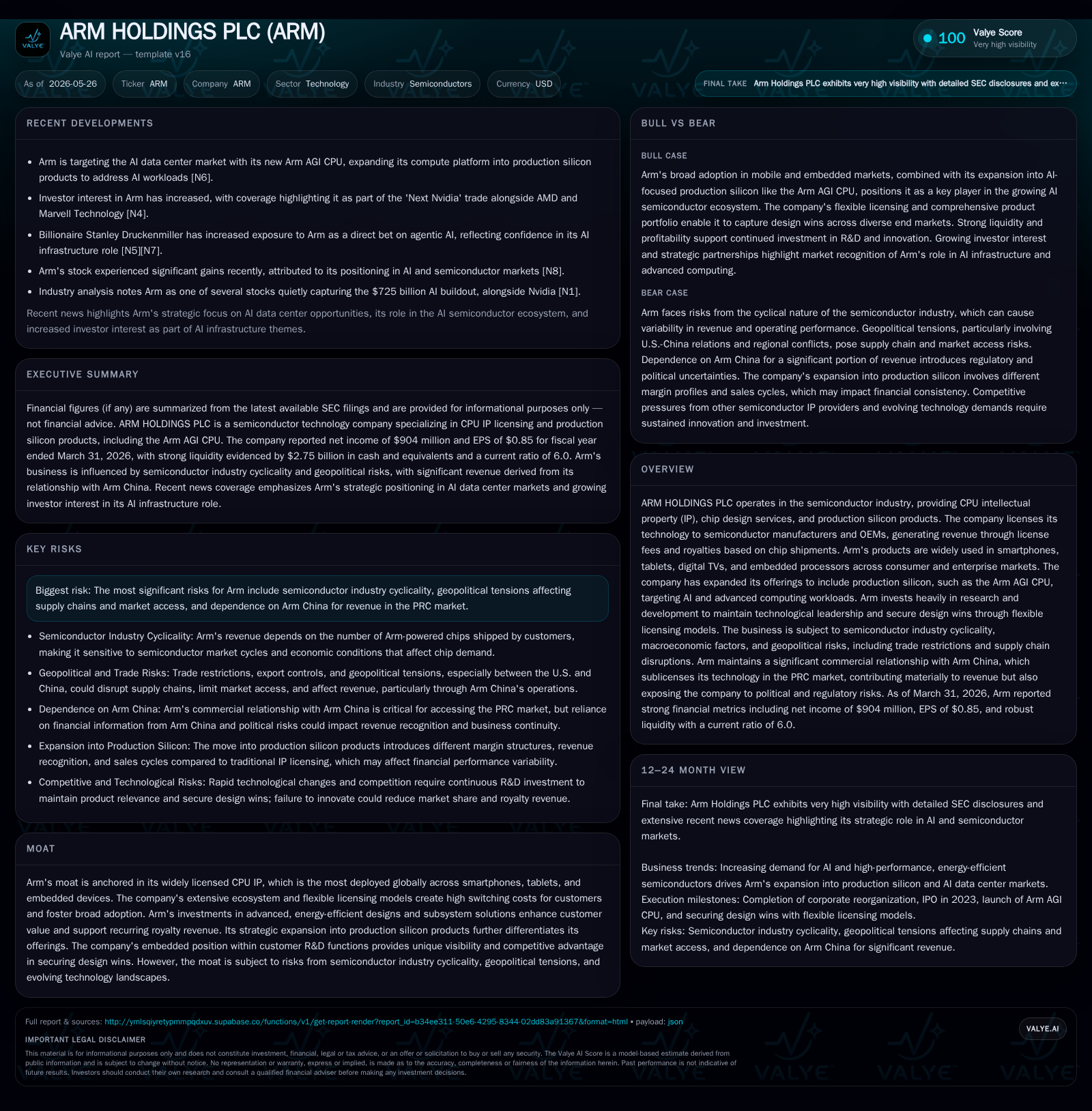
Arm Holdings plc reported solid operating performance in its latest quarter ended March 31, 2026, driven by strong royalty growth from higher chip shipments and an improved product mix favoring AI and advanced compute applications. The company is strategically expanding beyond its core IP licensing model into production silicon products like the Arm AGI CPU, targeting datacenter AI workloads. Despite the tailwinds of AI demand, Arm faces ongoing industry cyclicality and significant geopolitical risks stemming from export controls and supply chain concentration in East Asia. Arm's broad ecosystem, flexible licensing models, and deep integration into customer R&D operations underpin its competitive moat while the path to growth hinges on further design wins and effective navigation of export restrictions.
Recent Operating Update
Arm Holdings plc's latest quarterly filing for the period ended March 31, 2026 ([S2]) confirms robust operating momentum anchored in higher royalty revenues propelled by increased chip shipments and a superior product mix favoring advanced offerings. This quarter benefited from the growing proliferation of Arm-based designs across consumer electronics, automotive solutions, and increasingly critical AI workloads in data centers. The company also reinforced its strategic pivot by emphasizing production silicon products such as the Arm AGI CPU targeting AI inference and training use cases ([N5]).
While driven by structurally positive macro trends around semiconductor demand growth powered by AI and connectivity needs, Arm's business remains affected by semiconductor industry cyclicality inherent to end customer spending patterns. Furthermore, geopolitical developments — notably U.S. export control regulations restraining sales to China — introduce additional variability complicating visibility on near-term revenue streams ([S1], [S8], [S22]).
Business Model
Arm operates fundamentally as a licensor of semiconductor intellectual property (IP), primarily CPU designs alongside GPUs and other processor subsystems. The company's revenue stems from two main sources: upfront license fees when customers integrate Arm IP into their chip designs (fixed payments) and recurring royalties tied to each chip shipment embedding Arm technology.
The licensing approach provides high incremental margins due to low direct manufacturing costs, with royalties scaling proportionally to chip volume. Enhanced value delivery per chip through more integrated subsystems—such as pre-verified CSS (Chiplet Subsystem Solutions)—enables charging higher royalty rates per device ([S1], [S22]). This reflects a shift toward bundled IP packages that address more complex customer requirements during rising chip design intricacies.
Strategically recent shifts include expanding from pure IP licensing towards offering production silicon products like the Arm AGI CPU ([N5]), which introduces new revenue streams with differentiated margin profiles and sales cycles compared to pure licensing. While this broadens Arm’s go-to-market scope beyond traditional OEMs into direct product offerings for AI datacenters, it also increases operational complexity.
The company leverages flexible licensing options—term licenses with customizable renewal clauses—that allow customers to innovate while locking in multi-year commitments which underpin recurring royalty flows ([S1], [S15]). Arm's embedded role within customer R&D functions creates significant switching costs due to architectural lock-in and integration ecosystem dependencies.
Industry Structure and Competitive Position
Arm is an entrenched leader in CPU IP licensing with the broadest global footprint among smartphones (nearly ubiquitous), tablets, digital TVs, embedded processors, automotive electronics, and now cloud & AI data center chips ([S1], [S22]). Its architecture dominates mobile computing markets due to energy-efficient designs optimized for battery-powered devices.
Competition involves other IP licensors like RISC-V emerging players who offer open-source alternatives but lack Arm’s scale or ecosystem maturity. Vertically integrated semiconductor giants (like Intel) develop their own architectures but don't compete directly on the IP licensing front at Arm's scale.
Arm’s extensive partner ecosystem—including foundries, EDA tool providers, OS vendors—and flexible business models sustain a durable moat by reducing customer risk for adoption. Its CSS subsystem solutions raise barriers further by handling complex SoC integration challenges.
However, geopolitical factors constraining access to key markets like China—where Arm China sublicenses technology—and new U.S. export controls introduce notable competitive risks as supply chain realignment pressures intensify globally ([S8], [S22]).
Growth Drivers
AI Expansion Across Markets
The surging demand for artificial intelligence compute powers every segment of Arm’s opportunity landscape—from smartphones leveraging on-device ML features to data center acceleration requiring high-core-count CPUs like the AGI product line ([N5], [S15]). As AI workloads proliferate beyond GPUs to include CPUs optimized for neural processing units (NPUs), Arm stands poised to capture substantial design wins.
Increasing Value Per Chip Through Subsystems
Growing complexity in chip design favors pre-integrated subsystems over discrete IP pieces. By providing complete CSS platforms validated end-to-end with CPUs, GPUs, and NPUs combined under one license package, Arm accelerates time-to-market for customers grappling with longer development cycles and escalating costs ([S1], [S22]).
Flexible Licensing Fuels Design Wins
Arm’s portfolio approach—covering multiple processor IP blocks under flexible contractual frameworks—enables customers to innovate without negotiating new licenses constantly. This reduces friction for adoption across new chip generations or product categories leading to overall royalty base expansion ([S15]).
Strategic Acquisitions & Ecosystem Investments
Recent acquisitions like DreamBig Semiconductor aim to enhance network capabilities embedded within Arm's portfolio enhancing competitive differentiation in connectivity domains important for IoT and automotive use cases ([S6]). Continuous investment into R&D ensures sustained technological leadership.
Risks / Watchpoints / Growth Constraints
Semiconductor Industry Cyclicality
Volatility in end-market demand leads to fluctuating customer orders that cascade downstream affecting licensees’ chip shipments powering royalty variability—a key revenue component ([S1], [S17]).
Geopolitical Risks & Export Controls
U.S.-led export restrictions on advanced semiconductor technology destined for certain Chinese entities directly limit commercial reach in a critical market segment. Current assets totaled approximately $6.24 billion against current liabilities near $1.04 billion, yielding a very healthy current ratio of about 6 ([F1]).
Operating cash flow surged substantially year-over-year indicating solid profitability execution complemented by effective cost control despite elevated research & development expenditures required for innovation leadership ([F1]). Capital expenditure largely focuses on scaling data center infrastructure supportive of new silicon product introductions.
Liquidity remains robust enabling sustained investment in R&D pipeline advancement while navigating inherent industry volatility.
Disclaimer:
This analysis is intended solely for informational purposes reflecting observations based strictly on provided financial filings, SEC reports, and public disclosures without any investment advice or research views regarding ARM Holdings plc securities.
Disclaimer: This is research-only, informational analysis and not investment advice. It may include AI-generated interpretation and general industry context. Always verify important details using primary sources.

Comments