
Timberland Bancorp Inc: Navigating Washington’s Regional Banking Terrain with Conservative Discipline
A deep dive into Timberland Bancorp’s focused regional operations, credit profile, and financial resilience against evolving economic currents.
Timberland Bancorp Inc anchors its business in Washington state’s local economies, carrying approximately $2 billion in assets concentrated in loans and deposits across several counties. Its conservative asset-liability management underpins steady net interest income, while a sizable portion of the loan book engages the residential real estate construction market—a sector rife with cyclical risk and valuation challenges. Credit loss allowances reflect management’s cautious stance amid economic fluctuations, supported by robust audited controls and regulatory compliance. The company’s moat rests on operational discipline rather than distinct market dominance, requiring careful monitoring of regional economic sensitivities impacting credit quality and growth prospects.
Rooted in Washington: Timberland Bancorp’s Localized Identity
Few banks embody the spirit of regional banking quite like Timberland Bancorp Inc. Its operational footprint is firmly planted across Washington state counties including Grays Harbor, Pierce, Thurston, King, Kitsap, and Lewis. This geographic concentration positions the bank as a bellwether for local economic currents but also concentrates risk exposure tightly within these communities. The company thus lives and breathes the dynamics of Washington’s distinct economies—dependent on industries such as construction and manufacturing—and faces direct consequences from localized trade policies or demographic shifts affecting immigration.
Such concentrated presence creates a tangible intimacy with customer bases yet magnifies vulnerabilities when adverse events strike these specific markets. Inflation, natural disasters, or recessions hitting these counties ripple swiftly through Timberland's loan portfolio performance and deposit stability.
Building Stability: Asset and Liability Management in Focus
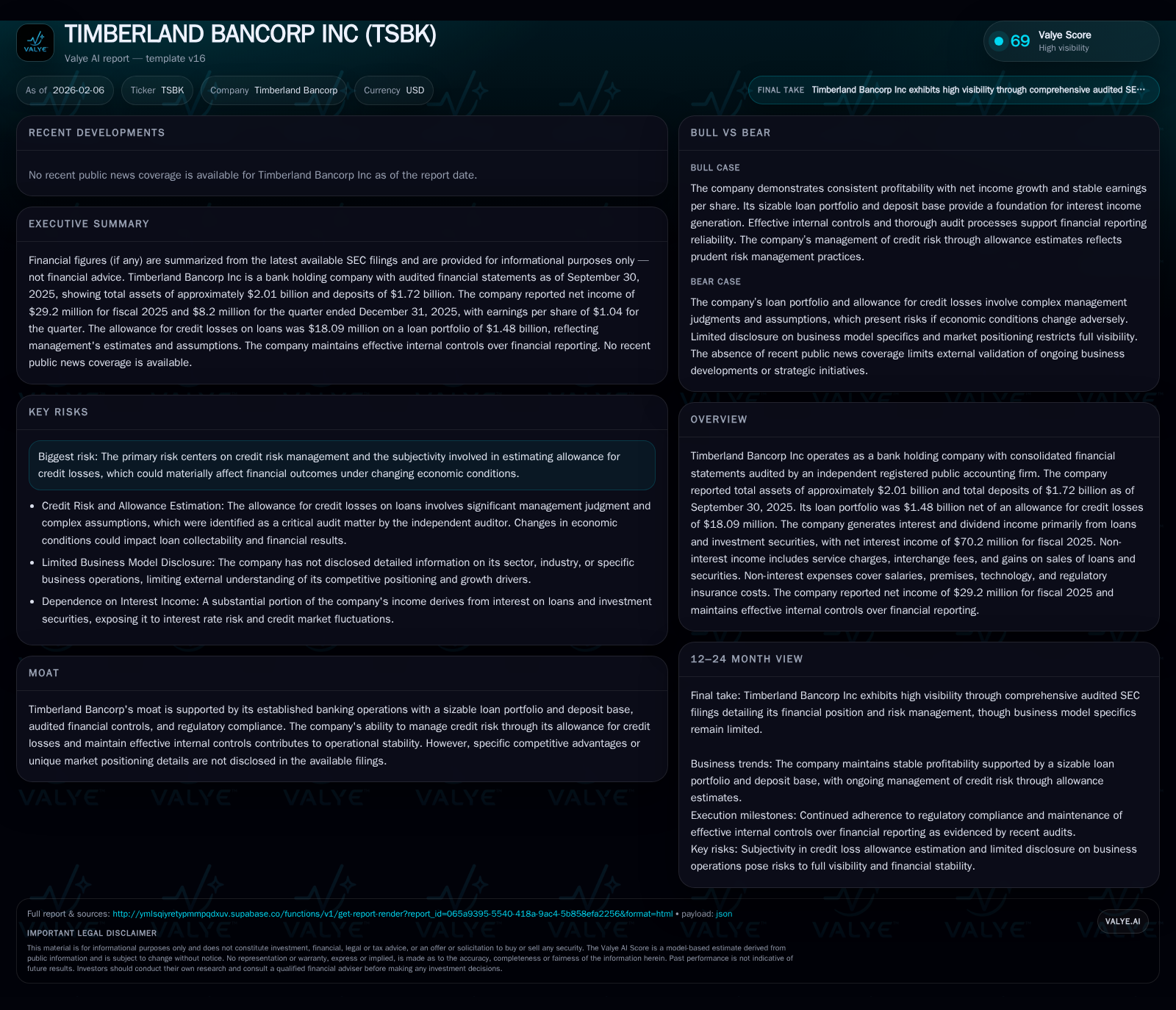
At the close of fiscal 2025, Timberland reported total assets near $2.01 billion supported by deposits totaling $1.72 billion. The bank’s loan portfolio stood at about $1.48 billion net of an allowance for credit losses amounting to $18 million—a material but measured digest for credit uncertainty exposure.
Net interest income recorded was approximately $70.2 million for the fiscal year—an anchor for core earnings that reflects the bank’s balanced approach to asset yield generation while managing liability costs effectively. Deposit bases underpin liquidity strength enabling prudent lending activities while interest income primarily stems from loans and securities investment returns.
Asset-liability strategies avoid excessive risk-taking; they prioritize sustaining cash flows critical amid fluctuating interest rate environments.
Real Estate Lending: Opportunity Meets Concentrated Risk
A spotlight falls on Timberland’s real estate construction loans totaling around $223.89 million as of September 2025—representing a significant 14.2% slice of its overall loan book. Residential projects dominate this loan class ($186.75 million), supplemented by commercial ($21.82 million) and land development ($15.32 million) exposures.
These loans frequently originate absent binding sales contracts on the underlying properties—a customary practice in local markets but one that intensifies credit risk under downturn scenarios when pre-sale commitments are scarce. In consequence, collateral values face pronounced sensitivity to swings in regional real estate fundamentals influenced by regulation changes or supply chain disruptions elevating construction costs.
This concentration means that any depreciation in property valuations or slowdowns in project completion rates could substantially impact Timberland’s loan performance metrics.
Decoding Credit Loss Allowances: The Subjectivity Factor
Timberland's allowance for credit losses (ACL) stands at $18.09 million against its loan portfolio—a figure that crystallizes management’s informed judgment balancing historical loss experience against forward-looking economic uncertainties.
Estimating ACL involves navigating the complexities embedded in volatile local markets where borrower capacity to repay can quickly erode due to external shocks such as inflation surges or commodity price shifts impacting industrial clients.
The subjectivity inherent here necessitates vigilant oversight since both under-provisioning risks sudden hit realization and over-provisioning could constrain earnings unnecessarily.
Economic Headwinds and Market Sensitivities Facing Timberland
Several macroeconomic forces converge upon Timberland's financial outlook:
- Inflationary trends impose wage pressures raising operational costs; interest rate adjustments affect net interest margins unpredictably given yield curve volatility;
- Unemployment fluctuations within the bank's service region alter demand for credit products and influence delinquency rates;
- Trade policies impacting construction materials availability particularly strain borrowers involved in building projects;
- Supply chain bottlenecks disrupt timelines causing revenue recognition delays and increased operational risks.
Regionally concentrated portfolios amplify these influences because unlike geographically diversified lenders, adverse developments hit earnings directly in cycles reflecting Washington's economic pulse.
Financial Soundness Through the Lens of Audits and Governance
Delap LLP’s independent audit concludes positively on both Timberland's consolidated financial statements’ fairness and internal control efficacy following COSO framework principles as of September 30, 2025.
These findings support confidence that reported figures reflect underlying reality without material distortions or gaps in oversight—a crucial pillar given the nuanced challenges around loan loss provisioning discussed prior.
Strong governance mechanisms thus flank risk management systems acting as guardrails preserving operational stability amid marketplace turbulence.
Income Streams Beyond Interest: Fees and Securities Gains
While net interest income remains dominant (E70M FY2025), Timberland supplements earnings through non-interest income channels including service charges levied on deposit accounts, interchange fees derived from card transactions, plus strategic gains realized on sales of certain loans and securities.
Though comparatively modest versus core lending revenue lines, these streams deliver incremental diversification enhancing revenue resilience especially useful during periods when net interest margins compress due to external shocks or competitive pressures.
The Moat Question: Assessing Competitive Positioning Absent Distinct Differentiators
Timberland does not tout an overt competitive moat characterized by unique scale advantages or cutting-edge technological platforms common among regional competitors expanding aggressively.
Instead, its “moat” derives largely from solidity fostered by disciplined credit underwriting standards, regulatory compliance rigor, and robust internal controls assuring operational integrity.
While this foundation promotes reliable earnings extraction within defined markets, it limits accelerated growth prospects or brand premium positioning typically associated with broader client reach or innovation-led differentiation strategies.
Capital Buffering & Regulatory Compliance: Foundations for Resilience
Capital adequacy metrics adhere closely to regulatory requirements mandating buffer levels consistent with perceived risk profiles—a necessity given real estate lending concentrations.
This prudential cushion prepares Timberland reasonably well to absorb unforeseen credit shocks related to localized mortgage defaults or cyclical asset devaluations without immediate jeopardy to solvency or depositor confidence.
Maintaining such balance is a cornerstone strategy that tempers appetite for outsized risk-taking enhancing survival through economic downturns prevalent in regional banking contexts.
Investor Takeaway: Balancing Steady Returns Against Regional Reliance
Timberland Bancorp presents as a case study in conservative community banking refined within Washington's unique socio-economic fabric. Fiscal 2025 culminated with net income approximating $29.2 million annually complemented by a recent quarter reporting roughly $8.2 million—signals of consistent profitability supported by robust cash reserves exceeding $246 million [F1].
However, investors attentive to underlying fragilities should acknowledge how concentrated geographic exposures restrict diversification benefits while heightening dependence on localized real estate cycles vulnerable to disruption.
Proactive monitoring of reserve adequacy aligned with dynamic assessment frameworks will remain essential alongside macroeconomic vigilance particularly concerning inflation trajectories and interest rate volatility that directly influence borrower capacity to perform under existing terms.
In essence, Timberland offers stable operating cadence offset by bounded expansion possibilities demanding disciplined portfolio stewardship coupled with nuanced understanding of regional economic dependencies shaping future outcomes.
This analysis draws exclusively on publicly available filings including SEC reports dated December 2025 and February 2026 alongside Valye proprietary excerpts without incorporating non-public information or investment advice.
Disclaimer: This is research-only, informational analysis and not investment advice. It may include AI-generated interpretation and general industry context. Always verify important details using primary sources.

Comments