
Tesla’s Multifaceted Growth amid Production and Competitive Headwinds in EV and Energy Sectors
Tesla remains a dominant player in electric vehicles and energy solutions while navigating operational, regulatory, and market challenges.
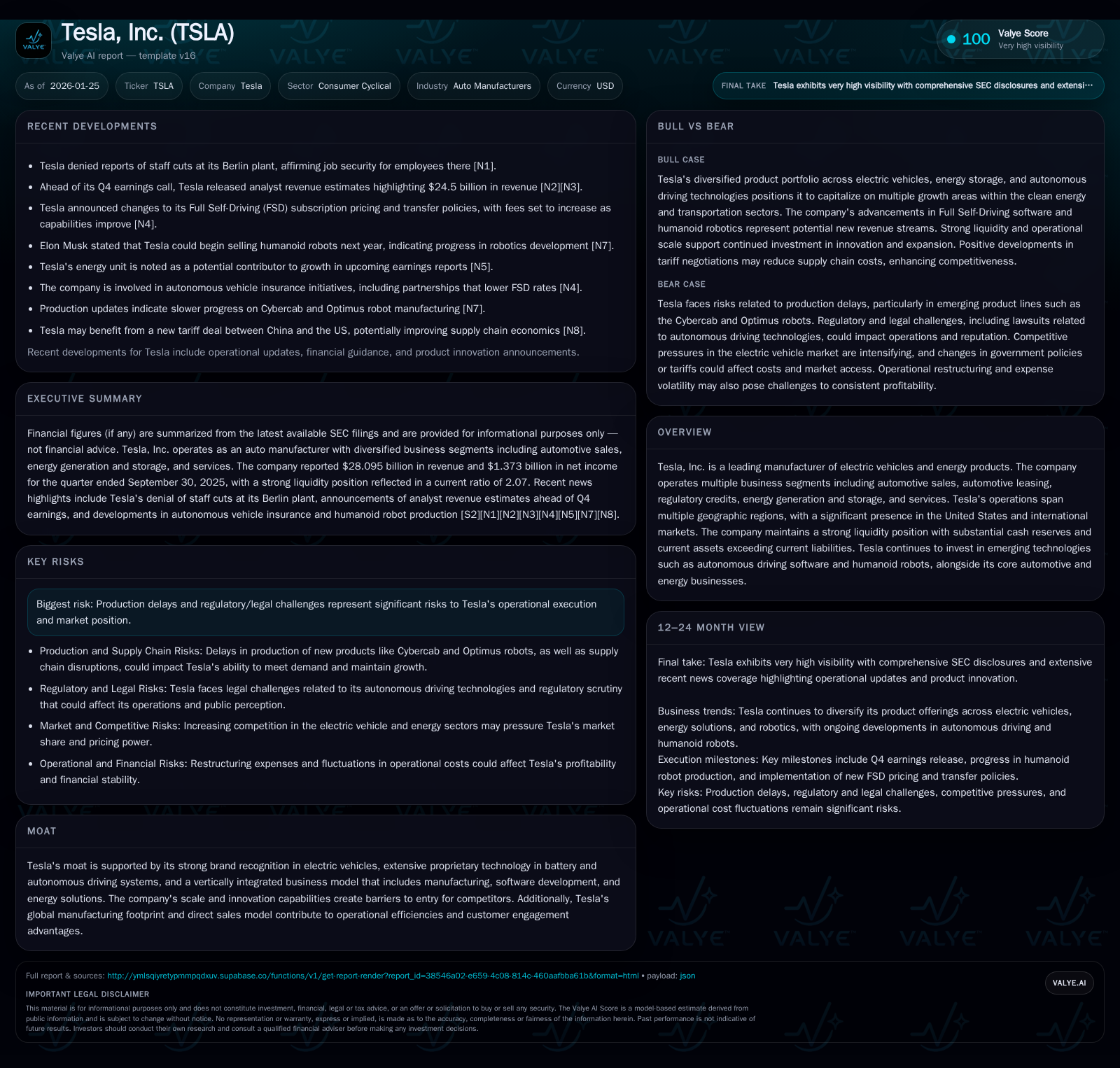
Tesla continues to expand its automotive and energy businesses with anticipated revenues exceeding $24 billion in Q4 2025, buoyed by global manufacturing scale and proprietary technology. The company’s vertically integrated model, spanning battery production to software, supports operational efficiency and brand moat, yet recent workforce adjustments and mixed earnings expectations highlight execution risks. Emerging investments in autonomous driving and robotics add complexity to Tesla’s growth narrative amid intensifying competition and regulatory scrutiny.
What Changed Recently
Tesla released analyst estimates ahead of its Q4 2025 earnings call, highlighting a topline revenue forecast around $24.5 billion, signaling continued robust sales in automotive and energy segments [N1][N2]. However, earnings previews suggest a potentially declining profitability as cost pressures, including supply chain constraints and R&D investments, weigh on margins [N4][N6]. Notably, Tesla publicly denied reports of significant workforce cuts at its Berlin Gigafactory, emphasizing operational continuity in a strategically important manufacturing location [N11]. Meanwhile, geopolitical developments, including a new tariff deal between China and other markets, may influence cost structures favorably for Tesla, given its significant China footprint [N9]. Supply chain dynamics also surfaced as a key factor when Tesla’s graphite supplier Syrah Resources secured more time in contract negotiations, underscoring ongoing raw material sourcing challenges [N10].
Investor behavior ahead of earnings reveals cautious positioning, with put options remaining attractive to short sellers and documented short-seller profits rising, reflecting skepticism on Tesla's near-term earnings trajectory [N3][N12]. Concurrently, Tesla continues to promote its advances in AI and robotaxi development, as well as humanoid robotics initiatives, signaling a broadening of its innovation agenda beyond core vehicle manufacturing [N13].
Business Model as a System
Tesla operates an integrated business model encompassing several interconnected segments: automotive sales, automotive leasing, regulatory credits, energy generation and storage, and services including software updates and vehicle maintenance [S1]. This vertically integrated structure spans from battery cell manufacturing to vehicle assembly and direct consumer sales, bypassing traditional dealership networks. The company’s proprietary battery technology and autonomous driving software form core competitive advantages that drive both product differentiation and operational efficiencies.
Automotive sales remain Tesla's largest revenue source, supported by a global manufacturing footprint including plants in the U.S., China, and Europe [S2]. The leasing business provides recurring revenue streams while broadening market penetration. Regulatory credits, though variable, contribute meaningful revenue tied to emissions regulations, though they are subject to policy risk.
The energy segment includes solar energy systems, energy storage products (Powerwall, Powerpack, Megapack), and energy services. Tesla leverages its battery expertise here as well, creating synergistic value across the energy and automotive domains [S1][S5]. Research and development expense is substantial, reflecting ongoing investment in battery chemistry, vehicle software, and emerging robotics [S14].
Tesla’s liquidity and capital structure support this model, with approximately $18.3 billion in cash and equivalents and a current ratio above 2x as of September 2025, providing a buffer for capex, R&D, and operational needs [S16][S11]. The company manages a mix of debt and finance leases, with long-term liabilities carefully balanced against asset growth.
Industry Map & Competitive Battlefield
The automotive industry is undergoing rapid electrification, with Tesla positioned as a pioneer and market leader in EVs. Its direct-to-consumer sales model contrasts with legacy automakers reliant on dealership networks, allowing Tesla tighter control over pricing, customer experience, and data collection.
Battery technology and scale are critical barriers to entry; Tesla’s Gigafactories and vertical integration reduce costs and improve control over supply. However, competition intensifies as traditional automakers invest heavily in EV platforms, and new entrants target niche segments with innovative designs or cost advantages.
In energy generation and storage, Tesla competes with established players in solar installation, battery storage, and grid services. The energy segment's growth depends on regulatory incentives, cost competitiveness, and integration with the automotive business.
Geopolitical factors, including tariffs and trade agreements, materially affect cost structures and market access. Tesla’s diversified manufacturing footprint helps mitigate some risks, but supply chain volatility remains a persistent concern.
Emerging areas such as autonomous driving and robotics represent both opportunity and risk. Successful commercialization of robotaxis or humanoid robots could redefine Tesla’s market scope but require heavy R&D and regulatory navigation.
Where the Economics Become Real
Tesla’s unit economics hinge on vehicle production scale, battery cost reduction, and software monetization. Manufacturing efficiency gains and vertical integration lower cost of goods sold, while direct sales increase gross margin by eliminating dealer markups [S8][S9]. However, rising raw material costs, including graphite and lithium, can compress margins if not offset by operational improvements or pricing power [N10].
Energy segment margins are less clarified but benefit from integrated battery manufacturing and economies of scale. Leasing adds recurring revenue but ties up capital and adds risk related to residual values.
Research and development expenses, running in the billions annually, represent an investment in sustaining the technological moat but pressure near-term profitability [S14]. Tesla’s capital expenditures focus on expanding Gigafactory capacity and advancing new technologies, balanced against maintaining liquidity reserves [S16].
Tesla’s current liquidity position (cash plus equivalents of $18.3 billion) and a current ratio of 2.07 provide financial flexibility to navigate operational cycles, invest in growth, and service debt [S16]. However, reported restructuring and other expenses indicate ongoing operational adjustments that can impact margins and cash flow.
Diligence Questions / Disconfirming Signals
- What are the detailed drivers behind the expected Q4 earnings decline despite strong revenue growth? Are cost pressures structural or temporary?
- How resilient is Tesla’s supply chain, particularly for critical battery raw materials, given ongoing contract renegotiations and geopolitical uncertainties?
- What is the scale and profitability trajectory of Tesla’s energy generation and storage segment, and how dependent is it on regulatory incentives?
- How meaningful and near-term are revenue contributions from advanced software features, autonomous driving, and robotics?
- How does Tesla’s labor management strategy evolve in light of reported workforce adjustments, especially in key production facilities like Berlin?
- What risks does Tesla face from regulatory scrutiny on autonomous driving, safety, and emissions, and how might these impact operational or legal costs?
- How sustainable is Tesla’s pricing power amid intensified competition from both legacy automakers and new EV entrants?
- To what extent do put option and short seller activity reflect genuine market concerns versus speculative positioning?
This analysis synthesizes recent news and publicly available company disclosures to outline Tesla’s current operational landscape, strategic positioning, and potential areas of risk. It does not provide investment advice or forecasts but seeks to deepen understanding of Tesla’s complex business system and competitive environment.
Disclaimer: This is research-only, informational analysis and not investment advice. It may include AI-generated interpretation and general industry context. Always verify important details using primary sources.

Comments