
Tyson Foods’ Q1 Mixed Results Illuminate Resilience Amid Market and Governance Challenges
Tyson delivers robust sales growth backed by government endorsements, yet faces profit margin pressures and cybersecurity demands.
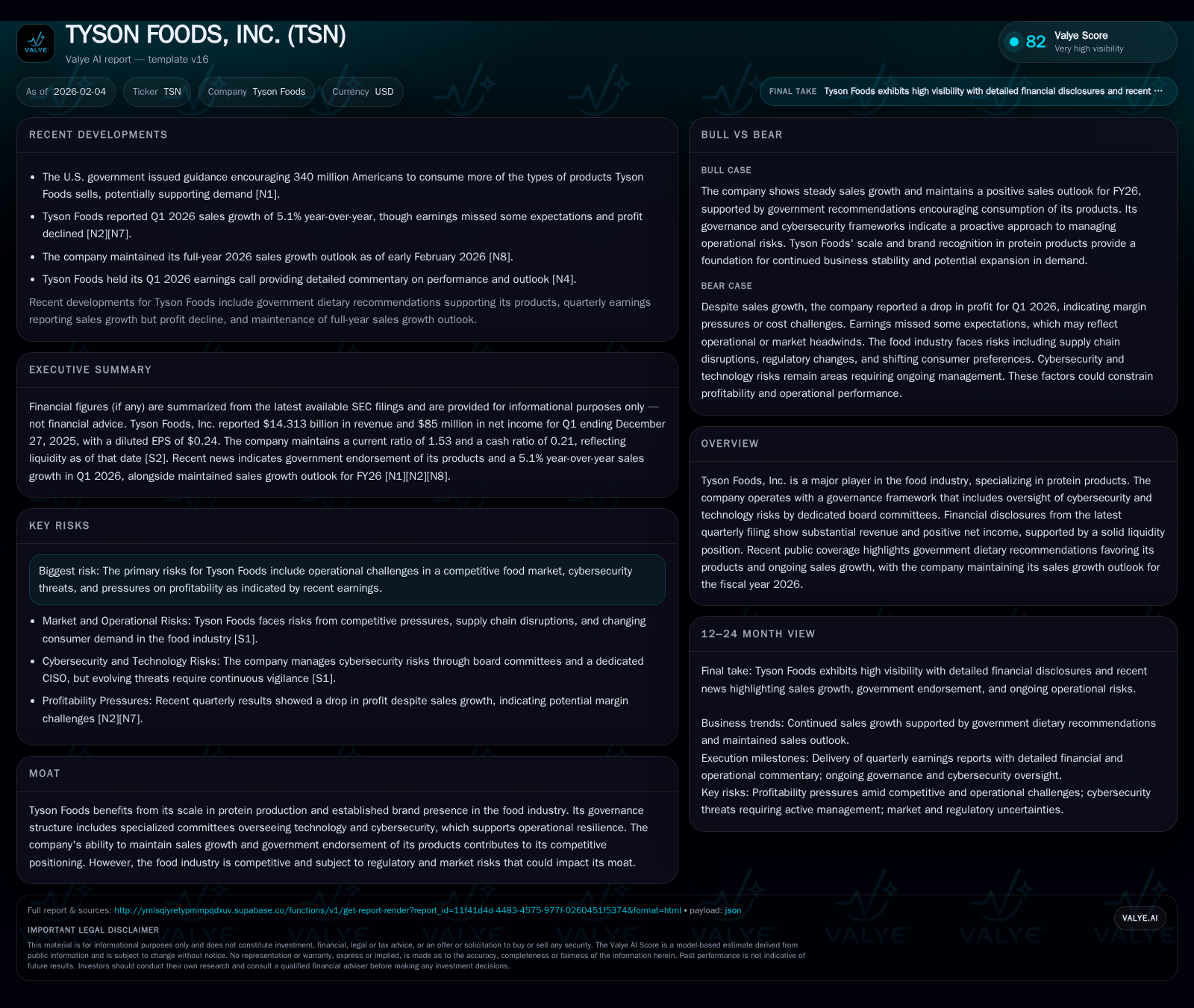
Tyson Foods reported a 5.1% increase in Q1 revenue year-over-year but missed earnings estimates, highlighting operational challenges despite strong top-line momentum. The company’s governance structure—including a dedicated Technology Committee—strengthens its cybersecurity posture, aligning with modern enterprise risk expectations. Favorable U.S. government dietary recommendations provide a strategic tailwind to sales growth, which Tyson maintains for FY2026. However, competitive intensity and profitability pressures remain persistent headwinds, underscoring the nuanced balance Tyson must strike between growth and margin preservation.
Navigating Q1: Growth vs. Earnings Reality
Tyson Foods opened fiscal 2026 with a revenue surge of 5.1% year-over-year to $14.3 billion, signaling resilience in demand within the protein products sector [N1][F1]. This topline strength reflects effective market penetration and consumer acceptance amid broad industry complexities. However, net income for the quarter was reported at $85 million—substantially below analyst expectations—indicating margin compression and operational cost pressures [N4][N5][F1].
The earnings call revealed management’s acknowledgment of these profit headwinds stemming partly from elevated input costs and logistical challenges [N2]. Despite this, they emphasized ongoing investments in productivity enhancements designed to stabilize margins over ensuing quarters. Thus, the narrative is one of strong sales momentum tempered by near-term profitability sacrifices.
Strategic Sales Momentum Backed by Government Dietary Recommendations
An important catalyst supporting Tyson’s growing revenues is the recent endorsement of higher protein intake by U.S. government dietary authorities [N11]. Official guidelines now encourage approximately 340 million Americans to increase consumption of protein-rich foods — categories where Tyson is deeply entrenched.
This regulatory favorability not only solidifies demand fundamentals but also provides Tyson with a unique marketing platform vis-à-vis competitors lacking equivalent product breadth or brand recognition [N11]. Correspondingly, the company reaffirmed its sales growth outlook for fiscal 2026 shortly after releasing quarterly results, reflecting confidence in sustained top-line expansion amid this supportive macro environment [N14].
Governance and Cybersecurity: A Pillar for Operational Stability
Highlighting Tyson’s commitment to robust risk oversight is its layered governance framework focused on technology and cybersecurity risks [S1]. The Board has delegated information security responsibility to the Governance and Nominating Committee while establishing a separate Technology Committee during fiscal 2025 to guide technology strategy, investments, and innovation alignment.
The Technology Committee oversees critical areas such as cybersecurity frameworks and information protection scorecards—a growing necessity given contemporary threat landscapes [S1]. Leadership continuity under an experienced Chief Information Security Officer (CISO), serving since 2016 and supported by specialized teams across identity management, cloud security, threat detection, and incident response further solidifies operational resilience.
Financial Health in Focus: Balancing Liquidity and Profitability
Tyson’s liquidity position remains robust with current assets exceeding current liabilities by roughly $3.3 billion ($9.51 billion vs. $6.20 billion), yielding a current ratio of approximately 1.53 [F1]. This comfortably surpasses typical consumer packaged goods benchmarks and ensures flexibility to navigate short-term financial exigencies despite market volatility.
Conversely, profitability signals present a more cautious picture. The relatively modest net income juxtaposed against large-scale revenues illustrates margin squeeze challenges exacerbated by inflationary pressures on feedstock costs and distribution expenses [N1][F1]. Such pressure points necessitate continued operational efficiency initiatives as well as pricing strategies resistant to commoditization.
Competitive Moat Under Pressure: Scale, Brand, and Market Dynamics
Tyson leverages formidable scale advantages in production capabilities alongside an established brand portfolio that commands considerable shelf presence across retail and food service channels [valye_report_excerpt][S2]. These factors afford pricing power to some degree while facilitating supply chain optimization.
Nonetheless, competitive intensity within the protein category remains acute due to evolving consumer preferences—including plant-based alternatives—and regulatory scrutiny on sustainability practices [S2]. While Tyson has not reported material changes in these risk vectors recently, these dynamics persist as potential erosion points against its moat requiring vigilant strategic responses.
Technology Committee’s Role in Future-Proofing Tyson Foods
The creation of the Technology Committee represents a forward-looking governance evolution reflecting Tyson's recognition of technology’s role beyond traditional IT functions [S1]. Fiscal 2025 marked this committee's inception tasked explicitly with steering technological innovation aligned with corporate strategy alongside operational priorities.
Its mandate covers oversight of cybersecurity systems integral to protecting data integrity as well as evaluating emerging investments that enhance productivity or consumer engagement platforms [S1]. By embedding technology expertise at the Board level through members skilled in risk management and IT domains, Tyson aims to fortify resilience amidst rapid digital transformation pressures.
Risks on the Horizon: Industry Competition, Cyber Threats, and Profit Margins
Tyson continues to face layered risks outlined in its SEC filings including competitive food industry challenges characterized by price volatility and regulatory burdens [S2]. Cybersecurity threats also represent an evolving concern given rising attack sophistication; while governance frameworks are strong, no system is impervious [S1][N5].
Earnings misses underscore ongoing margin vulnerability driven by cost inflation—specifically around commodity feed inputs and labor costs—which may persist if global economic uncertainties endure [N5][S2]. Operational disruptions linked to supply chain volatility remain possible though mitigated by diversified sourcing strategies.
Investor Takeaways: Sales Growth Outlook and Income Appeal
From an investor perspective, Tyson’s maintained forecast for fiscal 2026 sales growth signals management confidence in underlying demand trends — buoyed by both intrinsic product appeal and external policy endorsements [N12][N14].
Attractive liquidity metrics support balance sheet strength essential for navigating execution risks while dividend appeal continues to draw income-focused investors amidst broader market uncertainty [N12]. However, tempered earnings performance cautions against assuming unhindered profitability expansion absent technological or operational breakthroughs.
In aggregate, Tyson Foods embodies a complex interplay between resilient top-line drivers supported by official dietary guidance and challenging margin conditions shaped by competitive dynamics plus input cost volatility. Its enhanced governance architecture—particularly around cybersecurity—demonstrates proactive evolution addressing modern enterprise risks critical for medium- to long-term sustainability.
This analysis is based on publicly available information as of early February 2026 including SEC filings and recent earnings reports; it does not constitute investment advice.
Disclaimer: This is research-only, informational analysis and not investment advice. It may include AI-generated interpretation and general industry context. Always verify important details using primary sources.

Comments