
21Shares Solana ETF: Operating Resilience and Growth Prospects Amid Market Volatility
The latest quarterly filing underscores the Trust’s operational stability, staking dynamics, and evolving regulatory landscape shaping its strategic posture.
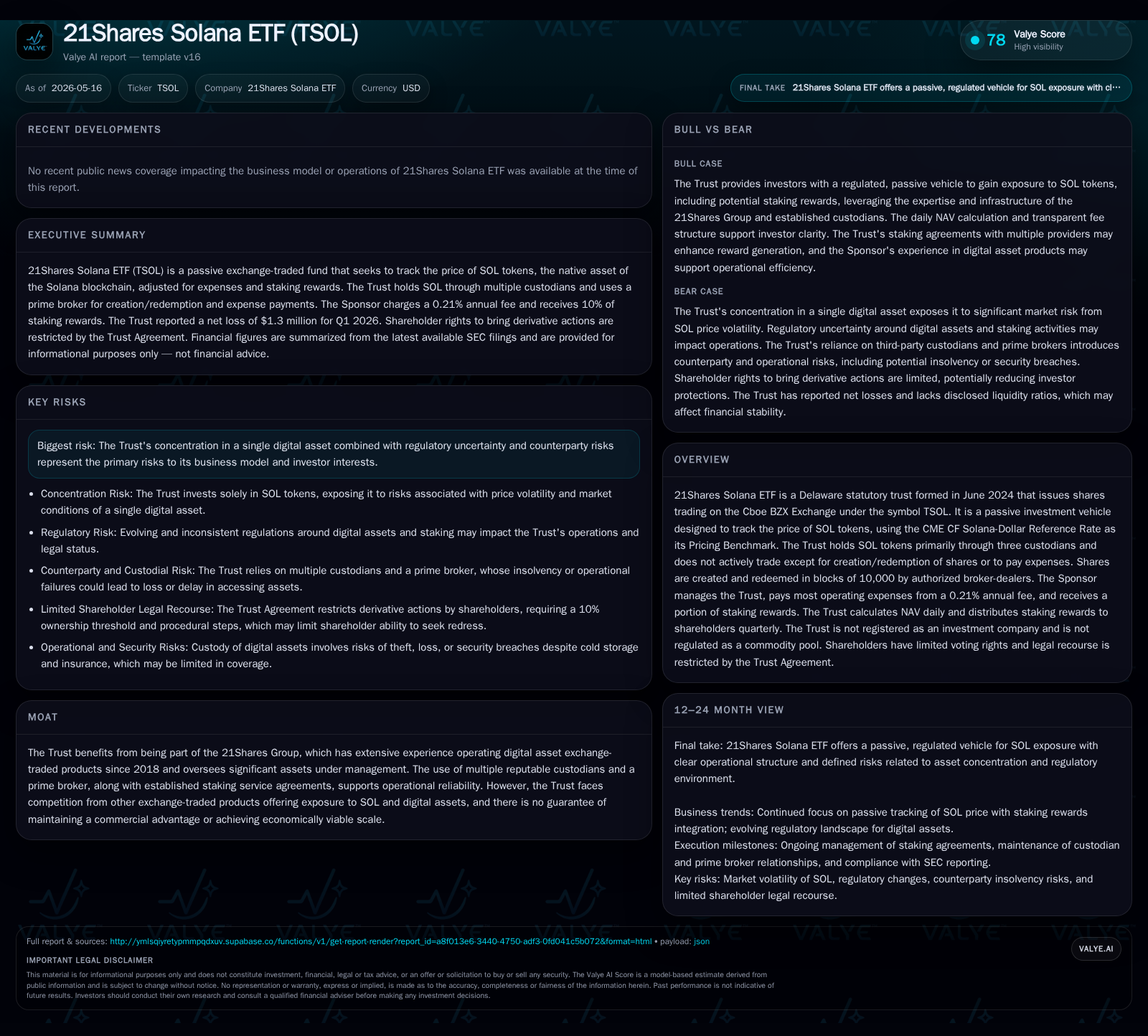
21Shares Solana ETF (TSOL) remains a tightly managed passive vehicle tracking SOL token price via a proprietary benchmark, delivering staking rewards while navigating volatile market conditions and regulatory uncertainties. Its May 2026 10-Q reaffirms consistent risk profiles with enhanced disclosure on derivative action constraints and staking reward distribution policies. The Trust’s multi-custodian framework, professional staking agreements, and Sponsor affiliation with the seasoned 21Shares Group support operational reliability amid an intensifying competitive exchange-traded crypto product environment. Demand growth hinges on institutional adoption of regulated SOL exposure and successful reward mechanics, while legal risks around classification of SOL and counterparty exposures represent ongoing watchpoints.
Latest Quarterly Developments and Operating Update
The May 15, 2026 Form 10-Q for 21Shares Solana ETF (TSOL) primarily confirms continuity in the Trust’s risk profile without material changes since its last annual report. Notably, it expands public detail on the statutory trust’s governance mechanism restricting shareholders’ derivative actions: effectively requiring at least two unrelated holders owning a minimum combined 10% of shares to jointly initiate suits on behalf of the Trust [S2][S14]. This provision notably limits individual investor litigation capacity, a factor pertinent to fiduciary recourse given the niche statutory trust structure under Delaware law.
The filing reaffirms the Trust's operational posture as a passive investment vehicle tracking the CME CF Solana-Dollar Reference Rate ("Pricing Benchmark") with daily NAV calculations adjusted for expenses and staking rewards [S2][S1]. While no new quantitative operating figures were disclosed this quarter, reaffirmation of key terms – such as creation/redemption procedures exclusively via authorized participants in blocks of 10,000 shares – attests to stable operational mechanics maintaining liquidity formation while controlling token movements [S2][S1].
Overall, the quarterly disclosure consolidates existing disclosures on business model discipline and risk factors without signaling material near-term shifts but clarifies governance nuances important for investor oversight understanding.
Business Model and Fund Mechanics
TSOL functions as a passive exchange-traded fund designed to provide exposure exclusively to SOL tokens held in trust. Its mission is to track performance against the CME CF Solana-Dollar Reference Rate – calculated specifically as the New York variant – effectively anchoring valuation to a transparent price benchmark rather than relying on spot exchange quotes subject to disparate liquidity or manipulation vulnerabilities [S1]. This reduces tracking error risks commonly affecting digital asset investment vehicles that reference multiple exchanges.
Authorized Participants (primarily registered broker-dealers with formal agreements) create or redeem shares by delivering or receiving either cash or SOL tokens corresponding to basket values computed daily at NAV [S1][S16]. These baskets comprise fixed increments of 10,000 shares; this concentration scale balances tradability liquidity with operational feasibility given custody logistics.
The Trust holds substantial amounts of SOL tokens without leveraging positions or active trading beyond share creations/redemptions or expense payments [S1]. This non-leveraged structure positions TSOL as a pure play passive vehicle focused on faithful index-like tracking rather than speculative returns.
Custody, Staking Services, and Operational Quality
Operational trustworthiness centers on multi-custodian safekeeping of SOL tokens. The Trust employs three leading custodians — Coinbase Custody Trust Company LLC, BitGo Bank & Trust Company N.A., and Anchorage Digital Bank N.A. — who jointly hold all SOL assets on behalf of the Trust [S1]. This diversified custody model mitigates concentration risk inherent in third-party custody by distributing holdings across multiple independent entities with extensive digital asset servicing credentials.
Staking services are principally provided under an agreement with Coinbase Crypto whereby a portion of SOL is staked on behalf of the Trust to generate protocol-level rewards that are then shared with shareholders [S6]. Operational stipulations require monitoring uptime performance of providers alongside historical slashing events that could diminish stake returns if validators misbehave on-chain [S6].
The economics of staking involve compensation arrangements where service providers receive low single-digit percentages of gross staking rewards as fees (“Staking Provider Consideration”). After deducting these fees, the Sponsor receives a further fixed portion (typically 10%) from net rewards before distributing remaining yields directly to shareholders quarterly [S6]. This fee arrangement aligns interests but slightly dilutes gross returns.
Execution assurance also relies on the Sponsor’s active management of minimal SOL transfers primarily used for expense payments only—minimizing unnecessary token movement that could introduce security vulnerabilities [S21]. Prime brokerage roles facilitate creation/redemption transactions but impose custodial omnibus claims rather than segregated holdings; thus some counterparty bankruptcy risk persists but is mitigated by robust contractual safeguards [S20][S25].
Competitive Environment and Industry Positioning
TSOL competes in an increasingly fragmented digital asset exchange-traded product landscape offering direct or synthetic exposure to SOL tokens. Unlike some rivals employing derivatives or actively managed strategies, TSOL’s passive approach tracked against a specialized CME CF reference rate offers transparency appealing to cost-conscious institutional investors seeking straightforward underlying asset ownership [S3].
As part of the larger 21Shares Group ecosystem—managing approximately $7.56 billion across over sixty-six crypto ETPs since 2018—the Trust benefits from established brand credibility alongside experienced governance frameworks tailored toward digital assets [S3]. This deep domain expertise supports optimized custodial partnerships and refined marketing execution distinct from newer entrants without longstanding infrastructure footprints.
Barriers to entry remain moderate; regulatory navigation expertise combined with multi-custodian infrastructure deployment represent tangible differentiation factors. Nonetheless, commoditization pressures could erode pricing power over time absent innovation or scale-driven cost advantages. The Trust faces structural limits typical for statutory trusts without expansive capital bases or advisory mandates.
Growth Drivers Shaping Trust Demand and Rewards
Institutional demand underpins primary growth vectors for TSOL as more traditional investors seek regulated channels providing direct exposure to core digital assets like SOL amid continuing blockchain ecosystem expansion [S1][S6]. Regulatory clarity developments around token classification influence inflows by enabling compliance-sensitive institutions greater comfort.
Staking participation acts as both an incentive for adoption—as accrued rewards enhance total returns net of fees—and an engagement mechanism reflecting technological maturation trends within Solana’s network scalability improvements. Reporting transparency about daily staked token percentages aims to build investor confidence by illustrating active participation rates aligned with network health indicators [S6].
Product launches within the wider crypto ETP universe employing similar standardized benchmarks may stimulate market awareness benefiting established offerings like TSOL indirectly through educational spillovers or broader fund flows toward crypto indexes anchored by major base-layer assets.
Risks and Regulatory Considerations for Investors
Several critical risks persist including:
- Volatile underlying asset: SOL exhibits high historical price swings with drawdowns exceeding 60% annually during recent years reflecting cyclical speculative waves inherent in blockchain protocols [S5]. Such volatility materially impacts share NAV variability.
- Regulatory uncertainty: Pending classifications under U.S. securities laws expose the Trust to potential forced registration under the Investment Company Act or Commodity Exchange Act frameworks which could trigger costly compliance burdens or premature liquidation if unresolved negatively [S8][S11][S27].
- Counterparty exposure: Custodians’ omnibus wallet holdings coupled with prime brokerage omnibus claims create non-segregated exposure risking loss should any intermediaries face insolvency [S25]. Limited recourse against service providers further accentuates residual vulnerabilities excluding gross negligence scenarios.[S26]
- Governance constraints: Shareholder rights restrictions limiting derivative legal actions constrain mechanisms typically used to safeguard minority interests against mismanagement or fiduciary lapses unique within Delaware statutory trust structures [S14].
- Operational risks: Possible slashing events due to misconfigurations by validators engaged by staking providers reduce yield streams impacting total return projections; technological upgrades or forks of Solana protocol may unpredictably affect token functionality or valuation consistency [S5].
Collectively these challenges entail vigilant monitoring given their capacity for rapid impact reverberating through share pricing dynamics.
Upcoming Milestones and Key Watchpoints
Investors should prioritize monitoring:
- Quarterly disclosures detailing staking reward distributions along with updates on percentages of SOL staked—key KPIs for gauging income sustainability [S2][S6].
- Amendments or renewals in custody agreements or prime brokerage contracts signifying shifts in operational risk profiles.
- Regulatory developments such as SEC/CFTC guidance addressing crypto ETP eligibility requirements that might trigger registration obligations or impact market access.
- Observable trends in average daily shares outstanding reflecting demand shifts amid competitive pressures.
- Any public announcements regarding protocol-level Solana upgrades or forks affecting network stability which could affect asset values underpinning NAV computations.
These event-driven milestones along with routine reporting cycles form essential indicators illuminating near-term prospects for operational continuity and growth potential aligned with investor expectations.
This analysis draws solely upon recent SEC filings including the May 2026 Form 10-Q as well as preceding annual filings contextualizing TSOL’s business model architecture within evolving regulatory frameworks governing digital asset ETFs. It emphasizes qualitative evaluation over granular financial data due to policy scope restrictions. Readers seeking detailed quantitative insights should consult official filings directly. The information herein reflects facts up to mid-May 2026 and remains subject to change as market conditions and regulations evolve.
Disclaimer: This is research-only, informational analysis and not investment advice. It may include AI-generated interpretation and general industry context. Always verify important details using primary sources.

Comments