
Tradeweb Markets: Navigating Electronic Trading’s Evolution with Tech and Strategy
Tradeweb Markets advances as a global electronic marketplace leader by combining innovative proprietary technology with strategic acquisitions and a vast client network.
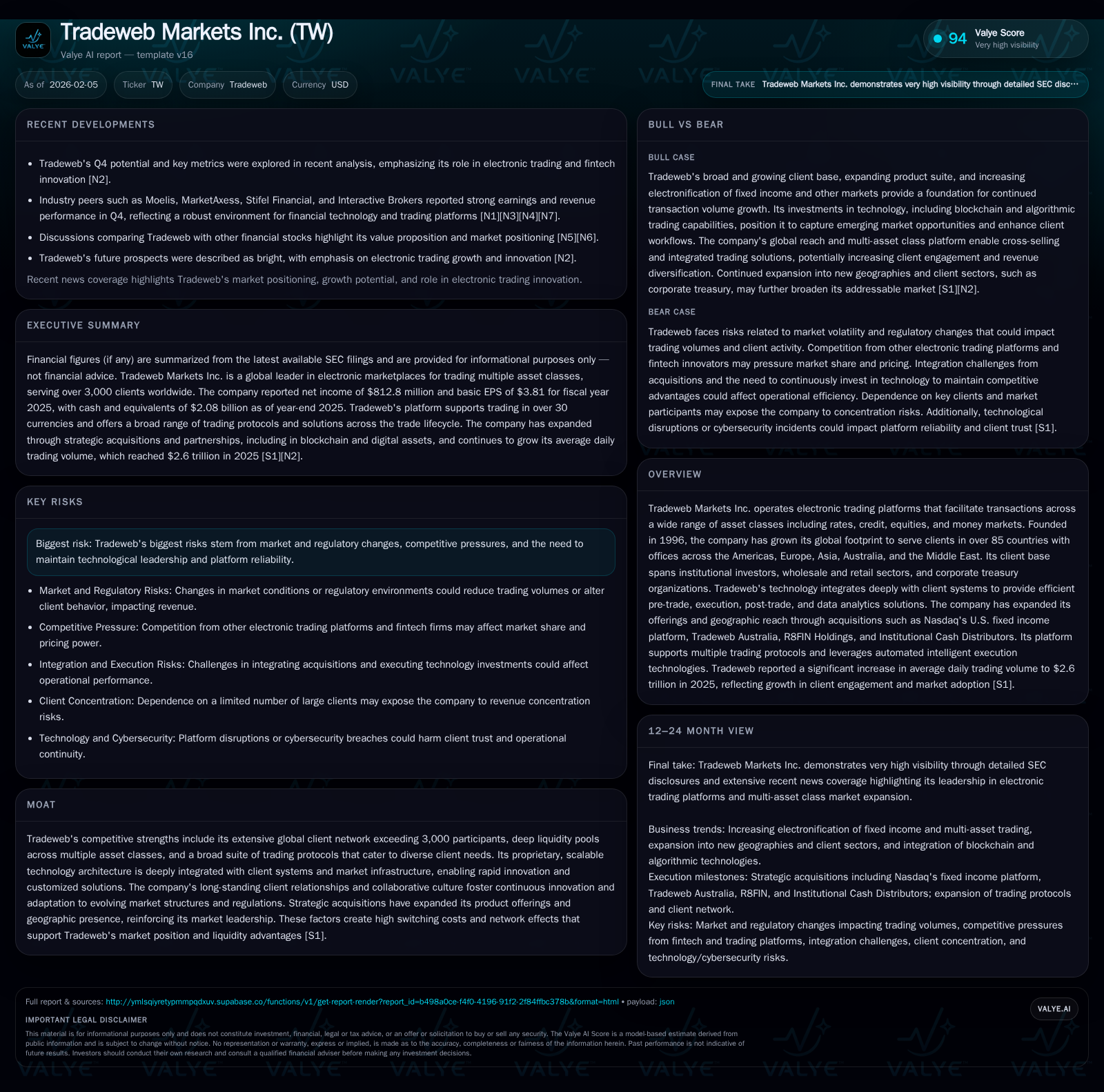
Tradeweb Markets, founded in 1996, has evolved from a platform pioneer to a dominant multi-asset electronic trading powerhouse operating across more than 85 countries. Its proprietary, scalable technology deeply integrates with clients’ trading ecosystems, enabling rapid deployment of adaptive solutions and broad asset class coverage. The company’s expansive client base exceeding 3,000 participants generates significant network effects, fortifying liquidity pools and reinforcing its competitive moat. Strategic acquisitions broaden both geographic reach and product suites, while regulatory and market risks require ongoing vigilance amid a complex landscape. Financially robust entering 2026, Tradeweb is poised to leverage innovation trends and navigate intensifying competition.
From Platform Pioneer to Global Powerhouse: Tradeweb’s Journey
Since its inception in 1996, Tradeweb Markets has charted an expansive trajectory — morphing from a niche electronic trading startup into a cornerstone of global financial markets infrastructure. Serving over 3,000 diverse clients spanning institutional investors, hedge funds, insurance carriers, central banks, retail brokers, and corporations, the company orchestrates multi-asset electronic marketplaces across rates, credit, equities, and money markets. Operating in more than 85 countries with offices dotting six continents including the Americas, Europe, Asia-Pacific, Australia, and the Middle East [S1], Tradeweb's footprint embodies both scale and sophistication.
This breadth affords Tradeweb critical mass in liquidity pools while addressing the increasing market demand for transparent, efficient price discovery and execution solutions across global regulatory regimes. The company’s underlying philosophy embraces collaboration: forging long-standing client relationships that span institutions of varied sizes and geographies to build marketplace ecosystems resilient to shifting market structures.
This journey from pioneering fixed income electronic trading platforms to encompassing a multi-asset suite represents not just growth but evolution keyed by recurring adaptation — weaving deeper into client workflows while expanding geographical and regulatory domains.
The Technology Backbone: Proprietary Innovations Fueling Scalability
Central to Tradeweb's dominance is its proprietary technology architecture — an evolving backbone designed for scalability, flexibility, and deep integration. Unlike off-the-shelf systems that struggle under heterogeneous operating conditions or fragmented asset classes, Tradeweb’s platform is developed in-house to tightly integrate with client order management systems (OMS), risk engines, treasury platforms, clearinghouses, middleware providers, and trade repositories [S1]. This interconnected fabric facilitates seamless pre-trade analytics, order execution across multiple developing protocols (such as request-for-quote (RFQ), all-to-all streaming), post-trade processing, and rich data analytics.
The platform’s modular yet cohesive design helps Tradeweb rapidly launch new offerings tailored to specific asset classes or regions — exemplified by swift rollouts of crypto-related instruments or enhanced digital bond marketplaces whenever market conditions warrant innovation. Moreover, this architecture supports massive transaction throughput without sacrificing latency or reliability — indispensable features as high-frequency trading behaviors and algorithmic strategies proliferate globally.
Importantly, Tradeweb fosters a culture of collaborative innovation involving both internal technologists and client stakeholders — enabling continuous iterative improvement rather than episodic upgrades. This accelerates responsiveness to regulatory changes (e.g., post-trade transparency mandates) or emerging workflow demands (e.g., enhanced collateral management).
Client Network and Liquidity: The Virtuous Cycle of Growth
At the heart of Tradeweb’s competitive advantage lies its extensive client tapestry comprising over 3,000 institutional investors, dealer banks, retail brokers, corporates and proprietary trading firms [S1]. The diversity is key: spanning traditional heavyweights like global asset managers alongside regional dealers or retail-focused intermediaries. This mix fuels abundant liquidity pooling across traded asset classes resulting in more competitive pricing and superior fill rates.
Liquidity begets liquidity — here the so-called network effect comes alive through compounded benefits: as more counterparties join the platform globally across rate products or credit securities denominated in various currencies (over 30 supported), each participant gains enhanced opportunities for order matching. Cross-pollination between client sectors further enriches available order books.
Such virtuous cycles improve client retention by raising switching costs; once embedded in Tradeweb’s ecosystem—deeply integrated at technological and operational levels—participants find value in continuing collaboration. As the company gathers extensive transactional data enabled via its open architecture and analytics suite [S1], clients achieve added insights bolstering their trading strategies while fueling further platform improvements.
Strategic Acquisitions Shaping Market Expansion and Product Breadth
Tradeweb has complemented organic growth with targeted acquisitions calibrated to extend geographical presence or add complementary product verticals. Noteworthy are the procurement of Nasdaq's U.S. fixed income platform which augmented North American market share; R8FIN Holdings providing sophisticated distribution solutions enhancing cash management capabilities; plus Institutional Cash Distributors expanding client access channels [S1].
Each acquisition did not merely expand footprint but reinforced the interconnected offering matrix integral to servicing complex client needs cross-asset-class and cross-regionally. While integrating acquired technologies poses inherent challenges—such as harmonizing differing legacy infrastructure—they have largely succeeded in expanding both scale efficiencies and product breadth.
The accretive nature of these acquisitions also positions Tradeweb well against peers competing within limited niches or geographies — further entrenching its leadership status by knitting together disparate market segments into a cohesive trading ecosystem.
Navigating Regulatory Hurdles and Market Risks in Electronic Trading
The finely balanced orchestration of electronic marketplaces is shadowed by material risks stemming from regulatory constraints, dynamic market conditions and cybersecurity threats [S1][S2]. As governments worldwide continuously tweak financial regulations aimed at boosting transparency or reducing systemic risks (e.g., MiFID II in Europe or Dodd-Frank reforms in the U.S.), Tradeweb must adapt swiftly deploying technical compliance features without disrupting client operations.
Market downturns or geopolitical shocks potentially dampen volumes impacting transactional revenue streams directly. Additionally, the firm depends significantly on dealer clients who provide necessary counterparty liquidity — dependence that introduces concentration risk should those relationships strain.
Operationally, maintaining platform uptime amidst increasing cyberattack sophistication remains a top priority given potential cascading failures impacting thousands of trades within milliseconds. Intellectual property considerations also arise in this fast-evolving fintech environment where open-source components are prevalent.
Tradeweb counters these exposures through diversified client base composition; robust disaster recovery protocols; proactive engagement with regulators; continuous monitoring for platform integrity; as well as investment into advanced security architectures [S1].
Financial Performance Snapshot: Resilience in Numbers
Tradeweb entered FY2026 with strong foundational financial health underscored by $812.8 million net income reported for fiscal year ended December 31, 2025 [F1]. Although revenue figures from past disclosed periods indicated approximately $233 million revenue circa 2020 [F1], recent earnings estimates from multiple analysts highlight optimism surrounding top-line growth driven by sustained electronic trading expansion globally [N3][N8].
Additionally notable is an abundant cash position exceeding $2 billion providing ample runway for continued technological investment or opportunistic acquisitions [F1]. This liquidity buffer underpins operational flexibility amid evolving competitive landscapes or unforeseen disruptions.
Such results emphasize operational leverage—the ability to grow profitability faster than revenue—stemming largely from scalable technology architecture combined with sticky network-driven revenues. Volatility may cause quarterly fluctuations but the overall trajectory suggests solid resilience even during intermittent market softness.
Future Outlook: Innovation, Competitive Pressures, and Growth Vectors
Looking ahead into mid-decade dynamics reveals Tradeweb positioned at an inflection point where technological innovation catalyzes new frontiers alongside paradoxical intensification of competition from peers like MarketAxess plus emergent fintech disruptors employing AI or blockchain frameworks [N11][S1]. While analyst commentary points toward earnings growth potential fueled by broader adoption of electronic marketplaces [N3], new entrants force continued pressure on pricing models and service differentiation strategies.
To maintain leadership stature requires continued investment not only in upgrading core infrastructure but also exploring nascent technologies including machine learning-assisted trade execution optimization or distributed ledger applications enhancing settlement transparency. International expansion remains fertile ground though carries inherent geopolitical and regulatory uncertainties requiring agile navigation.
Moreover emerging asset classes such as cryptocurrencies introduce both opportunity windows—and concomitant risk profiles along liquidity fragmentation lines—necessitating calibrated approaches balancing innovation zeal against prudential safeguards [S1].
In essence tradeoff management will define how aggressively Tradeweb extends its moat versus maintaining system reliability amidst increasing complexity.
This analysis is intended solely for informational purposes derived from publicly available data sources including SEC filings dated February 2026 ([S1], [S2]), Nasdaq news reports ([N3], [N8], [N11]) as well as company facts filings ([F1]). It does not constitute investment advice nor recommends any buy/sell actions.
Disclaimer: This is research-only, informational analysis and not investment advice. It may include AI-generated interpretation and general industry context. Always verify important details using primary sources.

Comments