
TXO Partners Expands Revenues via Strategic Acquisition While Operating Losses Deepen
In 2025, TXO Partners achieved substantial revenue growth driven by the White Rock Energy acquisition, while operating losses increased amid higher expenses and integration costs.
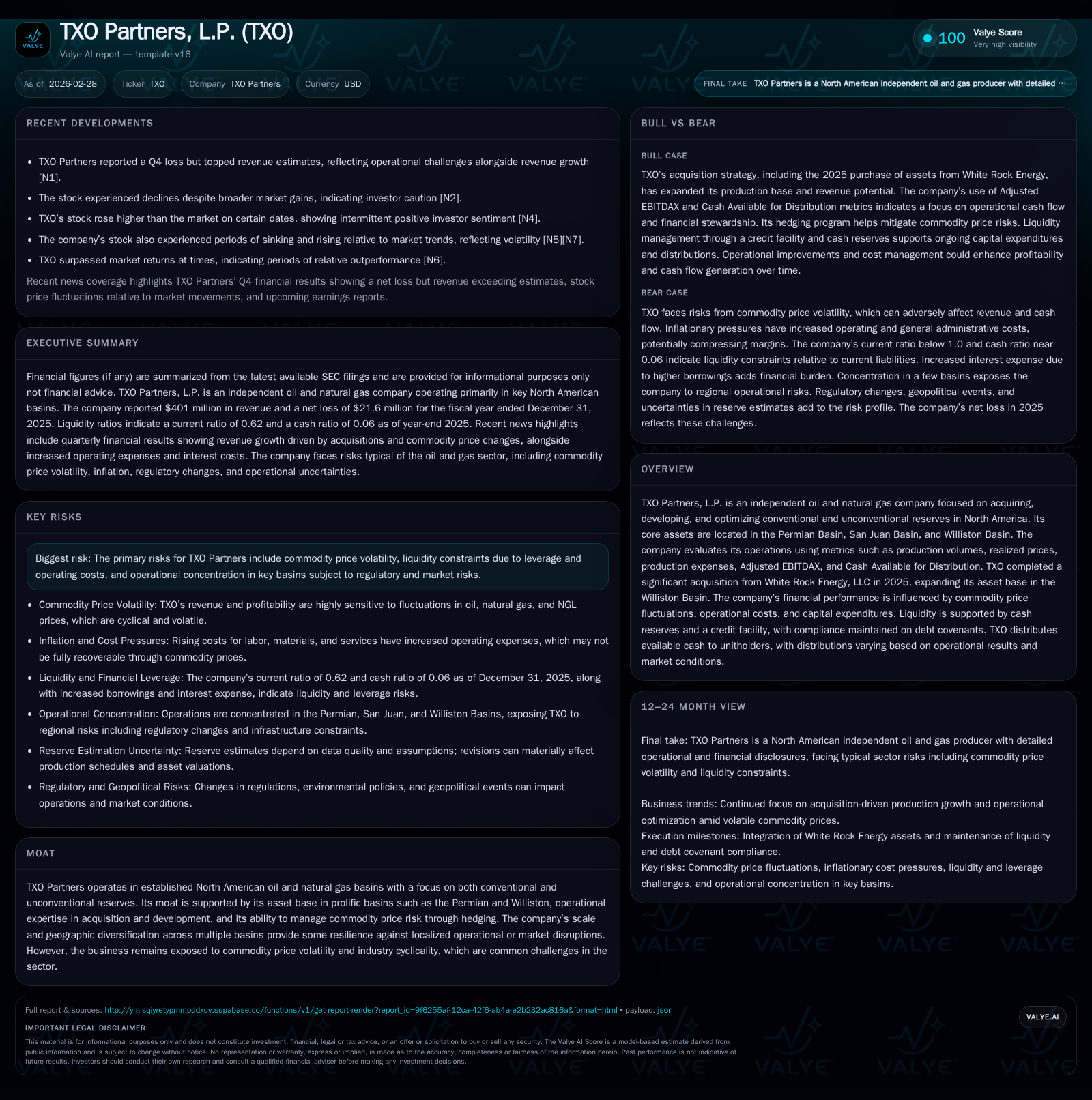
TXO Partners, L.P. reported a 41.8% revenue increase in 2025 compared to 2024, primarily due to its acquisition of White Rock Energy assets in the Williston Basin. Despite top-line growth, operating losses widened to $30.6 million, reflecting elevated depreciation, depletion and amortization (DD&A) and increased general and administrative (G&A) expenses tied to acquisitions and public company costs. Net income swung to a loss of $21.6 million from a prior year profit. The company generated strong operating cash flow of $118.2 million with capital expenditures controlled at $4.8 million, resulting in approximately $113 million in free cash flow. Liquidity was bolstered by an expanded credit facility borrowing base increased to $410 million with maturity extended to 2029. TXO’s distributions fluctuate with operational performance and commodity prices, while ongoing risks include commodity price volatility and regulatory factors concentrated in its core basins.
Overview and Recent Developments
TXO Partners, L.P., an independent oil and gas producer focused on North American basins including the Permian, San Juan, and Williston, significantly expanded its asset base in 2025 through the acquisition of White Rock Energy’s properties in the Williston Basin [S15][N1]. This strategic move contributed materially to revenue growth but also introduced higher operating costs.
Historical Financial Performance
The company's revenue rose markedly from $282.8 million in 2024 to $401.0 million in 2025 (+41.8%), largely attributed to the White Rock Energy acquisition alongside organic operations [F1]. However, operating income deteriorated further into negative territory at -$30.6 million compared with -$6.9 million in the prior year.
This decline stemmed primarily from increased depreciation, depletion, and amortization (DD&A) expenses associated with higher production volumes and capital intensity of newly acquired assets [S13][S18]. General & administrative expenses rose significantly—59% higher for the nine months ended September 30, reflecting personnel costs linked to equity awards and additional expenses related to public company status and acquisitions [S13].
Net income reversed from a positive $23.5 million in 2024 to a loss of $21.6 million in 2025 due to these operational pressures combined with commodity price fluctuations impacting realized margins [F1][N1]. Nonetheless, operating cash flow improved by 8.1% year-over-year to $118.2 million.
Historical performance (annual)
| FY | Rev ($mm) | Net ($mm) | CFO ($mm) | OpInc ($mm) | Rev YoY | Net YoY |
|---|---|---|---|---|---|---|
| 2025 | 401 | -22 | 118 | -31 | +41.8% | -192.0% |
| 2024 | 283 | 23 | 109 | -7 | -25.7% | +122.6% |
| 2023 | 381 | -104 | 77 | -124 |
Source: SEC companyfacts cache [F1].
Capital returns and efficiency (annual)
| FY | FCF ($mm) |
|---|---|
| 2025 | 113 |
| 2024 | 104 |
| 2023 | 76 |
Source: SEC companyfacts cache [F1].
Capital expenditures include acquisition-related spending; note sharp increases following lower prior year levels.
Capital Allocation and Liquidity
TXO secured liquidity through its revolving credit facility which was amended during the year to increase the borrowing base from $275 million to $410 million with maturity extended until August 30, 2029 [S4][S15]. The weighted average interest rate on borrowings was approximately 8%, varying depending on utilization.
A May 2025 public offering raised net proceeds of about $189 million used primarily for funding the White Rock Energy acquisition and repaying credit facility debt [S12]. Despite increased borrowings ($264 million outstanding at September compared with $150 million at prior year-end), leverage remained manageable given strong EBITDAX metrics.
The partnership agreement mandates distribution of all available cash flow to unitholders; as such quarterly distributions are directly impacted by operational results and commodity price variability [S12]. This approach aligns interests but subjects payouts to cyclicality inherent in upstream operations.
Operational Metrics and Cost Drivers
Production expense increases were driven largely by acquired Williston Basin assets that carry higher unit-level costs than legacy properties; inflationary pressures further raised maintenance, labor, transportation, and energy costs [S14][S29]. Taxes and transportation costs rose with expanded production but showed slight per-unit efficiencies due to changes in production mix.
General & administrative expenses reflected inflationary impacts plus elevated personnel costs related primarily to equity compensation amortization connected with acquisitions and public company requirements [S13][S24]. Other income decreased relative to prior periods largely due to lower CO2 plant revenues and absence of prior lease assignment bonuses.
Hedging Strategy
To mitigate commodity price volatility impacts on earnings, TXO utilizes derivative contracts such as fixed-price swaps or collars on oil and natural gas production volumes [S21]. However, these instruments can result in liabilities payable when market prices exceed contract prices at settlement dates—recorded as current liabilities totaling several millions as of mid-2025.
Outlook and Risks
Growth depends on successful integration of recent acquisitions like White Rock Energy alongside disciplined capital deployment targeting reserve replacement within core basins [N1][S15][S11]. Drilling budgets approximate $65 million for completion activities with flexibility retained based on market conditions.
Risks remain significant given commodity price volatility driven by geopolitical events or global economic trends affecting supply-demand balances [S10][N1]. Regulatory risks tied to environmental standards or extraction restrictions also pose challenges due to concentrated basin exposure.
The geographic focus enables scale benefits but limits diversification against basin-specific operational or regulatory risks.
Conclusion
In fiscal year 2025 TXO Partners achieved notable revenue expansion supported by strategic acquisition activity primarily within key U.S. hydrocarbon basins. Despite this growth, profitability pressures intensified from higher DD&A charges on new assets along with elevated G&A expenses leading to wider operating losses.
Robust operating cash flows combined with prudent capital expenditure control enabled strong free cash flow generation while enhanced liquidity through credit facility amendments provides financial flexibility.
Continued execution against integration plans alongside effective cost management will be critical as TXO navigates cyclical commodity markets within its concentrated operational footprint.
This analysis is provided solely for informational purposes without investment advice regarding TXO Partners or related securities.
Disclaimer: This is research-only, informational analysis and not investment advice. It may include AI-generated interpretation and general industry context. Always verify important details using primary sources.

Comments