
INVESCO DB US Dollar Index Bearish Fund: Analyzing Financial Returns and Strategic Risk
A thorough assessment of UDN’s financial performance, regulatory environment, and inherent risks tied to its inverse US Dollar exposure via futures contracts.
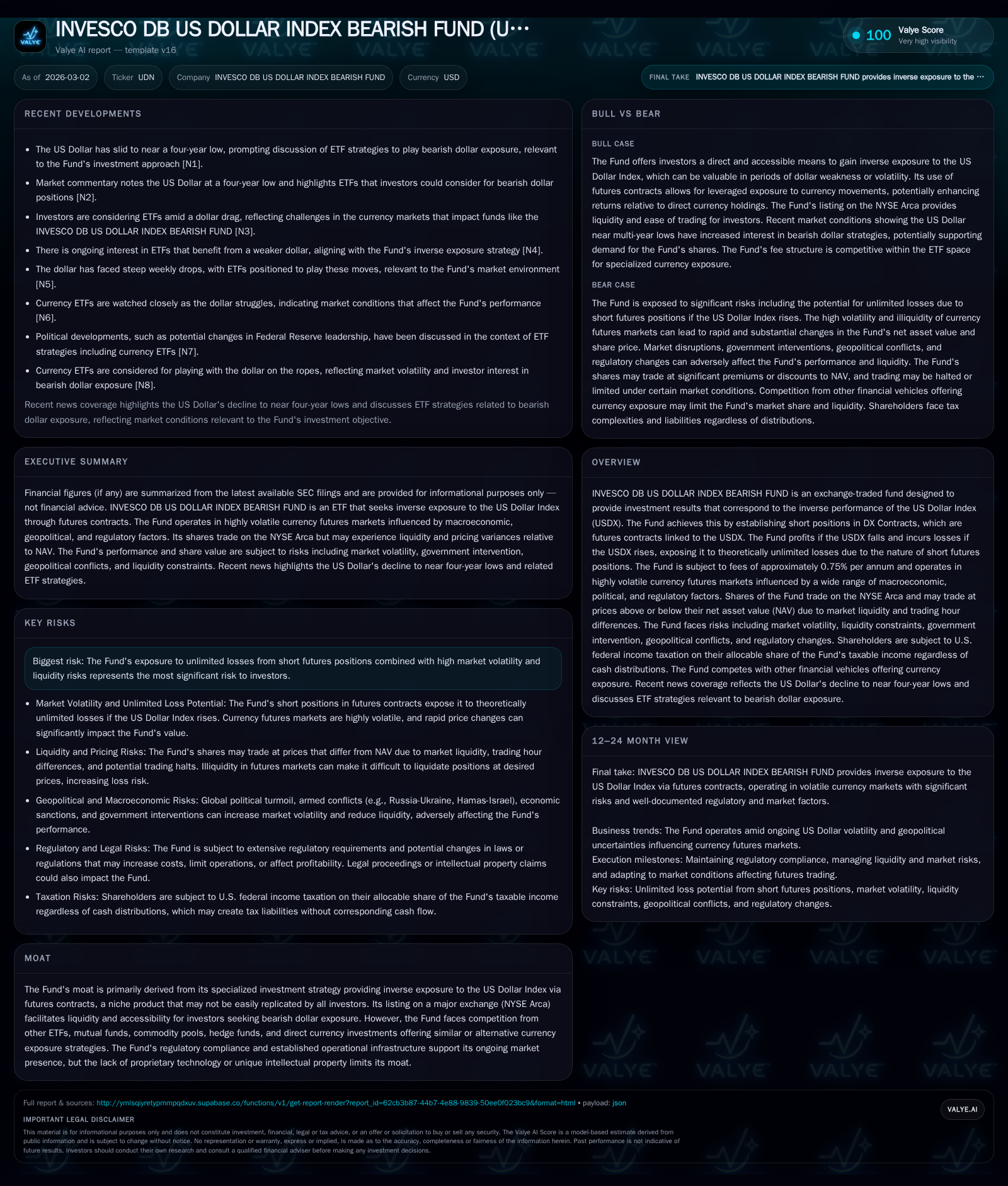
INVESCO DB US Dollar Index Bearish Fund (UDN) specializes in inverse exposure to the US Dollar Index using short futures positions on DX Contracts, enabling investors to potentially profit from dollar depreciation. The fund's recent financials show accelerated operating and net income growth alongside significant negative shifts in operating cash flows, reflecting the complexities of futures-based accounting. UDN operates amidst volatile market conditions, facing elevated regulatory oversight, counterparty credit risks, and liquidity challenges that could materially impact performance. Monitoring regulatory developments, market liquidity, and dollar dynamics will be central to assessing its strategic trajectory.
Fund Strategy and Market Positioning: Specialized Inverse Exposure Explained
INVESCO DB US Dollar Index Bearish Fund (ticker: UDN) occupies a distinctive niche within currency-focused ETFs by providing investors with direct inverse exposure to the US Dollar Index (USDX). This is executed primarily through establishing short positions in DX Contracts—futures contracts that track the USDX closely. The Fund aims to profit when the USDX declines and incurs losses when it rises.[S1][N1]
This inverted exposure situates UDN as an essential tactical instrument amid dollar depreciation scenarios which have recently garnered significant attention given the USD’s slide toward a four-year low as cited by [N1] and [N2]. The mechanics underlying UDN rely heavily on futures derivatives markets, which are inherently complex and volatile due to their sensitivity to macroeconomic policies, geopolitical tensions, central bank interventions, and speculative flows.[S1]
UDN’s listing on NYSE Arca ensures relatively broad accessibility and liquidity for market participants interested in bearish dollar plays without directly engaging in forex spot or swaps markets. However, this specialized focus means it operates in a less crowded segment where replication may be challenging for many traditional retail investors or passive vehicles lacking futures mandate expertise.[S1][S8]
Historical Financial Performance: Operating Income, Net Income, and Cash Flow Dynamics
Over the last four completed fiscal years (FY2022 through FY2025), the Fund’s financial results display distinctive volatility reflective of its underlying asset class dynamics. Operating income expanded dramatically from $674K in FY2022 to $4.12 million in FY2025—an increase of 57.4% year-over-year comparing FY2025 vs FY2024.[F1]
Net income highlights an even more pronounced swing: recovering from negative $3.45 million in FY2024 to positive $9 million in FY2025—a gain exceeding 360%. This swing reflects both realized trading results from successfully timed inverse dollar positions during periods of dollar weakness as well as effective control over costs such as advisory fees (0.75% annual).[F1]
However, operating cash flow fluctuates markedly and counters accounting profitability trends. CFO shifted from positive $10.86 million in FY2024 down into a negative $78.48 million result in FY2025—a year-over-year change exceeding -822%, emblematic of complexities reconciling futures mark-to-market accounting with actual cash inflows/outflows under short-selling dynamics.[F1]
Equity held by the Fund also rose sharply from approximately $51 million at end-FY2024 to near $139 million at end-FY2025.[F1] Dividends paid escalated steadily each year reaching approximately $4.07 million most recently.[F1] Share repurchases remain substantial; however, they dipped slightly from $30.56 million in FY2024 to $29.08 million in FY2025 after peak buybacks over prior years.[F1]
Historical performance (annual)
| FY | Net ($mm) | CFO ($mm) | OpInc ($mm) | Net YoY |
|---|---|---|---|---|
| 2025 | 9 | -78 | 4 | +360.8% |
| 2024 | -3 | 11 | 3 | -243.8% |
| 2023 | 2 | 36 | 3 | +219.1% |
| 2022 | -2 | -53 | 1 |
Source: SEC companyfacts cache [F1].
Capital returns and efficiency (annual)
| FY | Div ($mm) | Buybacks ($mm) | ROE% |
|---|---|---|---|
| 2025 | 4 | 29 | 6.5 |
| 2024 | 3 | 31 | -6.8 |
| 2023 | 3 | 81 | 3.7 |
| 2022 | 1 | 43 | -2.0 |
Source: SEC companyfacts cache [F1].
Note: Operating income YoY was +57.4% for FY25 vs FY24; Net income YoY was +360.8%; CFO fell -822.9%.
Drivers Behind Performance Swings: Macro and Market Volatility Impact
The Fund’s performance volatility tightly correlates with macroeconomic drivers influencing the USDX levels.[N1][N2][S1] Periods of fiscal tightening or easing by the Federal Reserve influence interest rate differentials with foreign currencies that underpin the USDX valuation.
Concurrently noteworthy are trade deficit trajectories that widen or narrow payments balances affecting dollar demand internationally.[S1] Such fundamentals combine with investor sentiment changes driven by inflation expectations both domestically and abroad.
Political uncertainties at home or globally—including trade tensions or geopolitical conflicts—can induce bouts of currency market volatility that inflate DX Contract price swings impacting UDN returns directly.[S1]
Market movements also reflect speculative flows from hedge funds adapting strategies dynamically around quantitative easing tapering or monetary policy shifts.[S1] Within this context,U.D.N.’s inverse exposure can become extraordinarily sensitive as market participants adjust delta hedging activities.
Risk Landscape: Regulatory Complexities and Unlimited Loss Potential
Primary risk considerations stem from UDN’s short positioning on DX Contracts which theoretically expose the Fund to unlimited losses if the USDX appreciates significantly post-positioning.[S1][S3][S8]
Though these contracts currently lack formal position limits imposed by the Commodity Futures Trading Commission (CFTC), future regulatory actions could introduce limits that would restrict the Fund’s trading capacity or necessitate aggregation of related positions across affiliated accounts – complicating portfolio management and potentially reducing liquidity availability.[S1][S22]
Additional layers of risk emerge from operational dependencies on Commodity Brokers subject to CFTC-mandated segregation rules protecting margin assets but susceptible nonetheless to insolvency or bankruptcy risks that could delay recovery of funds.[S8][S16]
Legal conflicts may arise due to overlapping fiduciary duties between Managing Owners’ affiliates acting across multiple clients resulting in adverse consequences for Fund shareholders despite monitoring efforts.[S10][S23]
Further complexity derives from tracking error risks amplified during disruptions where suspension or postponement of Creation Unit redemptions impede normal arbitrage mechanisms leading Shares prices to diverge materially from NAV,[S13][S24] complicating investor liquidity management.
Cybersecurity is another operational concern due to dependence on third-party administrators whose disruption could impair order processing or raise compliance costs further diminishing performance.[S21]
Capital Allocation Focus: Dividends, Buybacks, and Shareholder Value Creation
Despite inherent strategic risks linked with leveraged short exposures on futures contracts, UDN maintains robust capital return policies aimed at sustaining shareholder value. Dividend payments have increased steadily each year culminating at just over $4 million paid out during FY2025,[F1][S27] providing income streams aligned with distributed taxable earnings flowing through partnership structure tax characteristics.
Concurrent share repurchase programs remain substantial albeit slightly reduced relative to earlier years ($29M vs ~$31M prior fiscal year).[F1] This ongoing capital deployment underscores an emphasis on offsetting dilution effects prevalent across cycles marked by high volatility.
Return on equity approximates a modestly positive figure near ~6.5%,[F1] signifying measured profitability consistent with complex valuation swings notably unaligned with cash flow patterns. Such disparity between accounting earnings and free cash generation reflects typical divergences observed within futures-based inverse ETFs reliant on mark-to-market unrealized gains/losses rather than actual realized operating inflows.
Tracking Accuracy and NAV Premia/Discounts: Challenges in Futures-Based ETFs
UDN experiences nuanced difficulties common among ETFs employing inverse leverage strategies derived from futures contracts concerning precise NAV tracking fidelity relative to share market prices.[S13][S24] The processes involving creation units—that is authorized participant exchanges of basket securities for Shares—and redemption timing can be interrupted or suspended amidst crises leading Shares prices either above premium or below discount relative to intrinsic NAV. Such tracking error phenomena emerge due to restricted arbitrage possibilities during times when large market dislocations reduce authorized participants’ ability or willingness to transact underlying baskets efficiently.[S13] Additionally,costs associated with higher brokerage fees charged for more frequent rebalancing required by daily reset features intrinsic to many inverse ETFs further exacerbate tracking risks impeding seamless index replication over longer horizons.[S24] Understanding these mechanisms helps clarify why UDN may underperform its stated index inverse return over some intervals despite methodological intent, and why premium/discount volatility is standard observer expectation within futures-centric ETF structures.
Forward Outlook: Monitoring Market Indicators & Regulatory Developments to Watch
Although explicit forecasts are absent from filings or news coverage,[N1][S3][S8] several pivotal themes merit attention going forward. First,currency markets remain heavily influenced by Federal Reserve policy clarity concerning interest rates given their outsized impact on cross-currency valuations embedded within USDX calculation methodology (trade-weighted baskets).[N1][N2] Second,the CFTC’s posture toward possible imposition of position limits specifically targeting DX Contract holdings poses systemic execution constraints potentially limiting UDN’s flexibility in managing exposures efficiently.[S1][S22] Third,the Fund’s choice of clearing brokers will be significant as recent disclosures note possibilities of internal risk limit reductions that constrain trading volumes incurring higher costs if multiple broker relationships become necessary—directly detracting from performance potential via frictional expenses.[S8] Lastly,increasing geopolitical uncertainties cloud currency outlooks potentially causing sharp swings creating both opportunity but also heightened loss potentials underscoring critical need for adept operational risk management frameworks within UDN.
Investors following UDN should therefore vigilantly track monetary policy announcements, whether CFTC takes new regulatory actions affecting position aggregation/limits, as well as clearing broker partnerships stability—all factors capable of materially shaping returns realization profiles amid evolving global macroeconomic landscapes.
Disclaimer: This analysis is provided solely for informational purposes without offering investment advice or recommendations regarding participation in INVESCO DB US Dollar Index Bearish Fund. Readers should conduct their own due diligence including consulting qualified financial professionals before making investment decisions.
Disclaimer: This is research-only, informational analysis and not investment advice. It may include AI-generated interpretation and general industry context. Always verify important details using primary sources.

Comments