
Universal Electronics Inc Navigates Revenue Decline and Leadership Transitions Amid Market Challenges
UEIC faces headwinds in home entertainment sales with offsetting growth in connected home solutions, while implementing cost controls and managing executive changes.
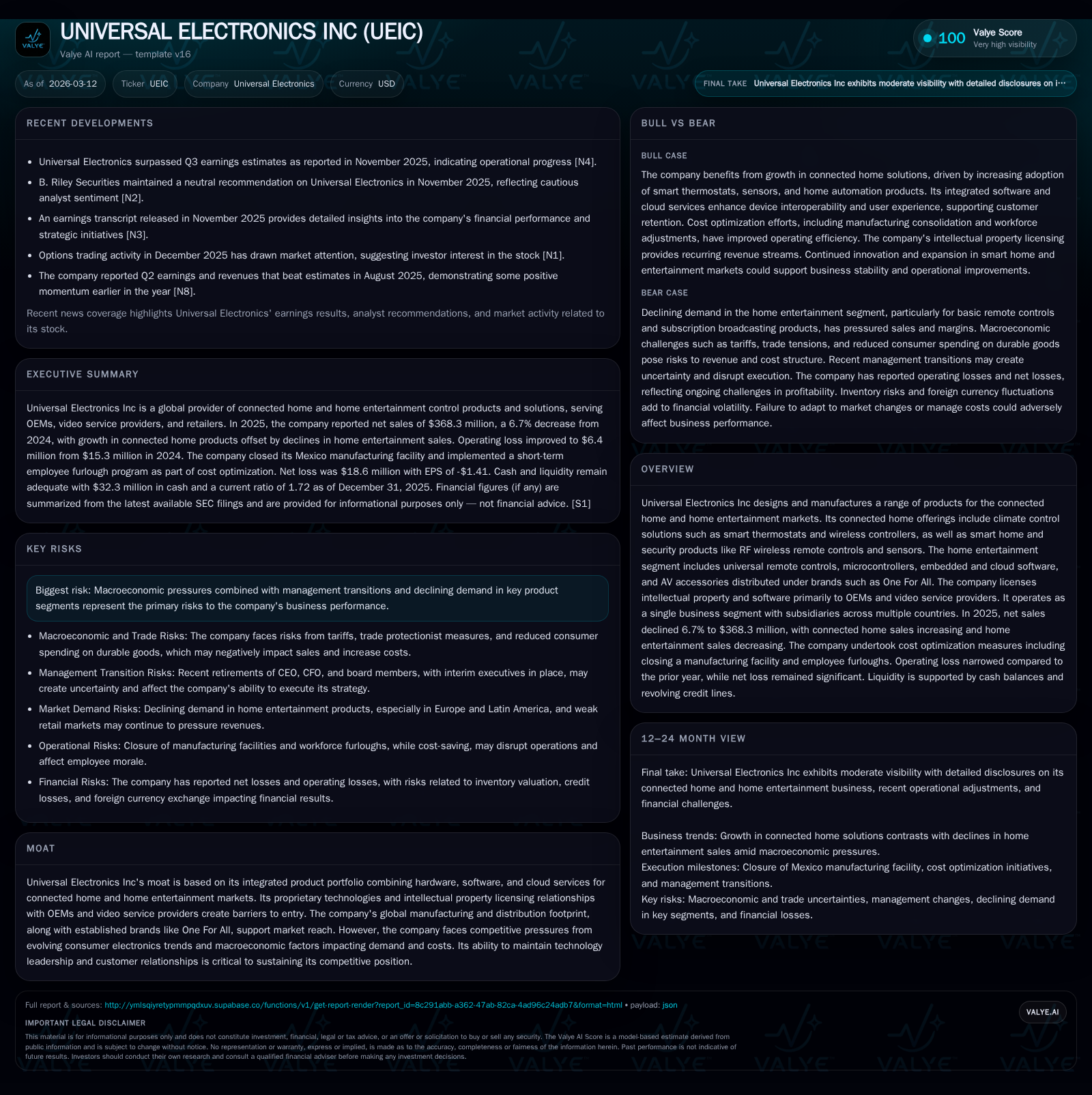
Universal Electronics Inc (UEIC) reported a 6.7% decline in 2025 net sales to $368.3 million, driven by softness in the home entertainment segment despite growth in connected home products. Operating losses narrowed to $6.4 million due to payroll savings and restructuring efforts, while net losses improved but persisted at $18.6 million. Strong operating cash flow of $23.6 million supported capital expenditures of $3.9 million, patent development, and $3.1 million in share repurchases. The company’s liquidity is bolstered by revolving credit facilities totaling $60 million, though management transitions present execution risks amid ongoing industry uncertainties.
Historical Financial Performance
Universal Electronics Inc (UEIC) reported net sales of $368.3 million for the year ended December 31, 2025, reflecting a 6.7% decrease compared to $394.9 million in 2024 [S1][S12]. This decline was chiefly due to a reduction in the home entertainment segment revenues from $286.6 million in 2024 to $242.9 million in 2025, attributed primarily to weaker demand for subscription broadcasting products and lower consumer electronics sales in Europe and Latin America [S12]. Conversely, the connected home segment grew from $108.3 million to $125.4 million over the same period driven by shipments related to climate control and home automation projects [S12].
Gross profit remained consistent year-over-year at approximately 28.9%, aided by freight cost stabilization initiatives and favorable foreign currency movements including a weaker U.S. dollar against the Euro and British Pound which contributed positively to margins; these effects were partly offset by tariffs that reduced gross margin by about one percentage point [S12].
Operating expenses decreased as a percentage of sales from 32.7% in 2024 to 30.6% in 2025 reflecting cost-saving measures such as payroll reductions totaling around $2.6 million, cuts in discretionary spending including travel and professional services, and factory restructuring charges which fell from higher levels in prior years but still amounted to approximately $1.2 million related mainly to plant closures including Mexico operations [S15]. Consequently, operating loss narrowed significantly from $15.3 million (3.9% of sales) in 2024 to $6.4 million (1.7%) in 2025 [S1][F1].
Net income losses moderated but remained material at -$18.6 million compared with -$24 million for the prior year period [F1]. Income tax expense rose slightly to $6.6 million despite overall losses due to tax provisions across jurisdictions [S1][S27].
Cash flow generation strengthened with net cash provided by operating activities increasing from $14.8 million in 2024 to $23.6 million in 2025 driven largely by improved working capital management including faster receivables collection and inventory reduction consistent with lower sales demand [F1][S17]. Capital expenditures declined modestly from approximately $4.6 million previously to about $3.9 million invested primarily in property, plant and equipment; patent development expenditures stood near $3 million during the year reflecting continued investment in intellectual property [F1][S9]. Free cash flow approximated nearly $20 million underpinning UEIC’s ability to repurchase shares totaling about $3.1 million during the year alongside funding ongoing business operations [F1][S13].
Historical performance (annual)
| FY | Net ($mm) | CFO ($mm) | OpInc ($mm) | Capex ($mm) | Net YoY |
|---|---|---|---|---|---|
| 2025 | -19 | 24 | -6 | 4 | +22.6% |
| 2024 | -24 | 15 | -15 | 5 | +75.5% |
| 2023 | -98 | 25 | -85 | 8 | -24237.1% |
| 2022 | 0 | 11 | 15 | 14 |
Source: SEC companyfacts cache [F1].
Capital returns and efficiency (annual)
| FY | Buybacks ($mm) | FCF ($mm) | ROE% |
|---|---|---|---|
| 2025 | 3 | 20 | -12.7 |
| 2024 | 2 | 10 | -15.7 |
| 2023 | 2 | 17 | -54.9 |
| 2022 | 13 | -3 | 0.2 |
Source: SEC companyfacts cache [F1].
Growth Outlook & Strategic Focus
UEIC’s growth prospects are anchored primarily on its connected home product portfolio which includes advanced climate control solutions leveraging wireless technologies such as WiFi, BLE, Zigbee and Matter protocols alongside environmental sensors for temperature and occupancy monitoring [S1]. Expansion into smart home automation markets via proprietary RF wireless remote controls and sensors supports incremental revenue opportunities.
However, legacy challenges persist within the home entertainment segment where declining demand for basic remote controls tied to softer television sales—especially across European and Latin American markets—continues to weigh on top-line performance [S12]. Retail sell-through remains weak amid elevated channel inventories.
The company’s intellectual property licensing model centered on firmware update provisioning and digital rights management for consumer electronics OEMs provides recurring revenue streams but requires sustained R&D innovation amidst competitive pressures; R&D spending decreased by approximately 11.6% reflecting headcount optimization and reduced third-party development engagements which could impact long-term product pipeline breadth if not carefully managed [S8][S15].
Recent retirements of CEO Paul Arling and CFO Bryan Hackworth during mid-to-late-2025 have resulted in interim appointments filling these roles creating potential uncertainty regarding strategic continuity and execution risk during this transition period [S2].
UEIC operates through one consolidated business segment with extensive global operations including a domestic subsidiary plus twenty-two international subsidiaries located across Asia (notably China), Europe, Latin America and other regions exposing it to foreign exchange fluctuations and geopolitical complexities including restrictions on cash repatriation [S1][S4][S6]. The largest customer concentration remains Daikin Industries Ltd., accounting for more than eighteen percent of total revenue which underscores concentration risk amid fluctuating demand conditions [S25].
Capital Allocation & Liquidity Position
The company maintains liquidity supported by revolving credit agreements: a U.S.-based Credit Line with a maximum availability of up to $60 million (approximately $48 million available at year-end) plus a China Credit Line denominated at RMB130 million (~$18.6M), fully drawn at year-end but expected for renewal under uncertain terms given market conditions [S4][S5][S18]. Cash and cash equivalents totaled over $32 million providing additional liquidity cushion.
Capital allocation priorities include measured capital expenditures aligned with operational needs alongside share repurchases which increased substantially from under two million dollars spent in FY24 to over three million dollars during FY25 as part of an authorized buyback program approved by the Board [F1][S13][S22]. UEIC has not declared dividends.
Restructuring efforts continue albeit at reduced levels; charges related primarily to factory closures such as Mexico facility amounted to approximately $1.2M during FY25 compared with higher restructuring costs recorded previously reflecting ongoing supply chain rationalization initiatives [S14][S15][F1].
Risks & Industry Context
Macroeconomic uncertainties remain significant risks given UEIC’s exposure to consumer electronics markets vulnerable to economic cycles particularly within Europe and Latin America where recent softness is evident resulting in volatile order patterns especially within the home entertainment channel [N/A S10][N/A S12][N/A S24]. Leadership transitions pose execution risks potentially disrupting momentum on strategic initiatives.
Tariff pressures continue affecting margins despite freight cost improvements; currency volatility also generates earnings variability necessitating active hedging strategies amid complex international operations.
Legal disputes related to prior litigation involving Roku have largely been resolved or stayed minimizing immediate financial impact though latent risks remain.
Conclusion
Universal Electronics Inc’s latest results reflect ongoing challenges balancing declines within legacy product lines against growing connected home revenues coupled with cost containment progress that has narrowed losses considerably though profitability remains elusive through FY25. Strong operating cash flow supports continued investments alongside disciplined capital returns through share repurchases while leadership transitions introduce near-term execution uncertainties. Navigating evolving consumer electronics dynamics alongside internal restructuring will be critical for UEIC’s path toward sustainable profitability.
Disclaimer: This analysis is based on publicly available SEC filings as of March 12, 2026 without any forward-looking projections or investment recommendations.
Disclaimer: This is research-only, informational analysis and not investment advice. It may include AI-generated interpretation and general industry context. Always verify important details using primary sources.

Comments