
urban-gro, Inc.: Navigating Shifts in Controlled Environment Agriculture Amid Market and Compliance Challenges
urban-gro transitions from a comprehensive CEA design-build firm to a focused equipment reseller amid market headwinds and Nasdaq compliance risks.
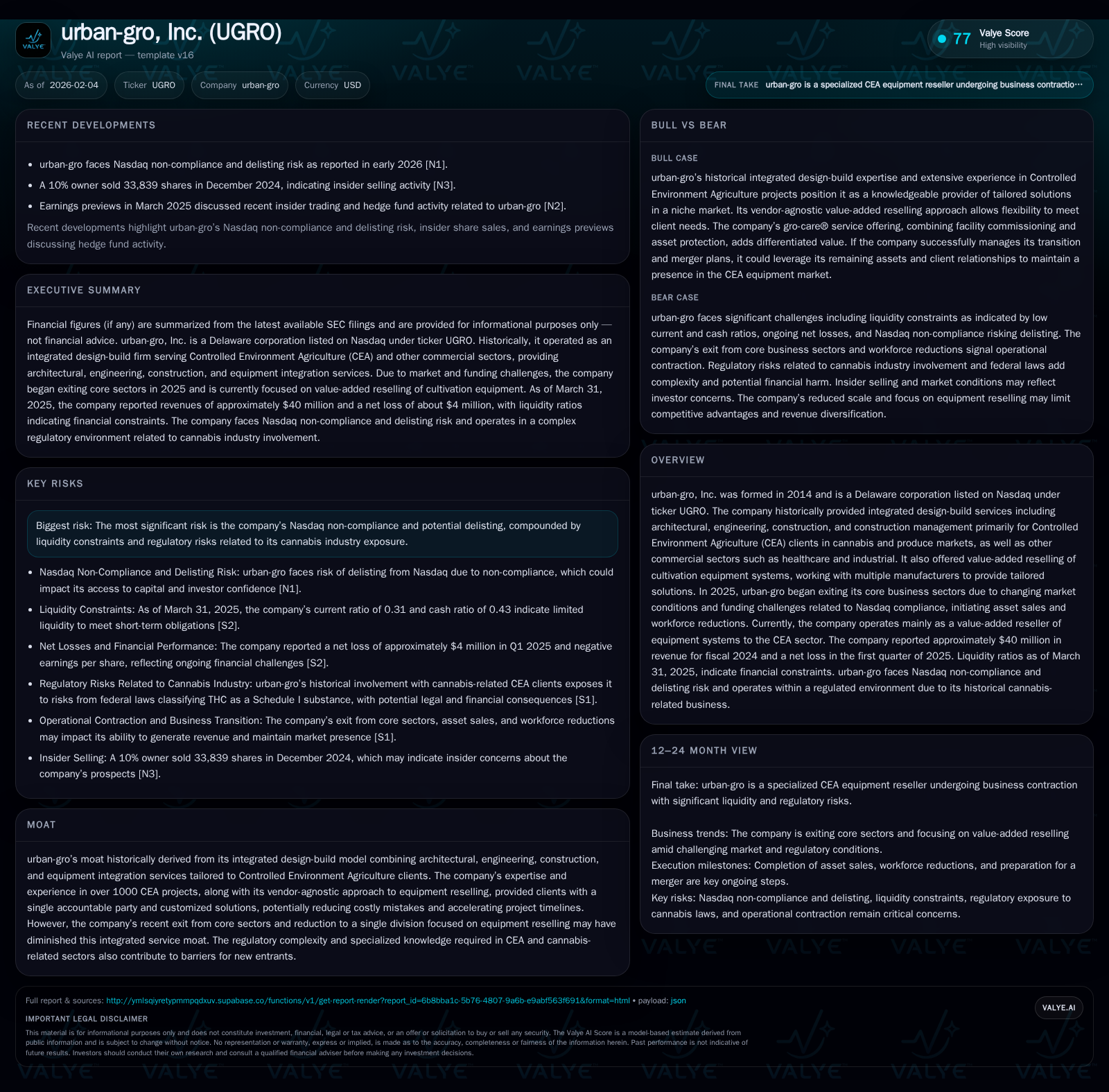
Founded in 2014, urban-gro initially carved a niche offering integrated architectural, engineering, construction, and equipment solutions to clients in the Controlled Environment Agriculture (CEA) sector, primarily cannabis and produce cultivation. However, deteriorating market conditions and funding challenges tied to Nasdaq compliance prompted a strategic retreat starting in 2025, leading to asset sales and workforce reductions. Today, the company operates predominantly as a value-added reseller of cultivation equipment, relying on vendor-agnostic partnerships but facing liquidity stresses and potential Nasdaq delisting. Its historical competitive moat—deep expertise in integrated CEA project delivery—is significantly diminished though industry regulatory complexities still pose barriers for new entrants.
Company Evolution and Business Model
urban-gro, Inc. traces its origins back to March 2014 as a Colorado-based limited liability company focused on technology-enabled Controlled Environment Agriculture (CEA), particularly serving the cannabis cultivation market. Over time, the company broadened services beyond initial cannabis clients to include produce-focused vertical farming and other commercial sectors such as healthcare and industrial applications [S1]. The hallmark of urban-gro’s offering was an integrated design-build model encompassing architectural design, engineering systems integration, construction management, and equipment provisioning. This comprehensive approach sought to address the complex requirements of CEA facilities — facilities that demand precise environmental control and specialized systems that are expensive to retrofit or modify post-construction.
Through both organic growth and acquisitions, urban-gro grew its footprint across North America and Europe delivering over 1,000 projects cumulatively. Its vendor-agnostic equipment sourcing allowed tailored configurations favoring client needs over manufacturer allegiances, theoretically mitigating "single source" risk for clients while optimizing cultivation efficacy.
Financial Trajectory
Revenue grew steadily through the early years culminating near $70 million in 2023 before declining sharply to $40 million in 2024—the latest full fiscal year reported [F1][S1]. Despite revenue scale-up early on, urban-gro consistently posted net losses escalating from a $0.9 million loss in 2021 up to a sizable $36.5 million loss in 2024 [S1]. Cash flow remained negative for multiple years reflecting ongoing operating expenses not offset by sales cash inflows. At the end of Q1 2025 (latest available data), current liabilities ($43.48 million) substantially exceeded current assets ($13.42 million), producing a low current ratio (~0.31), signaling short-term liquidity stress and funding risk [F1]. Net income was again negative $4 million for that quarter.
The company’s relentless net losses despite top-line growth underscores structural challenges within its operational model amid dynamically shifting industry conditions.
Strategic Retrenchment Beginning in 2025
Citing changing market dynamics and inability to secure funding linked to its Nasdaq listing compliance status—which is critical for broad investor access—urban-gro initiated a restructuring process during Q3 2025 [N1][S1]. This involved divesting key assets tied to its comprehensive design-build operations and substantial downsizing of staff levels. The exit from core business lines left only one active division focusing on value-added reselling (VAR) of equipment systems tailored for the CEA sector.
This VAR model involves sourcing cultivation lighting solutions, irrigation/fertigation infrastructure, environmental controls, odor mitigation technologies, automated benching systems among others from an array of manufacturers. Acting as an intermediary rather than full project integrator shifts urban-gro toward lighter asset intensity but also commoditizes much of its value proposition.
Competitive Positioning & Moat Analysis
Historically urban-gro’s moat stemmed from the technical complexity of delivering end-to-end CEA projects—blending architecture with domain-specialized engineering plus project management—particularly for cannabis clients operating under strict regulatory scrutiny [Valye report excerpt]. This differentiated it from simple equipment providers or generic contractors lacking CEA expertise.
Now reduced predominantly to reseller status without large-scale construction or architectural services means significant erosion of this moat. Competition at this juncture consists largely of wholesalers or online retailers selling off-the-shelf horticulture products often at lower price points [S1]. Urban-gro still relies on its seasoned expertise with product vetting and integration knowledge as a selling point but faces pricing pressure and commoditization risk.
Regulatory complexity related to controlled substances remains an indirect barrier slowing new entrants who must navigate evolving laws—a residual advantage for experienced players like urban-gro but less impactful absent broader service offerings.
Industry Context & Regulatory Environment (Analysis)
The CEA market has experienced ebbs linked closely with cannabis regulation developments coupled with macroeconomic pressures like inflation affecting capital expenditure appetite among cultivators. The fragmentation in cannabis legalization across U.S. states complicates long-term investment planning; meanwhile vertical farming produce players face their own scalability headwinds given energy costs associated with indoor agriculture.
From an investor perspective, companies deeply embedded across engineering-design–build elements hope to lock clients into multi-year engagements securing recurring revenue streams; however economic cycles heavily impact new facility builds—a key driver behind urban-gro’s revenue volatility.
Furthermore, heightened scrutiny by Nasdaq arising from financial metrics non-compliance encapsulates stock market governance tightening relevant for mostly small-cap tech/ag firms like urban-gro [N1]. Delisting risk looms unless structural improvements or corporate transactions materialize.
Risks Highlighted by SEC Filings
SEC disclosures emphasize several acute risks: ongoing net losses threaten sustainability; cash flow deficits require capital raises which may be unavailable or come on dilutive terms; continued regulatory flux can abruptly alter market conditions; nascent nature of CEA results in operational unpredictability; finally Nasdaq non-compliance risks ultimate removal from public markets if corrective measures fail [S1][S2].
Additionally, competition from traditional horticulture dealers or manufacturers selling direct erodes margins achievable via reseller arrangements.
Conclusion: Current State and Outlook Considerations
urban-gro presents a cautionary tale of specialization within emerging ag-tech markets intersecting complex regulations transforming business models radically under financial pressures. While once poised as an integrated leader in niche construction-engineering-services for CEA clients—mostly cannabis cultivators—the company’s pivot towards a streamlined reseller operation reflects pragmatic adaptation amid unsustainable losses and capital constraints.
The equity remains exposed to execution risk around stabilizing operating cash flow alongside resolution of Nasdaq compliance challenges; simultaneous market trends such as continuing legalization progress or setbacks will shape demand trajectories within CEA.
Stakeholders tracking urban-gro should weigh how the loss of its comprehensive design-build identity affects competitive durability versus simpler commodity resale rivals. Moreover, the company’s ability or failure to overcome liquidity hurdles within the next quarters will prove crucial for survival or further transformation.
Disclaimer: This analysis is provided solely for informational purposes based on publicly available data as of early 2026. It does not constitute investment advice or any recommendation regarding securities transactions.
Disclaimer: This is research-only, informational analysis and not investment advice. It may include AI-generated interpretation and general industry context. Always verify important details using primary sources.

Comments