
UroGen Pharma’s RTGel Advantage and Commercial Execution Define 2025 Performance
UroGen leverages its proprietary RTGel technology to innovate urothelial cancer treatments while balancing intensifying commercialization costs and patent litigation risks.
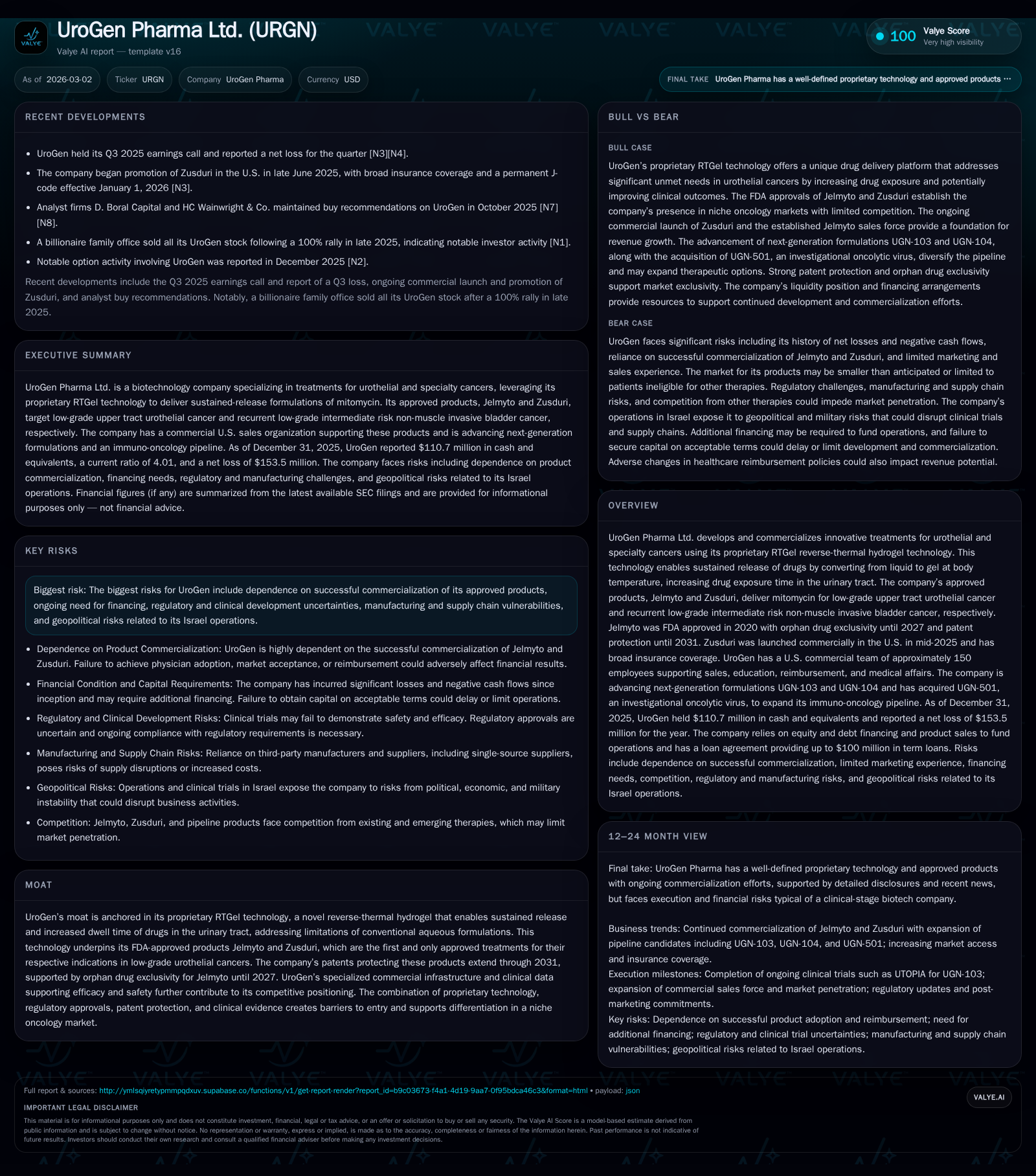
UroGen Pharma has established a differentiated position in the niche urothelial cancer market through its proprietary reverse-thermal hydrogel (RTGel) technology, embodied in FDA-approved products Jelmyto and Zusduri. Despite initial revenue gains from product launches, 2025 saw significant revenue contraction alongside deepening operating losses caused by heavy investment in commercial infrastructure and ongoing R&D. The company’s upcoming patent litigation against Teva represents a critical inflection for exclusivity beyond 2027 when orphan drug protections expire. UroGen is expanding its U.S.-based specialized sales and medical affairs team to drive physician uptake amidst broad insurance coverage for its products but faces dependence on financing and regulatory uncertainties. Key milestones include the October 2026 patent trial and continued adoption monitoring of Zusduri.
Innovative Technology Fueled Initial Growth: RTGel’s Role in Market Entry
UroGen Pharma’s foundational asset is its proprietary RTGel technology—a reverse-thermal hydrogel platform that acts as a sustained-release vehicle designed specifically for urothelial cancers. Unlike traditional aqueous drug formulations that rapidly dilute or wash out due to urine flow and voiding cycles, RTGel remains liquid at cool temperatures allowing easy instillation via catheter but solidifies into a gel upon warming to body temperature. This gel then gradually dissolves upon contact with urine over several hours, effectively increasing active drug dwell time on the urinary tract tissue.
This extended local drug exposure improves tissue coverage and potentially enhances therapeutic efficacy without compromising safety or natural fluid flow. RTGel’s biocompatible polymer base is inert, serving as the delivery matrix rather than the active ingredient itself. This innovative mechanism underpinned UroGen’s first two FDA-approved products: Jelmyto (for low-grade upper tract urothelial cancer) approved in 2020, and Zusduri (for recurrent low-grade intermediate risk non-muscle invasive bladder cancer), launched commercially in mid-2025.
The ability of RTGel to conform anatomically within challenging urinary structures addresses a critical hurdle conventional formulations cannot overcome—rapid clearance—thereby creating meaningful differentiation in an underserved niche oncology market [S1][F1][S15].
Financial Performance Evolution: Revenue Decline Amid Rising Expenses
Analyzing UroGen’s financial trajectory reveals an initial phase of product introduction followed by revenue contraction compounded by escalating losses as commercial efforts scaled aggressively. The company reported revenues of approximately $1.13 million in FY2018 before commercial launches. By FY2025, revenue declined precipitously by about 86% year-over-year [F1], reflecting transitional challenges possibly linked to product lifecycle dynamics or competitive pressures.
Operating income deteriorated steadily from -$79 million in FY2022 to -$125 million by FY2025, a nearly 29% YOY worsening driven largely by increased selling, general & administrative expenses tied to expanding commercial infrastructure alongside sustained R&D investment [F1][S3]. Net income plunged deeper into loss territory, hitting -$153 million in FY2025—a greater than threefold YOY increase in net loss percentage terms [F1].
Negative operating cash flows worsened significantly (-$162 million in FY2025 vs -$97 million prior year), underscoring ongoing investment demands without commensurate near-term profitability [F1]. Capital expenditures remained modest (~$289k annually), indicating focus on human capital over fixed assets.
Historical performance (annual)
| FY | Net ($mm) | CFO ($mm) | OpInc ($mm) | Capex ($) | Net YoY |
|---|---|---|---|---|---|
| 2025 | -153 | -162 | -125 | 289000 | -309.2% |
| 2024 | -38 | -97 | -97 | 295000 | +63.3% |
| 2023 | -102 | -76 | -66 | 194000 | +6.9% |
| 2022 | -110 | -88 | -79 | 254000 |
Source: SEC companyfacts cache [F1].
Capital returns and efficiency (annual)
| FY | FCF ($mm) | ROE% |
|---|---|---|
| 2025 | -163 | 145.5 |
| 2024 | -97 | 426.1 |
| 2023 | -77 | 156.8 |
| 2022 | -88 | 122.9 |
Source: SEC companyfacts cache [F1].
Table summarizes steep revenue decline alongside increasing operating losses despite moderate capital expenditure trends.
Regulatory Milestones and Market Penetration of Jelmyto and Zusduri
Jelmyto received FDA approval in December 2020 accompanied by orphan drug exclusivity lasting until April 2027 that offers seven years of market protection aimed at rare disease indications and confers benefits such as premium pricing levers and limited competition during exclusivity [S1]. The underlying patents are valid through circa 2031 providing additional statutory barriers albeit litigated.
Zusduri was introduced commercially mid-2025 targeting a broader patient population of recurrent low-grade intermediate risk non-muscle invasive bladder cancer, rapidly attaining broad insurance coverage across managed care payors—an essential factor given complex reimbursement environments for specialty oncology drugs [S15].
The expanded U.S.-based commercial team numbering about 150 personnel supports this dual launch effort via multi-faceted approaches encompassing territory business managers specializing in urology/oncology clinics, nurse educators skilled in instillation training, reimbursement specialists navigating access pathways, key account directors liaising at executive clinic levels, plus medical science liaisons facilitating scientific discourse both virtually and onsite [S15].
Together these factors aim at deepening physician adoption curves essential for sustained sales momentum given the modest size but highly specialized target patient populations.
Patent Litigation as a Critical Battleground for Exclusivity Maintenance
Since April 2024 UroGen has been engaged in a high-stakes patent infringement lawsuit against Teva Pharmaceuticals alleging violation of core Jelmyto patents including the more recent '745 patent issued April 8, 2025 which was promptly added to the FDA's Orange Book listing enhancing its enforceability protections [S1].
The legal conflict centers on securing a permanent injunction barring generic entry before expiration of key patents scheduled till circa 2031 despite JELMYTO's orphan exclusivity ending April 2027—potentially exposing UroGen to immediate generic competition if court relief is denied.
The forthcoming bench trial scheduled for October 2026 constitutes a pivotal event shaping competitive dynamics post-orphan exclusivity expiration. The dismissal of certain earlier patent counts underscores tightening litigation focus around contemporary intellectual property claims representing forward-looking legal strategy aimed at fortifying product moat [S1].
A negative outcome could materially undermine pricing power and market share while raising risk profiles among investors regarding future returns on Jelmyto commercialization efforts.
Commercial Expansion: Building a Targeted U.S. Sales and Medical Affairs Team
UroGen orchestrates an intricate go-to-market strategy emphasizing targeted institutional selling within urology oncology clinics where prescribing decisions are concentrated among specialized practitioners. With roughly 150 customer-facing professionals deployed across sales, market access, education and reimbursement functions [S15], this operational build mirrors sector best practices observed among niche biotech firms commercializing orphan or specialty oncology indications.
Reimbursement specialists play a crucial role navigating payer formularies shaped by complex requirements governing pharmaceutical benefit managers (PBMs), managed care entities, and Medicare policies—a delicate balance given ongoing regulatory reforms impacting coverage terms . Nurse educators augment this framework by training clinical staff on instillation protocols for RTGel-based products which require procedural expertise distinct from oral or intravenous therapies.
Medical science liaisons maintain scientific engagement ensuring key opinion leaders remain apprised of efficacy safety data supporting Jelmyto’s unique mechanism thereby driving prescription confidence [S15]. Additionally, executive-level business directors engage hospital leadership to embed service lines facilitating broader institutional adoption.
Capital Allocation Reflects Heavy Investment into Commercial Infrastructure
Reflecting its emphasis on commercial scale-up alongside R&D endeavors targeting next-generation pipeline candidates including immuno-oncolytic viruses (UGN-501), UroGen consistently generated severe negative free cash flow: operating cash flow stood at -$162 million for FY25 with negligible capex expenditure near $289k illustrating human capital rather than facility expansion focus [F1][S3][S13].
Equity shrinkage highlights accumulated losses pushing book value into negative territory (-$105 million) as net income losses mount [F1]. Absence of dividends or share repurchases aligns with typical biotech reinvestment profiles where long-term value accrues through successful new product development rather than short-term capital returns.
The company maintains a sizable cash reserve ($111 million year-end FY25) providing near-term operational runway but acknowledges potential need for additional financing subject to market conditions and business evolution [F1][S13]. Lending covenants tied to existing loan facilities impose restrictions that could limit strategic flexibility including borrowing constraints linked to product revenues collateralization arrangements.
Risks from Financing Needs, Competitive Pressures, and Regulatory Dynamics
UroGen faces multifaceted risks notably its dependence on successful market penetration of Jelmyto and Zusduri amid uncertain physician adoption rates outside core early launch periods ([S2]). Clinical development uncertainty persists around pipeline assets compounded by manufacturing single source dependencies that may impact supply continuity.
Regulatory environment complexity intensifies as evolving federal healthcare reforms threaten pricing & reimbursement models through mechanisms like Medicare Drug Price Negotiation programs; these policies may lower gross-to-net margins while increasing compliance burdens particularly considering anti-kickback statutes, HIPAA/HITECH privacy rules governing marketing conduct plus foreign jurisdictional laws related to Israel operations introducing geopolitical overlays ([S4]-[S14]).
Healthcare fraud & abuse laws impose tight controls over promotional activity risking costly penalties if breached unintentionally ([S8],[S9],[S11]). Environmental compliance laws cover hazardous material handling inherent to mitomycin based drug production adding operational cost layers ([S14],[S23]). Financing risk arises from substantial negative FCF driving periodic capital raises which may dilute ownership or burden balance sheets ([S13],[S16],[S18],[S25]). Patent litigation adds uncertainty shaping competitive landscape forcing retention of costly legal resources ([S17],[S26],[S29]).
What to Watch: Key Milestones in Litigation, Product Uptake, and Pipeline Progress
Looking ahead analysts should monitor several inflection points shaping UroGen’s trajectory:
- October 2026 bench trial verdict on Teva patent infringement case will clarify post-2027 competitive environment for Jelmyto critically affecting revenue sustainability;
- Adoption metrics following Zusduri’s mid-2025 launch will signal traction within intermediate risk bladder cancer segment leveraging broad insurance coverage—prescriber receptivity may correlate with educational efforts effectiveness;
- Pipeline clinical updates especially around immuno-uro-oncology candidate UGN-501 bear significance as they indicate potential new revenue streams diversifying beyond current low-grade urothelial cancers;
- Capital structure developments reflecting fundraising outcomes will influence financial flexibility amid persistent negative operating cash flows;
- Regulatory policy progress at federal/state levels affecting pricing/reimbursement frameworks warrants attention given sector-wide implications.
These factors framed together encapsulate both the opportunities provided by innovative platform technology commercialization along with tangible operational challenges balancing growth ambitions against litigation outcomes and capital constraints.
This analysis synthesizes publicly filed financial statements and regulatory disclosures dated through March 2, 2026 ([F1],[S1]-[S29]) without offering any investment advice or price projections. Readers should consider evolving data as company progress unfolds.
Disclaimer: This is research-only, informational analysis and not investment advice. It may include AI-generated interpretation and general industry context. Always verify important details using primary sources.

Comments