
United States 12 Month Oil Fund's Volatile Earnings and Regulatory Constraints Shape Growth and Capital Allocation
USL provides exposure to light sweet crude oil prices via futures contracts, navigating volatile commodity markets and strict regulatory position limits.
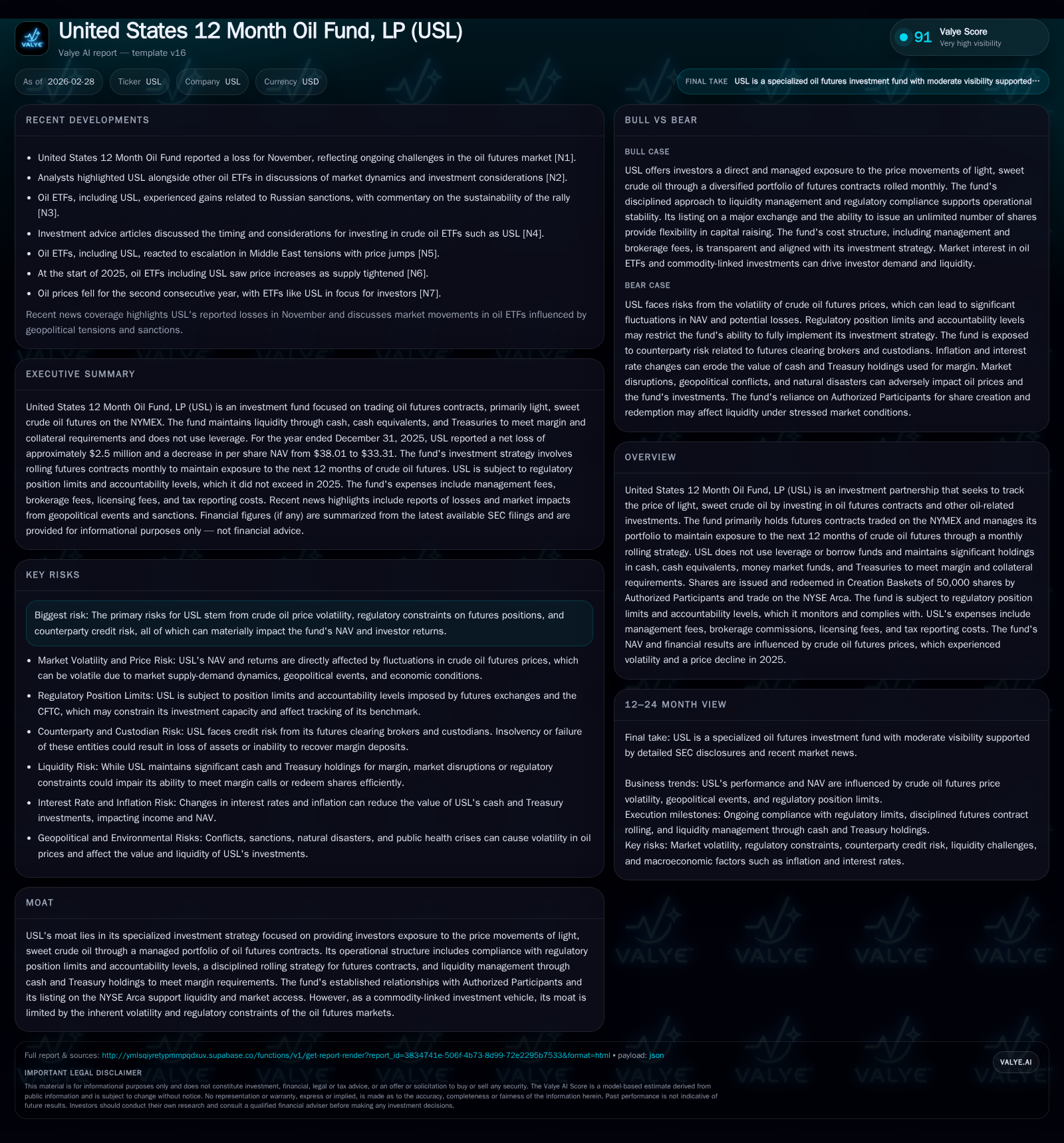
United States 12 Month Oil Fund, LP (USL) offers investors exposure to light sweet crude oil price movements through a managed portfolio of oil futures contracts with a 12-month rolling strategy. The fund's financials demonstrate significant volatility in revenues and net income driven by fluctuations in oil futures valuations, with FY2025 marked by losses following positive results in FY2024. Operational constraints include regulatory position limits, market volatility, and counterparty credit risks that limit growth potential and complicate returns. USL maintains liquidity prudently through cash and treasury holdings to meet margin requirements without leveraging its balance sheet. Future performance will depend on crude oil price trends, regulatory developments, and management of tracking accuracy within exchange-imposed limits.
Company Overview
United States 12 Month Oil Fund, LP (USL) is a commodity-linked investment partnership that provides investors exposure to light sweet crude oil price fluctuations through a managed portfolio of oil futures contracts. The fund primarily invests in futures traded on the NYMEX using a monthly rolling strategy designed to maintain exposure across the next twelve months of futures maturities. USL does not use leverage or borrowings; instead it allocates significant portions of its net assets in liquid instruments such as cash, money market funds, and Treasuries to cover margin and collateral requirements inherent in futures trading [S1,S4].
Shares trade publicly on NYSE Arca in Creation Baskets consisting of 50,000 shares each. These baskets are issued or redeemed exclusively by Authorized Participants who facilitate liquidity. USL operates under regulatory accountability thresholds and position limits imposed by exchanges that govern maximum exposures on commodity contracts. These structural features influence portfolio construction and may contribute to tracking error relative to spot prices [S1].
Historical Performance
Financial results over the recent four-year period exhibit considerable earnings volatility aligned closely with crude oil price swings impacting futures valuations.
Historical performance (annual)
| FY | Rev ($mm) | Net ($mm) | CFO ($mm) | Rev YoY | Net YoY |
|---|---|---|---|---|---|
| 2025 | -2 | -2 | -3 | -177.8% | -185.0% |
| 2024 | 3 | 3 | 4 | +131.9% | +129.9% |
| 2023 | -10 | -10 | -1 | -210.0% | -214.2% |
| 2022 | 9 | 9 | 50 |
Source: SEC companyfacts cache [F1].
Source: Company filings [F1]
These oscillations reflect commodity price cycles; FY2025 revenues turned negative after a strong rebound in FY2024. Similarly negative net income in FY2023 was followed by profits in FY2024 before retreating again in FY2025.
Operating cash flow patterns align with these earnings swings: an extraordinary inflow occurred in FY2022 followed by negative cash flows in subsequent years tied to changes in valuations of futures positions.
Growth Prospects
USL's growth prospects primarily hinge on the price trajectory of light sweet crude oil as realized through its managed futures positions. Exchange-imposed position limits currently cap holdings at accountability levels of up to 10,000 contracts per single month or aggregate exposure not exceeding 20,000 net contracts per NYMEX rules [S1]. These caps prevent excessive speculative concentration but inherently restrict USL's ability to capture large bullish movements fully.
Liquidity management also shapes growth potential since the fund must maintain sufficient cash or treasury equivalents without leveraging while meeting margin calls for open contracts. Sudden increases in margin requirements could constrain investment flexibility [S4,S6,S18].
Regulatory risks include potential changes from CFTC or SEC affecting commodity pools or tax law shifts influencing investor returns given USL’s limited partnership structure [S2,S19].
Forecasts and Milestones
USL does not provide explicit forward-looking financial guidance typical for commodity-linked funds tracking external indices rather than generating intrinsic earnings streams. Key milestones for monitoring include:
- Monthly NAV updates reflecting short-term price changes in underlying crude oil benchmarks [N1,S3].
- Regulatory developments impacting position limits or commodity pool regulations.
- Market events affecting crude oil supply-demand fundamentals influencing futures curves.
- Redemption activity by Authorized Participants impacting outstanding share counts.
Capital Allocation & Returns
USL does not pay dividends nor repurchase shares directly. Instead capital allocation revolves around redemptions of Creation/Redemption Baskets handled exclusively through Authorized Participants in blocks of 50,000 shares [S13,S21]. Returns essentially mirror underlying commodity price movements less fees.
Traditional return metrics such as Return on Equity are not applicable given the fund’s structure as a financial intermediary with earnings driven by mark-to-market valuations rather than operating profits.
Management fees are approximately 0.60% annually of net assets payable monthly [S16], covering key expenses including brokerage commissions and licensing fees.
Liquidity is maintained primarily via cash deposits totaling approximately $31.8 million at fiscal year-end December 31, 2025 [F1], supplemented by investments in money market funds and Treasuries held at custodians and Futures Commission Merchants (FCMs) [S6,S10]. The fund carries no debt or off-balance sheet leverage [S16,S18].
Operational & Risk Profile
Tracking error relative to spot crude prices can arise from the rolling strategy combined with exchange-imposed position caps limiting full investibility [S1]. Daily price fluctuation limits imposed by exchanges may also restrict trade execution during volatile periods.
Counterparty risk is concentrated with FCMs responsible for clearing trades; segregation regulations mitigate but do not eliminate risk related to broker insolvency [S7,S10]. OTC derivative exposures could increase credit risk; however historically USL’s holdings have been exchange-traded ensuring counterparty risk is limited through clearinghouses.
Legal contingencies stem from ongoing litigation involving USCF—the general partner managing USL—and related funds concerning disclosures during extreme market stress periods around early COVID-19; these proceedings have not materially impaired current operations but represent contingent risks [S9,S12,S17].
Cybersecurity risk management is embedded within USCF’s framework overseeing IT infrastructure and third-party service providers to safeguard sensitive data against attacks or operational disruptions [S8,S22].
Industry Context & Analysis
Commodity-linked funds like USL face challenges balancing direct commodity exposure benefits against structural market constraints such as regulatory caps on speculative positions implemented globally post-2008 reforms. These limitations can impede replication strategies leading to tracking imprecision versus spot indices.
Market volatility combined with complex rolling mechanics inherent in maintaining long-dated exposures can produce negative roll yields adversely impacting investor outcomes relative to physical commodities or energy equities.
Tax complexities unique to partnership structures may result in unpredictable tax liabilities at the investor level unrelated directly to economic profits or losses.
Summary
United States 12 Month Oil Fund occupies a niche enabling investors access to light sweet crude pricing via a rolling portfolio of regulated oil futures contracts without leveraging balance sheets. The fund’s recent history embodies pronounced earnings swings reflective of volatile energy markets compounded by operational constraints imposed by regulatory oversight limiting contract positions. Capital deployment remains conservative maintaining robust liquidity buffers ensuring margin compliance without borrowings. Long-term growth requires navigating maintaining tracking fidelity amid exchange-imposed restrictions alongside adapting risk controls against ongoing geopolitical and macroeconomic shocks influencing crude prices globally. Investors should monitor monthly NAV reports for roll yield effects; regulatory developments potentially altering position limit frameworks; as well as broader crude demand-supply fundamentals critical for future performance projections.
This analysis reflects publicly available information up to February 28th, 2026 from company SEC filings and news disclosures without offering investment advice.
Disclaimer: This is research-only, informational analysis and not investment advice. It may include AI-generated interpretation and general industry context. Always verify important details using primary sources.

Comments