
Viking Acquisition Corp I Advances Strategic Business Combination Amid Structural SPAC Dynamics
Recent amendments to transaction sequencing and closing mechanics mark a key operational progression as Viking Acquisition Corp I approaches its initial business combination.
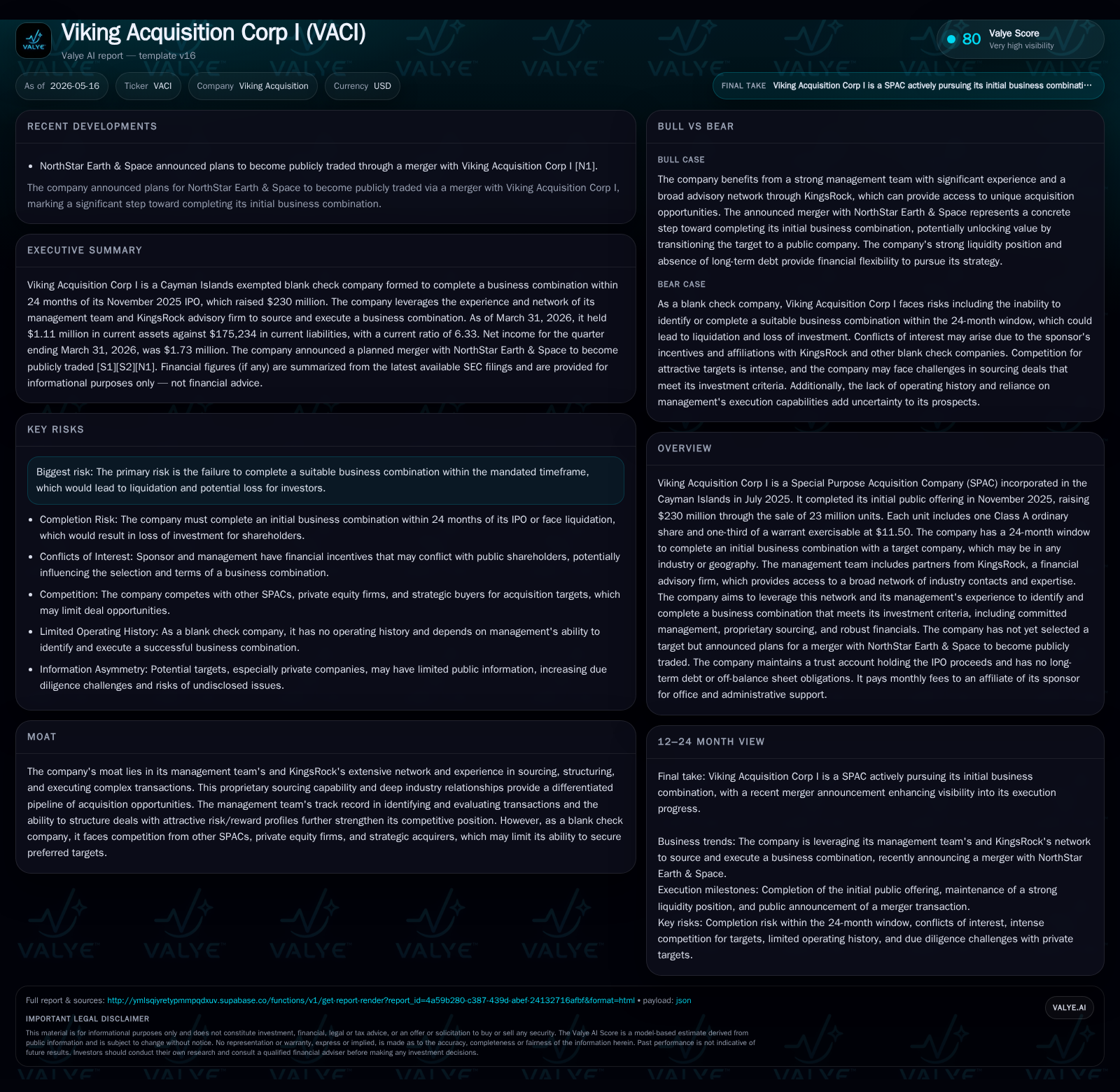
Viking Acquisition Corp I, a Cayman Islands-based Special Purpose Acquisition Company (SPAC), has recently amended its Business Combination Agreement to refine share redemption sequencing and transaction structures ahead of its initial merger. Leveraging KingsRock’s extensive network and the management team's expertise, Viking is positioned to compete in a crowded acquisition market through proprietary sourcing advantages. The firm faces classic SPAC risks, including the finite 24-month timeframe to complete a business combination, but recent filings suggest active deal progress and strong liquidity underpin execution readiness.
Operational Update: Key Amendments and Milestones from the Latest Quarterly Filing
Viking Acquisition Corp I’s latest 10-Q filing dated May 15, 2026 [S2] reaffirms stability in risk profiles with no new material changes but anchors attention on progressive execution steps reflected in contemporaneous Form 8-K filings [S3]. Notably, on May 15, 2026, Viking entered into Amendment No. 1 with NorthStar and NewCo concerning the Business Combination Agreement. This amendment recalibrated critical aspects of the transaction mechanics: it mandates that public share redemptions occur before the Cayman Islands-to-Canada corporate jurisdictional continuation and prior to the closing [S3]. This sequence refinement reduces execution risk by clarifying shareholder liquidity rights ahead of structural changes.
Furthermore, the amendment revised share conversions, warrant conversions, and equity exchanges related to the amalgamation structure [S3], providing enhanced clarity on post-merger ownership implications and securities treatment. These institutional calibrations demonstrate diligent navigation of complex multi-jurisdictional and multi-party transaction elements—a notable advance toward closing certainty.
Business Model Primer: How Viking Acquisition Creates Value as a Cayman-Based SPAC
Viking Acquisition Corp I was incorporated in July 2025 as a Cayman Islands exempted company with a sole purpose: effecting an initial business combination via merger, amalgamation, or similar means [S1]. In November 2025, it completed an IPO raising $230 million by selling 23 million public units priced at $10 each [S1]. Each public unit bundles one Class A ordinary share plus one-third of one warrant exercisable at $11.50 per share [S1]. Concurrently, the sponsor and underwriters purchased 660,000 private placement units under identical terms but subject to certain transfer restrictions until after business combination completion [S1].
Additionally, the sponsor retained approximately 7.67 million founder shares convertible into Class A shares upon close of the initial business combination [S1].
Prior to completion of a target acquisition, Viking operates without revenues—its income solely comprises interest earnings on marketable securities held in its trust account formed from IPO proceeds [S1]. Operating costs are limited primarily to expenses associated with being publicly traded and target diligence support.
Value creation is expected post-combination through accretion of operating businesses acquired using cash from trust account proceeds supplemented potentially by equity or debt instruments issued during the merger [S1]. The explicit management alignment comes via founder shares and incentive fees structured around deal success.
Competitive Environment: Differentiation Through KingsRock Network Versus Market Peers
The SPAC landscape remains intensely competitive with numerous blank-check vehicles pursuing overlapping acquisition targets alongside traditional private equity firms and strategic corporate acquirers [S26]. Viking confronts these pressures but uniquely benefits from its executives’ track record coupled with KingsRock’s extensive advisory ecosystem that offers differentiated deal origination capabilities [S6][S26].
This relational moat extends beyond capital availability; it integrates industry insight enabling identification of higher-quality targets paired with creative transactional structures adjusting for valuation or regulatory nuances. Such competitive advantages can materially influence target negotiations where multiple bidders exist.
However, despite these strengths, Viking acknowledges competitive constraints shaped by its finite capital pool relative to larger PE funds or strategics and limited window for completion constraining pacing flexibility [S26].
Growth Catalysts: Deal Pipeline Quality and Execution Timing
Viking’s principal growth lever is timely consummation of an initial business combination that meets criteria such as committed management teams at targets, solid financial fundamentals, and scalable operational platforms [N1][S3][S1]. Successful announcement followed by positive market reception could revalue warrants embedded in units if post-combination share prices exceed exercise thresholds.
Deal execution timing has been actively managed via amendments ensuring orderly redemption processes precede jurisdictional transitions—mitigating potential closing disruptions [S3]. Ongoing investor communication about regulatory clearances and shareholder approvals also serve as potential catalysts enhancing confidence.
Leveraging external financing mechanisms like PIPEs or structured equity components remains viable cushioning should redemption volumes strain available proceeds or expansion capital become necessary [S1][S26].
Risks and Constraints: Timebound Completion Window and Target Competition
Key risks for Viking center around failure to complete an approved business combination within its contractual 24-month window culminating in mandatory liquidation thereby erasing significant investor value [S1][S2]. Such adverse outcome would dissipate both principal invested capital outside trust account funds.
Intense competition among SPACs coupled with traditional acquirers compounds difficulty sourcing attractive targets on favorable terms [S26]. Additionally, uncertainty linked to the continuation transaction shifting domicile from Cayman Islands to Canada introduces added legal complexity that may delay closing milestones or invite regulatory scrutiny [S3][S26].
Furthermore, redemption rates exceeding expectations may diminish net capital available for investment post-close potentially necessitating dilutive financings impacting existing holders negatively.
Upcoming Catalysts: Execution Markers and Shareholder Approval Milestones
Investors should closely monitor formal announcement of definitive target selection disclosures—NorthStar Earth & Space has been publicly referenced as the merger candidate with planned public listing via this combination [N1][S3].
Key procedural steps include completion of shareholder votes approving amended memoranda affecting redemption rights aligned with the recent Amendment No.1 sequence revisions [S3][N1]. The timing of Closing Date announcements will signify narrowing execution risk margins.
Receipt of any requisite regulatory approvals especially tied to cross-border amalgamation processes remain watchpoints impacting definitive timetable forecasts.
Financial Position Snapshot: Current Liquidity and Capital Status
Latest financial snapshot
| Metric | Value | Period |
|---|---|---|
| Current assets | $1110069 | |
| 2026-03-31 | ||
| Current liabilities | $175234 | |
| 2026-03-31 | ||
| Current ratio | 6.33x | |
| 2026-03-31 |
Source: SEC companyfacts cache [F1].
As of March 31, 2026 quarter-end, Viking reported current assets totaling approximately $1.11 million against current liabilities near $0.175 million yielding a robust current ratio of 6.33—a clear indication of sufficient near-term liquidity for operating expenses precursory to combination close [F1].
Importantly, trust account funds raised at IPO stand at roughly $231 million including accrued interest reserved strictly for use toward completion of the business combination or liquidation refunds per governing agreements [S1][F1][S3].
Together these reserves position Viking comfortably from a balance-sheet perspective to meet scheduled deal-related cash requirements without immediate fundraising needs barring unforeseen contingencies.
This analysis incorporates only publicly disclosed SEC filings up through May 15, 2026; subsequent developments could further clarify or alter these assessments. It does not constitute investment advice but aims to provide a detailed operational context within which Viking Acquisition Corp I is advancing toward its inaugural business combination closing.
Disclaimer: This is research-only, informational analysis and not investment advice. It may include AI-generated interpretation and general industry context. Always verify important details using primary sources.

Comments