
Vericel Corp's Growth Fueled by MACI Innovations Counterbalanced by Regulatory and Market Risks
Vericel leverages autologous cell therapies with expanded surgical applications amid evolving healthcare regulations and competitive pressures.
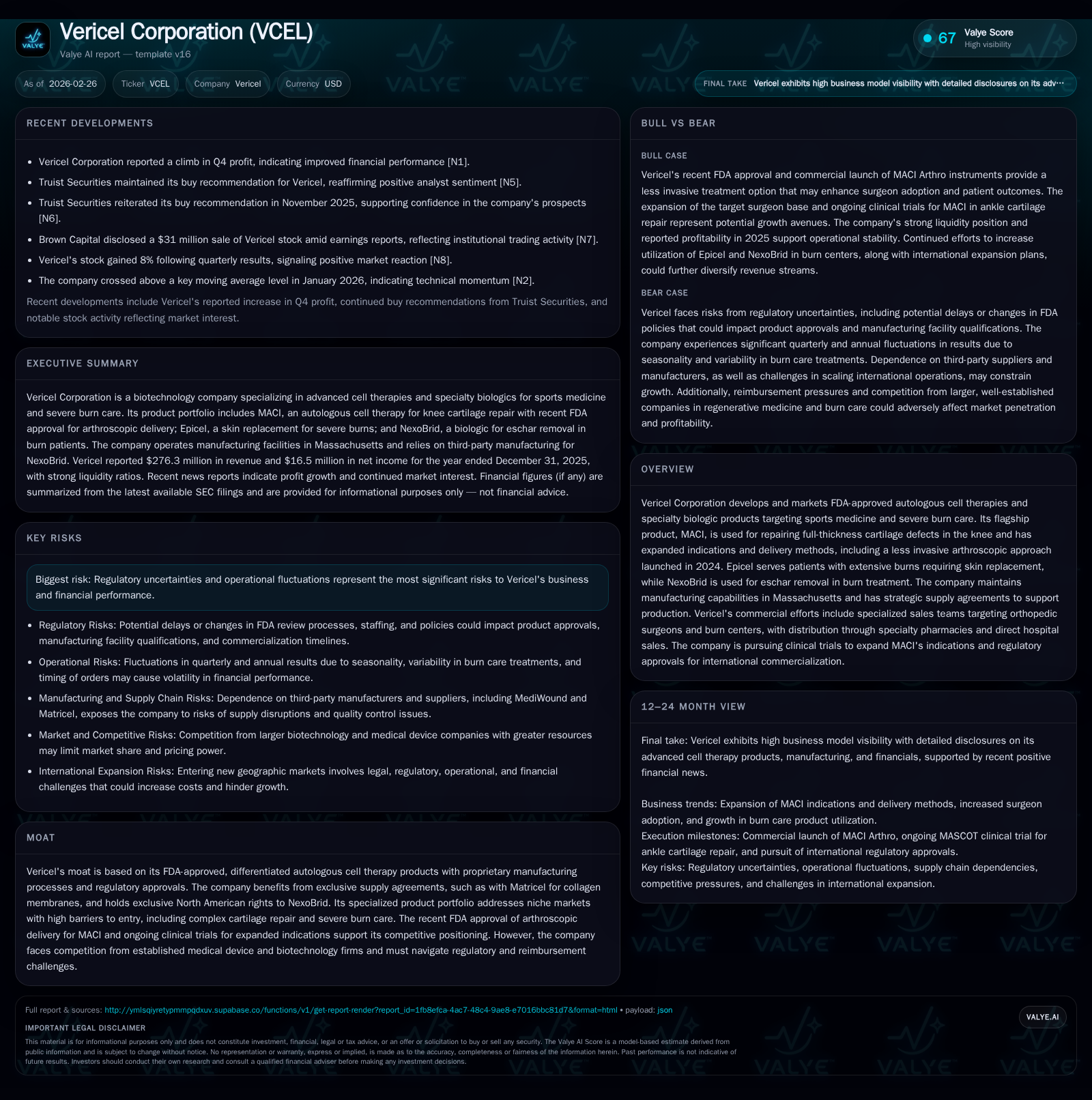
Vericel Corporation has demonstrated robust revenue growth over the past four years driven by its flagship MACI product and expansion into less invasive delivery methods. The company’s commercial, manufacturing, and clinical development strategies focus on enlarging orthopedic and burn care markets. However, regulatory uncertainties, evolving healthcare policies, complex reimbursement environments, and supply dependencies pose ongoing risks. Vericel reported increased profitability and positive operating cash flow in 2025, supporting sustainable operations despite industry headwinds.
Company Overview
Vericel Corporation stands out as a provider of FDA-approved autologous cell therapies targeting niche yet critical markets: sports medicine (cartilage repair) and severe burn care. Its lead product, MACI®, addresses full-thickness cartilage defects in the knee. The recent FDA approval for the arthroscopic delivery method (MACI Arthro®) launched commercially in Q3 2024 signals an important shift towards less invasive surgery options that could significantly broaden surgeon adoption by lowering procedural complexity [S1][N1].
Complementing MACI’s orthopedics focus is Epicel®, a skin replacement therapy authorized under Humanitarian Use Device status for patients with extensive burns (≥30% TBSA). Additionally, Vericel markets NexoBrid®, a specialty biologic for enzymatic eschar removal in severe burns under exclusive North American license from MediWound [S1][S10].
Manufacturing is centralized at Vericel’s Cambridge, Massachusetts facility including cell processing infrastructure essential to maintain autologous therapy quality standards. Strategic supply agreements with partners like Matricel ensure proprietary scaffold components needed for MACI remain controlled amid complex regulatory requirements [S1][S10]. This vertical integration coupled with strong intellectual property protection underpins Vericel’s market moat.
Historical Financial Performance
Vericel’s revenue trajectory reflects consistent growth driven largely by MACI’s expanding clinical acceptance and burn care product sales. Revenue rose from $164 million in FY2022 to $276 million in FY2025—a compounded annual growth rate exceeding 20%. Operating income turned positive only recently in FY2024 after several loss-making years marked by steep R&D investment toward commercial scale-up and product development. The margin expansion continued into FY2025 with operating income more than doubling to over $11 million.
Net income moved correspondingly from losses of roughly $17 million in FY2022 to a profit exceeding $16 million last year. Operating cash flow trends also improved substantially; CFO increased from $17.7 million in FY2022 to over $51.9 million in FY2025 despite somewhat uneven quarterly fluctuations attributed mainly to working capital management nuances intrinsic to cell therapy commercialization [F1].
Capital expenditures peaked in FY2024 as Vericel ramped up manufacturing capacity but declined sharply last year reflecting completion or pause of certain facilities expansions. As a result, free cash flow remained positive at nearly $25 million in FY2025 providing ongoing funding flexibility without external debt drawdowns (zero borrowings outstanding though up to $150M revolver available) [F1][S6][S9][S14].
Historical performance (annual)
| FY | Rev ($mm) | Net ($mm) | CFO ($mm) | OpInc ($mm) | Rev YoY | Net YoY |
|---|---|---|---|---|---|---|
| 2025 | 276 | 17 | 52 | 11 | +16.5% | +59.4% |
| 2024 | 237 | 10 | 58 | 5 | +20.1% | +425.6% |
| 2023 | 198 | -3 | 35 | -6 | +20.2% | +81.0% |
| 2022 | 164 | -17 | 18 | -17 |
Source: SEC companyfacts cache [F1].
Capital returns and efficiency (annual)
| FY | FCF ($mm) | ROE% |
|---|---|---|
| 2025 | 25 | 4.7 |
| 2024 | -6 | 3.5 |
| 2023 | 15 | -1.4 |
| 2022 | 10 | -8.7 |
Source: SEC companyfacts cache [F1].
Note: Dividend history not significant; no buybacks executed according to available records.
Future Growth Prospects
Vericel's strategic roadmap emphasizes leveraging existing platforms through multiple avenues:
- Clinical Expansion: Pursuit of expanded indications for MACI such as treatment in additional joints beyond the knee is underway with enrollment for the MACI Ankle clinical trial expected in H2 2025 [S2].
- Less Invasive Delivery: Arthroscopic delivery permits ease of access driving enhanced orthopedic surgeon adoption gains.
- Geographic Expansion: Plans include launching MACI outside the U.S., particularly targeting key European markets like the UK where regulatory approvals are targeted next.
- Burn Care Market Penetration: Growing accounts among burn centers for Epicel® and NexoBrid® supported through dedicated clinical specialists and account management [S10].
- Operational Efficiency: Investments aim at scaling manufacturing cost-effectively while maintaining strict regulatory compliance considered a competitive advantage.
Growth may be moderated or capped by several factors:
- Regulatory hurdles remain inherent given the novel nature of cell therapies; disruptions or delays at agencies like FDA are material risk points especially with recent government staffing challenges affecting review timings [S2][S4].
- Healthcare reform efforts including Medicare pricing negotiations under the IRA, potential MFN drug pricing schemes introduced recently, and state initiatives imposing reimbursement constraints may depress realized prices or utilization rates over time [S8][S15][S24].
- Dependence on third-party suppliers such as MediWound for NexoBrid manufacturing exposes Vericel to supply chain risks including geopolitical tensions influencing global supply logistics [S1][S4].
- The specialized nature of products demands continual investment in sales force expansion and training targeting high-volume orthopedic surgeons and burn centers; failure here could stall adoption momentum.
Forecasts and Key Milestones to Watch
While explicit numeric guidance was absent from the latest filings ([N1], [S3]), areas warrant close attention include:
- Enrollment progress and interim data reports from expanded indication trials (e.g., ankle cartilage repair)
- Commercial uptake metrics of MACI Arthro instruments since their introduction late-2024
- Regulatory milestones for international launches beyond the U.S.
- Burn care sales trajectory reflecting deeper penetration into established burn centers nationwide
- Impact assessment of drug pricing reforms on product average selling prices (ASPs) and payer coverage policies.
These will collectively signal whether Vericel can sustain momentum against evolving market dynamics.
Returns and Capital Allocation
Vericel generated approximately $16.5 million net income on equity capital exceeding $350 million at FY2025-end yielding an approximate ROE near 4.7% reflective of still maturing profitability balanced against ongoing growth investments [F1]. Cash flows from operations have consistently exceeded capital expenditures each year since FY2023 producing a positive free cash flow surplus close to $24.7 million last year that supports organic capacity expansion without reliance on debt draws [F1][S6]. No dividends or share repurchases have been reported recently indicating retention of earnings to finance internal growth priorities.
The company holds no outstanding borrowings against its revolving credit facility as of December 31, 2025,[F1] illustrating prudent balance sheet management to maintain ample liquidity over near-term horizons.[S6][S9]
Industry Context & Competitive Positioning (Analysis)
Cellular therapies like MACI occupy a distinct niche requiring integration of surgical expertise with biologically engineered products, posing high entry barriers from R&D complexity through regulatory approval and commercialization logistics versus traditional medical devices or pharmaceuticals alone. Vericel benefits from proprietary manufacturing know-how enhancing product consistency critical given autologous nature while holding exclusive rights such as those covering NexoBrid's North American distribution.
Nonetheless,the broader biotech sector grapples with accelerated regulatory scrutiny amidst ongoing health policy reforms targeting costs which challenge pricing power historically enjoyed by specialty biologics.
Competitors range across large medtech companies developing synthetic cartilage substitutes or next-generation allografts to emerging regenerative medicine firms exploring gene editing or stem cell modalities.
Risks Summary
The company acknowledges substantial risks including quarterly earnings volatility,[S1] dependency on manufacturing partners,[S1] potential regulatory delays influenced by FDA workforce issues,[S2] reimbursement shifts due to health policies (IRA/MFN),[S8] legal exposures related to promotional compliance, geopolitical supply disruptions,[S1]and environmental/safety regulations associated with hazardous materials use.[S25]
Comprehensive compliance programs aim to mitigate anti-kickback statute risks yet enforcement trends have intensified across healthcare sectors raising audit probabilities.
Continued investment balancing innovation advancement versus operational controls will be critical navigating this complex landscape.
Conclusion
Vericel Corporation’s consistent revenue increase coupled with profitable results marks it as a notable player consolidating early wins within autologous cell therapy domains for orthopedics and burn care. Its salient market differentiators—FDA-approved cell products deployed via innovative delivery technologies—drive sustained demand compounded by carefully managed commercialization efforts.
However, the interplay between stringent regulatory oversight, evolving healthcare economics pressures including aggressive drug pricing reforms, dependence on third-party suppliers amid geopolitical uncertainties, plus intricate compliance landscapes introduces execution risks warranting vigilant monitoring.
Financially resilient with commendable cash flow generation ability provides flexibility but future performance hinges on successful clinical advancement and market expansion under these constraints.
This analysis is based exclusively on publicly available information as of February 26, 2026, including SEC filings ([F1], [S#]) and relevant market disclosures ([N#]). It does not constitute investment advice.
Disclaimer: This is research-only, informational analysis and not investment advice. It may include AI-generated interpretation and general industry context. Always verify important details using primary sources.

Comments