Veru Inc.'s Strategic Pivot to Clinical-Stage Biopharma in Cardiometabolic Innovation
Tracing Veru Inc.’s shift from consumer products to pioneering cardiometabolic and inflammatory disease drug development.
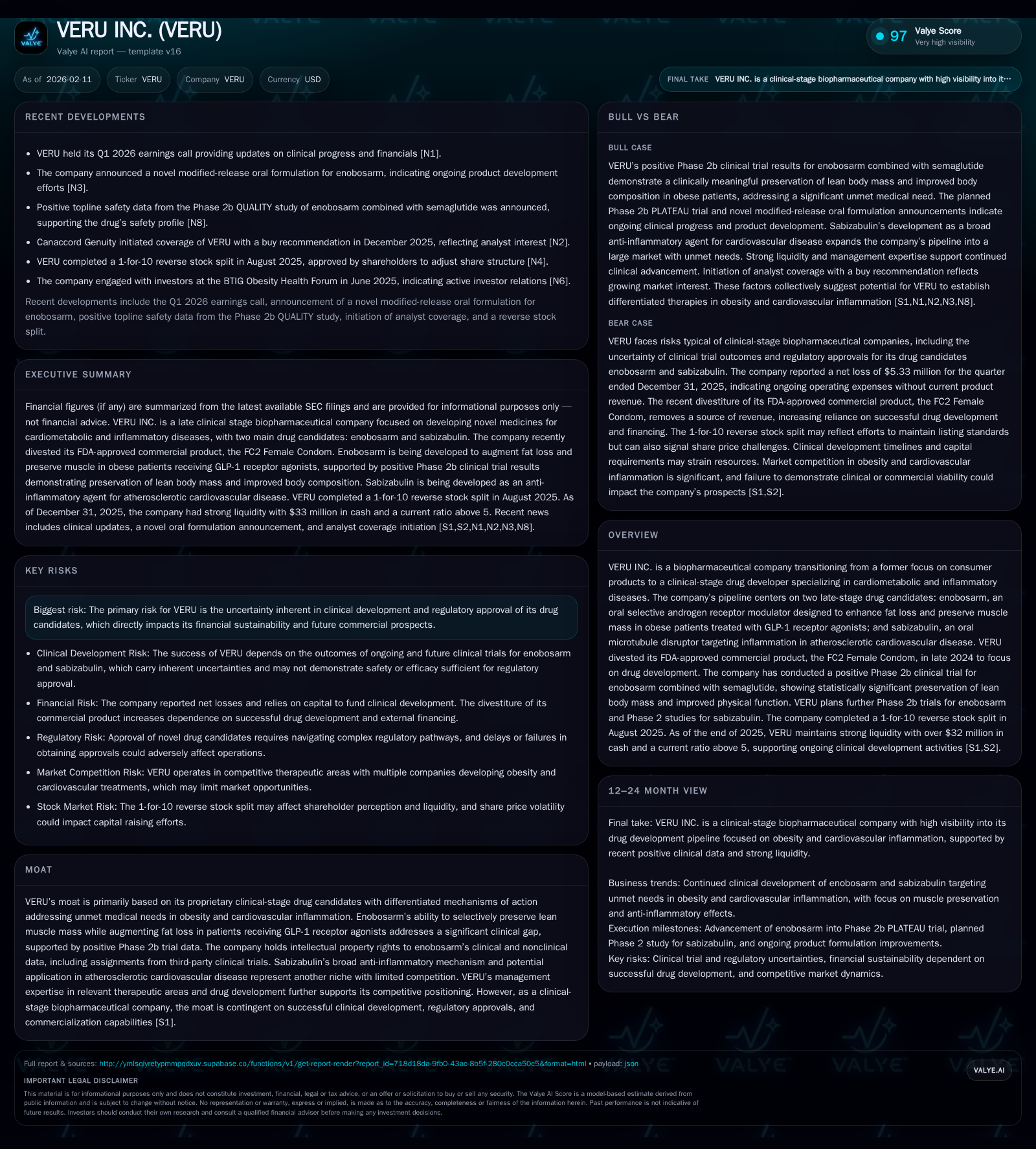
Veru Inc. transitioned from its heritage as a consumer product company known for the FC2 Female Condom to a late-stage clinical biopharmaceutical entity focusing on innovative therapies in cardiometabolic and inflammatory diseases. Its pipeline centers on two novel drug candidates, enobosarm and sabizabulin, addressing significant medical needs with promising Phase 2b trial results, though regulatory and developmental risks remain material. The company’s strategic divestiture of its commercial product line underscores an intent to focus exclusively on drug development amid ongoing financial pressures and the need for future capital.
From Condom Innovator to Clinical Stage Pioneer: Veru’s Evolution
Veru Inc.'s journey embodies a striking transformation—from its early days as The Female Health Company rooted in specialty consumer products like the FDA-approved FC2 Female Condom, to a dedicated clinical-stage biopharmaceutical enterprise targeting complex cardiometabolic and inflammatory pathologies [S1]. Founded initially as Wisconsin Pharmacal Company in 1971, Veru's pivot began earnestly after acquiring Aspen Park Pharmaceuticals in 2016 and rebranding itself in 2017 to reflect its new mission [S1]. The landmark divestiture of the FC2 condom business at the close of 2024 was more than a simple asset sale; it symbolized shedding entrenched commercial operations to fully commit resources and management focus towards advancing novel therapeutics [valye_report_excerpt, S1]. This strategic shedding is fundamental to understanding Veru’s current identity—it no longer straddles consumer goods but aims squarely at clinical innovation in indications with significant unmet needs.
Dissecting the Pipeline: Enobosarm and Sabizabulin’s Promise and Data
Two late-stage drug candidates anchor Veru's pipeline: enobosarm and sabizabulin. Enobosarm functions as an oral selective androgen receptor modulator (SARM) designed explicitly to complement GLP-1 receptor agonist therapy by mitigating lean muscle loss common during aggressive weight reduction regimens. This tissue-selective approach introduces enhanced body composition benefits including improved physical function—a feature corroborated by statistically significant outcomes from a completed Phase 2b study combining enobosarm with semaglutide [valye_report_excerpt]. Notably, this combination therapy addresses a clinically relevant gap as GLP-1 RA drugs are rapidly adopted but cause undesirable muscle depletion potentially limiting functional gains.
Sabizabulin offers a mechanistically distinct approach as an oral microtubule disruptor aimed at curbing inflammation pivotal in atherosclerotic cardiovascular disease progression [valye_report_excerpt]. Inflammation drives plaque instability and related adverse cardiac events, making anti-inflammatory interventions highly sought after. Sabizabulin’s broad anti-inflammatory action positions it uniquely amidst existing cardiovascular pharmacotherapy modalities.
Though both candidates showcase differentiated mechanisms targeting pressing cardiometabolic challenges, neither has yet received regulatory approval—highlighting that their promise is contingent on successful upcoming clinical developments.
Clinical Trial Insights: How Phase 2b Outcomes Shape Perspectives
The positive topline data released for enobosarm's Phase 2b trial instill vital proof-of-concept confidence: preservation of lean mass alongside augmented fat loss when co-administered with semaglutide demonstrates clinically meaningful benefit over GLP-1 RA monotherapy [valye_report_excerpt]. These findings hint at potential enhancements in patient quality of life and adherence due to improved physical function metrics.
However, Veru's disclosures prudently caution investors about typical developmental uncertainties: delays or additional costs could arise if regulatory bodies like the FDA do not accept proposed trial designs or require further evidence prior to advancing sabizabulin or additional enobosarm studies [S1, N1]. Management affirmed plans for more extensive Phase 2b trials focusing on optimized dosing and broader patient populations during the Q1 2026 earnings call [N1], underscoring momentum yet acknowledging inherent binary clinical readout risks common within biopharma.
Navigating the Biopharma Landscape: Veru’s Differentiated Moat
Veru’s competitive advantage rests chiefly on its proprietary intellectual property tied to enobosarm’s selective androgen receptor modulation capabilities and sabizabulin’s microtubule disruption mechanism. Holding exclusive clinical and nonclinical data sets—including rights derived from third-party trials—solidifies barriers against generic replication or competitive encroachment [valye_report_excerpt]. These scientific differentiators address large unmet needs especially within obesity management complicated by muscle loss and within inflammatory pathways driving cardiovascular morbidity.
Complementing these assets is a management team versed in both clinical development nuances and biotech commercialization strategies—crucial given the high attrition rates typical of late-stage drug pipelines. Nevertheless, analysis notes that despite these strengths, Veru operates amidst crowded cardiometabolic markets where incremental innovations are prolific; thus success depends substantially on navigating regulatory pathways efficiently while demonstrating robust clinical benefit [analysis].
Risk Radar: Regulatory, Developmental & Financial Headwinds
Veru faces volatility typical of nascent biopharma firms transitioning from predecessor commercial models. Key risk factors outlined highlight multiple pressure points:
- Absence of current commercial revenues accentuates dependency on successful trial completion for future cash inflows [S1].
- Potential delays or nonacceptance of trial protocols by FDA could derail timelines or inflate costs unexpectedly [S1].
- Heavy reliance on contract research organizations (CROs) and third-party manufacturers adds operational complexity and vulnerability to external disruptions [S1].
- Coverage, reimbursement challenges post-approval remain unquantified risks affecting market penetration.
- Ongoing net losses erode financial reserves; notably, accounting auditors flagged going concern considerations reflecting viability uncertainty without new funding or partnerships [S1].
Together these elements create a high-risk profile requiring vigilant monitoring of developmental milestones combined with rigorous capital strategy execution.
Capital Structure & Cash Flows: Stability Amid Transition
As of December 31, 2025, Veru reported cash and equivalents totaling approximately $33 million juxtaposed against current liabilities near $7.1 million—yielding a strong current ratio exceeding 5 which suggests short-term liquidity sufficiency [F1]. Nonetheless, net losses approaching $5.3 million for fiscal year suggest that cash burn remains substantive due primarily to ongoing R&D activities focused on pipeline advancement. The company effected a reverse stock split (1-for-10) in August 2025 intending to consolidate trading float possibly aiding capital raising efforts but carrying typical dilution considerations [S1].
Given the planned expansion of Phase 2b trials particularly for enobosarm alongside anticipated initiation efforts for sabizabulin programs, expenditures are expected to increase dynamically. Historical references signal that future success largely hinges on accessing new capital either through equity financings or partnering collaborations under reasonable terms without excessive dilution pressure [S1].
Strategic Moves: Divestitures Reflect Management Focus
The sale of the FC2 Female Condom business marked a deliberate severing from legacy consumer health products toward exclusive pursuit of pharmaceutical R&D endeavors [S1]. This streamlining enhances clarity around corporate vision—channeling management bandwidth into drug candidate optimization while freeing capital deployed previously within low-growth commercial units. Such portfolio pruning projects discipline favorable for long-term shareholders prioritizing innovation-driven value creation over diversified consumer exposure.
This realignment also aligns Veru with industry norms where pure-play biopharma companies sharpen pipelines rather than maintain fragmented operating segments.
Forward Look: Upcoming Trials & Milestones Shaping Valuation Dynamics
Investor attention now pivots sharply toward the execution success of planned Phase 2b expansions for enobosarm which will test efficacy replicability across broader cohorts alongside semaglutide therapy. Simultaneously securing FDA alignment on sabizabulin trial designs remains essential before commencement can occur [N1]. Positive readouts could meaningfully de-risk these assets elevating commercial prospects; however, failure or delay would reinforce typical sector risks exerting downward pressure.
These upcoming catalysts encapsulate the quintessential binary outcomes influencing valuation trajectories frequently observed in late-stage biopharma ventures—underscoring the interplay between scientific promise and inherent uncertainty.
Disclaimer: This report is for informational purposes only and does not constitute investment advice or recommendations. It integrates publicly available information up to February 11, 2026, including SEC filings and earnings transcripts. Users should conduct their own due diligence before making any financial decisions related to VERU INC.
Disclaimer: This is research-only, informational analysis and not investment advice. It may include AI-generated interpretation and general industry context. Always verify important details using primary sources.

Comments