
Vistance Networks Rebuilds Profitability Through Transformation and Operational Discipline
The company’s multi-year restructuring and portfolio refocus reversed past losses, setting a foundation for sustainable earnings in broadband infrastructure.
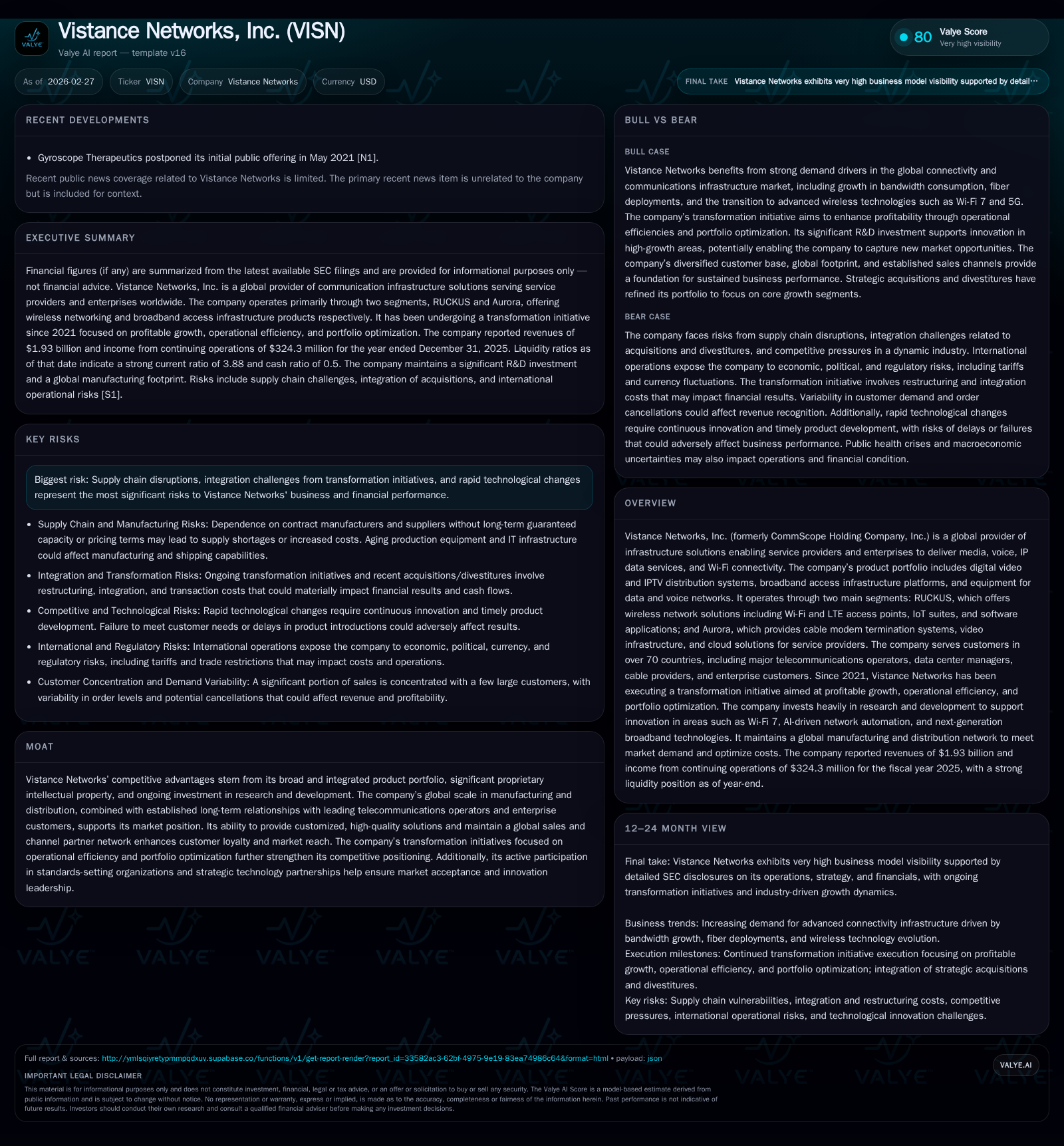
Vistance Networks, formerly CommScope Holding Company, initiated a comprehensive transformation in 2021 targeting portfolio optimization, operational efficiency, and profitable growth. This effort culminated in a sharp net income turnaround in fiscal 2025 despite industry headwinds. The company serves global telecommunications and enterprise customers through its RUCKUS wireless and Aurora broadband infrastructure segments. While supply chain risks and intellectual property litigation remain material concerns, Vistance’s strengthened cash flow generation and disciplined capital allocation underpin its recovery path.
Legacy Roots and Product Portfolio Evolution
Vistance Networks traces its lineage back to its founding as an independent company in 1976 and subsequent public offering in 2013 under the name CommScope Holding Company. The company delivers infrastructure solutions enabling service providers—including cable, telephone, satellite operators—and enterprises to provide media, voice, Internet Protocol (IP) data services, and Wi-Fi connectivity [S1][S26].
Its two core segments are RUCKUS, focused on wireless innovations such as Wi-Fi and LTE access points along with IoT suites; and Aurora (formerly ANS), delivering cable modem termination systems (CMTS), passive optical networks (PON), video infrastructure, and cloud-based management solutions [S5][S6][S7]. These segments serve telecommunications operators, MSOs, data centers, and diverse enterprise verticals worldwide through direct sales forces complemented by channel partners [S5].
Vistance invested $283.5 million in research and development during 2025 to advance product innovation aligned with market trends including Wi-Fi 7 and DOCSIS 4.0 technologies [S14][S19]. Its extensive proprietary intellectual property portfolio supports this innovation pipeline.
Recent Financial Performance Overview
Revenue reached approximately $1.12 billion by FY2017 after growth from $828 million in FY2014 but showed limited progression thereafter [F1]. Operating income has been volatile: significant losses of -$714 million in FY2022 improved to a slight operating loss of -$2.9 million in FY2025 [F1]. Net income swung dramatically from a deep loss of -$1.29 billion in FY2022 to a substantial profit of $1.36 billion in FY2025 [F1]. This turnaround reflects transformation-related impacts alongside operational improvements.
Historical performance (annual)
| FY | Net ($mm) | CFO ($mm) | OpInc ($mm) | Capex ($mm) | Net YoY |
|---|---|---|---|---|---|
| 2025 | 1360 | 323 | -3 | 70 | +19892.6% |
| 2024 | 7 | 273 | 118 | 25 | +101.3% |
| 2023 | -525 | 290 | -62 | 53 | +59.2% |
| 2022 | -1287 | 190 | -714 | 101 |
Source: SEC companyfacts cache [F1].
Capital returns and efficiency (annual)
| FY | FCF ($mm) | ROE% |
|---|---|---|
| 2025 | 253 | -135.4 |
| 2024 | 248 | -0.2 |
| 2023 | 237 | 17.7 |
| 2022 | 89 | 83.2 |
Source: SEC companyfacts cache [F1].
Note: Revenue data is available only up to FY2017; cash flow figures reflect recovery despite earnings volatility.
Transformation Initiative Driving Turnaround
Since launching a comprehensive transformation program in 2021 focusing on profitable growth, operational efficiency, and portfolio optimization [S1], Vistance executed significant restructuring actions including workforce reductions and facility consolidations [S13][S25]. These efforts incurred restructuring charges exceeding $19 million recently along with transaction costs over $60 million during prior years [S1].
Strategic divestitures sharpened the portfolio: CCS segment exited post-FY2025; DAS business sold earlier; OneCell unit divested mid-2025 [S6][S7]. Pricing processes were revamped to improve margins while procurement efficiencies enhanced cost control [S6]. Collectively these initiatives shifted the company from heavy losses toward adjusted EBITDA expansion by the end of fiscal year 2025.
Manufacturing Footprint and Supply Chain Risks
Vistance operates a hybrid manufacturing model combining internal facilities with contract manufacturers globally including major operations in Mexico aimed at labor cost advantages [S11]. However, contract manufacturers operate primarily without long-term capacity guarantees exposing Vistance to risks of supply shortages or price volatility [S1]. Aging production equipment further increases potential operational disruptions if maintenance or upgrades lag.
Climate-related events pose additional supply chain risks by potentially delaying component deliveries or disrupting logistics routes [S1]. Although contingency plans exist for supplier diversification and inventory buffers, rapid ramp-up alternatives may carry higher costs or delays.
Intellectual property risks are heightened given reliance on third-party manufacturers who might inadvertently expose proprietary technology to infringement claims or misappropriation [S4][S10]. Insurance coverage mitigates but may not fully eliminate potential liabilities.
Segment Market Positions: RUCKUS & Aurora
RUCKUS delivers wireless technologies tailored for enterprise environments requiring high-density Wi-Fi deployments such as stadiums or campuses along with LTE access points and IoT suites supporting smart city applications [S5]. Sales predominantly occur through independent distributors or system integrators serving telecom operators and varied vertical markets.
Aurora focuses on wireline network service providers including cable MSOs with offerings such as IPTV infrastructure, virtualized CMTS platforms compliant through DOCSIS 4.0 standards, distributed access architecture products, cloud management solutions, and passive optical networks facilitating fiber rollouts [S7]. It sells mainly direct to major service providers requiring customized engineering support.
Together these segments address converging wired-wireless market demands amid competitive pressures from semiconductor-embedded connectivity vendors and integrated network solution providers [S21].
Capital Allocation & Cash Flow Strength
In fiscal year 2025, operating cash flow increased to approximately $323 million (+18% YoY), supporting capital expenditures of $70 million focused on capacity expansion aligned with backlog growth areas [F1]. Free cash flow approximated $253 million indicating strong internal funding capability despite ongoing restructuring costs.
Equity remains negative at about -$1 billion due to accumulated deficits from prior years’ losses even as current-year net income surged dramatically; this results in an approximate negative return on equity metric reflecting accounting legacy rather than operational inefficiency per se [F1].
No recent dividends or share repurchases have been reported consistent with management prioritizing operational stabilization before capital returns.
Intellectual Property & Regulatory Risks
Ongoing intellectual property litigation represents a material risk given the complex hardware-software integration within Vistance’s solutions especially around RUCKUS IoT products where infringement claims could lead to damages or licensing fees impacting earnings [S4][S10]. Outcomes remain uncertain but could materially affect future results.
Regulatory compliance challenges include adherence to environmental laws regulating hazardous materials handling during manufacturing as well as evolving data privacy regulations such as GDPR across jurisdictions imposing costly adaptations [S8][S20]. While policies are in place to mitigate exposure risks, penalties or reputational harm cannot be excluded.
Outlook & Key Milestones Ahead
Looking forward, Vistance prioritizes organic growth driven by continued innovation around Wi-Fi 7 adoption within RUCKUS offerings alongside DOCSIS 4.0 enhancements in Aurora products complemented by AI-enabled cloud network management platforms [S19]. The order backlog exceeded $630 million entering calendar year-end indicating stable demand though shipment timing remains subject to macroeconomic variables.
Key upcoming milestones include sustaining adjusted EBITDA gains post-absorption of remaining restructuring charges; stabilizing supply chains amid geopolitical tensions; expanding software-as-a-service revenue streams; and successful commercialization of next-generation product lines.
Disclaimer: This document is based solely on publicly available information without investment advice or recommendations.
Disclaimer: This is research-only, informational analysis and not investment advice. It may include AI-generated interpretation and general industry context. Always verify important details using primary sources.

Comments