
Viemed Healthcare Grows Clinic-Embedded Respiratory Care Model with 20% Revenue Surge
Viemed’s integrated home respiratory care combining equipment rental and licensed RTs fuels strong financial growth amid evolving reimbursement policies.
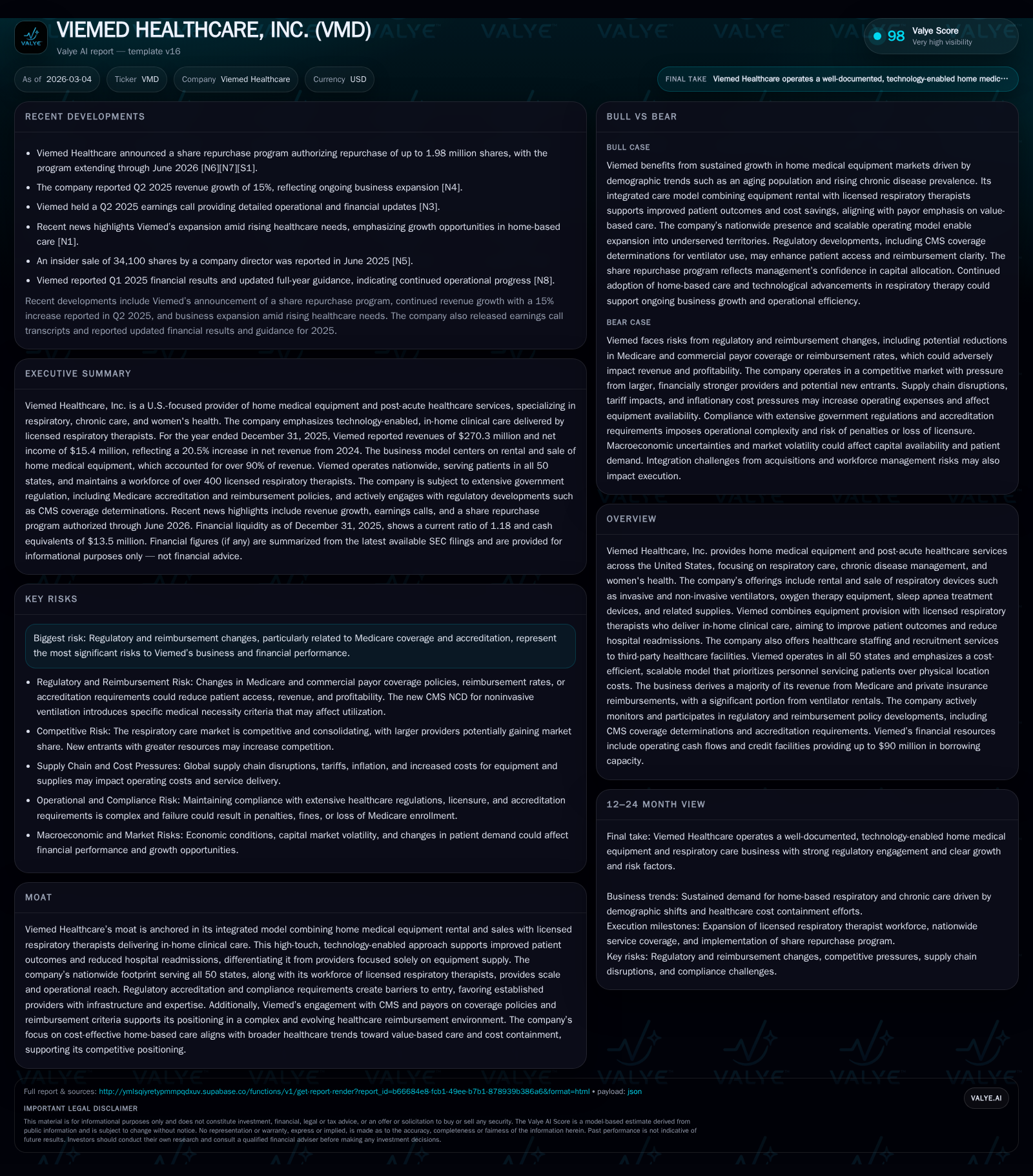
Viemed Healthcare, Inc. reported a 20.5% revenue increase for FY2025, driven by its model coupling home medical equipment rental with in-home licensed respiratory therapists. The company expanded its workforce to 401 RTs by year-end 2025, enabling superior patient outcomes and reduced hospital readmissions. CMS's June 2025 National Coverage Determination for noninvasive ventilation introduces new reimbursement criteria with broad payer implications. Viemed generated positive free cash flow and returned capital via share repurchases while investing in scalable growth.
From Equipment Rental to Clinical Care: Historical Growth Drivers
Viemed Healthcare has evolved from a traditional home medical equipment rental supplier into an integrated provider of respiratory care services by combining equipment provision with in-home clinical care delivered by licensed respiratory therapists (RTs). This strategic shift has fueled consistent growth over recent years. For FY2025, Viemed posted revenues of $270.3 million, a robust 20.5% increase over the prior year’s $224.3 million [F1][S1]. Operating income followed suit, expanding 28.2% year-over-year to $22.9 million, while net income surged 32.6% to $14.9 million [F1].
The rental and sale of non-invasive and invasive ventilators remain core revenue contributors, constituting approximately 50.6% of total revenue in FY2025 [S1]. What differentiates Viemed is its deployment of licensed RTs who provide high-touch in-home clinical management aimed at improving outcomes and reducing costly hospital readmissions—a critical factor supporting premium reimbursement arrangements and patient retention.
By year-end 2025, Viemed employed 401 licensed RTs representing around 29% of its total workforce [S1]. This emphasis on clinical staff reflects management’s view that prioritizing personnel directly servicing patients enables better scalability and care quality than expanding physical storefronts or distribution centers.
Expanding the Reach: Workforce and Geographic Growth Strategy
Operating nationwide across all 50 U.S. states, Viemed’s strategy centers on broadening patient volumes through cost-efficient territory launches that limit fixed location expenses while investing heavily in qualified personnel [S1][N2]. This approach mitigates overhead complexity typically associated with brick-and-mortar expansions common among durable medical equipment providers.
Beyond servicing internal patient needs, Viemed also offers healthcare staffing and recruitment solutions to third-party healthcare facilities seeking clinical professionals, adding an adjacent revenue stream leveraging its labor pool [S1].
This dual focus on home-based service delivery complemented by external staffing aligns well with macro trends favoring outpatient and home care modalities driven by escalating hospital costs and patient preference shifts.
Coverage Policy Changes and Their Impact on Reimbursement
In June 2025, the Centers for Medicare & Medicaid Services (CMS) finalized a National Coverage Determination (NCD) establishing detailed medical necessity criteria for noninvasive positive pressure ventilation (NIPPV) used at home to treat chronic respiratory failure related to chronic obstructive pulmonary disease (COPD) [S2][S4][S5]. This marks a notable evolution from previous broader Durable Medical Equipment (DME) coverage lists towards more prescriptive policy frameworks.
Viemed actively engaged throughout the policy formation process via formal comments and stakeholder advocacy involving CMS, the Department of Health and Human Services, and Congressional offices [S2]. While the NCD aims to clarify coverage thresholds potentially facilitating consistent payer reimbursement decisions and broader patient access, it also introduces utilization controls that could restrict some prior uses.
Since Medicare rules significantly influence commercial insurers and Medicare Advantage plan coverage decisions, this regulatory development carries broad implications for Viemed's payer environment.
Financial Performance and Operational Efficiency Trends
The following table summarizes Viemed’s key financial metrics over the past four fiscal years:
Historical performance (annual)
| FY | Rev ($mm) | Net ($mm) | CFO ($mm) | OpInc ($mm) | Rev YoY | Net YoY |
|---|---|---|---|---|---|---|
| 2025 | 270 | 15 | 52 | 23 | +20.5% | +32.6% |
| 2024 | 224 | 11 | 39 | 18 | +22.5% | +10.0% |
| 2023 | 183 | 10 | 45 | 14 | +31.8% | +64.6% |
| 2022 | 139 | 6 | 28 | 8 |
Source: SEC companyfacts cache [F1].
Capital returns and efficiency (annual)
| FY | Buybacks ($mm) | FCF ($mm) | ROE% |
|---|---|---|---|
| 2025 | 13 | 12 | 10.6 |
| 2024 | 0 | 1 | 8.6 |
| 2023 | 0 | 19 | 9.0 |
| 2022 | 10 | 5 | 6.4 |
Source: SEC companyfacts cache [F1].
Table sourced from latest company filings as of March 4, 2026 [F1]
Revenue expansion above industry baseline stems from effective top-line scaling paired with operating leverage evidenced by accelerating operating income growth exceeding revenue gains in FY2025.
Operating cash flow improved substantially by nearly one-third year-over-year reaching $51.9 million after moderate increases in capital expenditures necessary to support new market deployments and technology upgrades.
Free cash flow is estimated at approximately $11.9 million (operating cash flow minus capital expenditures), indicating positive cash generation supporting both organic growth investments and shareholder return initiatives.
Capital Allocation: Balancing Growth Investments and Shareholder Returns
Historically reinvesting primarily through capital expenditures aligned with geographic expansion strategies, Viemed introduced share repurchases during FY2025 totaling approximately $13.2 million—the first such program since earlier modest buybacks in FY2022 but none in FY2023 or FY2024 [F1][S15].
No dividends were declared during this period; instead capital allocation reflects management prioritizing scalable growth investments while cautiously returning excess capital via buybacks amid ongoing industry uncertainties.
The company maintains access to substantial liquidity through revolving credit facilities expandable up to $90 million under certain conditions providing flexibility for near-term funding requirements [S6][S14]. The balance sheet reveals an equity base of $141.5 million against net income of $14.9 million for FY2025 implying an approximate return on equity near 10.6%, indicating moderate profitability relative to equity invested [F1].
Risks in Regulation and Supply Chain: Navigating Industry Headwinds
Despite structural strengths in scale and integrated clinical offerings, Viemed faces persistent risks primarily stemming from evolving regulatory landscapes around Medicare coverage policies where any reduction or tightening could materially affect demand or reimbursements [S4][S5]. Compliance with federal laws including the False Claims Act introduces operational complexities given heightened government scrutiny emphasizing accurate medical documentation accompanying claims submissions.
Further vulnerability arises from supply chain dependencies on domestic and international suppliers subject to tariff-related cost inflation and potential logistical constraints affecting equipment pricing or availability, though no material impacts have been reported thus far [S16][S26][S18].
Loss or suspension of Medicare accreditation would critically impair business continuity given direct ties to federally reimbursed programs underscoring importance of maintaining rigorous compliance protocols across all operating regions.
Future Outlook: Milestones and KPIs to Track
Key performance indicators will be crucial for assessing Viemed’s trajectory:
- Patient volume ramp tied closely to incremental RT hiring given their outsized role in service delivery quality [N2][S1].
- Margin progression benchmarked against evolving reimbursements influenced by the June ’25 NCD implementation along with competitive bidding reforms remains pivotal.
- Cash flow trends especially free cash flow generation will indicate efficiency balancing capital expenditures versus organic growth returns.
- Management’s ability to sustain share repurchase programs or initiate dividends reflecting confidence without compromising liquidity or investing capacity should be observed.
- Potential contingent payments arising from acquisitions like Lehan’s Medical Equipment referenced in filings may impact near-term financials.
Collectively these factors shape Viemed’s capacity to consolidate leadership positioning within technologically enabled home respiratory care solutions amid dynamic regulatory conditions.
Disclaimer: This analysis is based solely on publicly available data from SEC filings [F1], company disclosures [S#], and news reports [N#] as noted; it does not constitute investment advice.
Disclaimer: This is research-only, informational analysis and not investment advice. It may include AI-generated interpretation and general industry context. Always verify important details using primary sources.

Comments