
Verisign's Exclusive .com/.net Registry Role and 2026 Capital Moves Amid Contract Renewal Risks
Verisign maintains dominant control of the .com and .net domain registries with growing buyback firepower, even as its pivotal ICANN contract faces renewal in 2030.
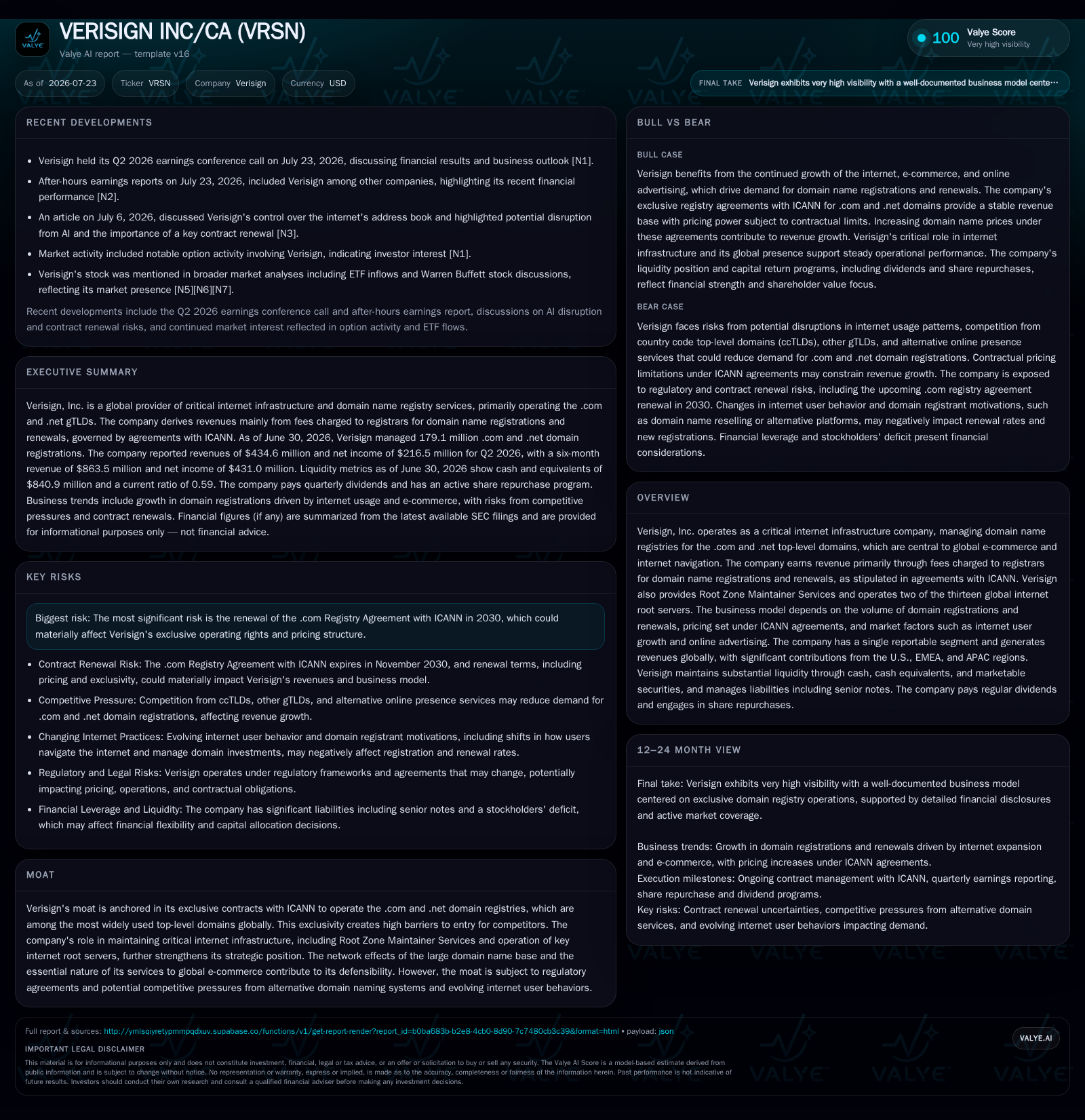
In Q2 2026, Verisign announced a major $1.5 billion increased share repurchase authorization and repaid legacy debt with new notes, underscoring strong cash flow generation and capital discipline [S2]. Its business model relies on exclusive contracts with ICANN to manage the .com and .net top-level domains, generating recurring revenue primarily through registrar fees for domain registrations and renewals [S1]. While the company enjoys a robust moat from its exclusivity and critical internet infrastructure role, the looming 2030 renewal of the .com Registry Agreement creates uncertainty around future pricing and operating rights. Growth depends on domain registration volume expansion powered by global internet adoption, yet evolving internet behaviors and alternative naming systems pose emerging risks [S1].
Verisign Inc. reinforced its capital allocation strategy in Q2 2026 by securing an incremental $884.2 million share repurchase authorization, supplementing the $615.8 million remaining from its prior program. This raises the total repurchase capacity to $1.5 billion with no expiration date, reflecting the company’s confidence in its robust free cash flow generation and commitment to returning capital to shareholders [S2]. Concurrently, Verisign executed a strategic refinancing by issuing new 2026 Notes on June 26, 2026, and promptly redeeming all outstanding 2017 Notes on July 20, 2026, using the proceeds combined with cash on hand. This maneuver optimizes the debt maturity profile and may reduce interest expenses, underscoring disciplined financial management [S2].
Operating expenses increased modestly in the first half of 2026, primarily driven by higher stock-based compensation related to elevated performance-based restricted stock unit (RSU) achievement estimates, alongside increased employee benefits such as health insurance and salary adjustments [S2]. These investments likely aim to retain critical technical talent essential for maintaining Verisign’s secure and reliable internet infrastructure
Business Model: Exclusive Registry Operator Monetizing Domain Registrations
Verisign operates as the exclusive registry for the.com and.net top-level domains (TLDs) under contractual agreements with the Internet Corporation for Assigned Names and Numbers (ICANN). These Registry Agreements, valid through December 2030, grant Verisign exclusive operating rights and establish contractual pricing frameworks for domain registration and renewal fees charged to accredited domain registrars, who in turn serve end customers globally [S1]. The company’s revenue model is predominantly recurring, driven by the volume of domain registrations and renewals, with average revenue per domain registration influenced by ICANN-approved pricing terms [S1].
In addition to registry services, Verisign fulfills the role of Root Zone Maintainer, responsible for the authoritative management of the DNS root zone file, and operates two of the thirteen globally distributed root servers. These functions are critical to the stability and security of the Domain Name System (DNS) infrastructure but do not currently generate significant direct revenue streams [S1]
Verisign’s revenue is geographically diversified, with substantial contributions from the United States, Europe-Middle East-Africa (EMEA), and Asia-Pacific regions, reflecting the global demand for trusted digital identity assets embodied by domain names [S1], [F1]. Given the contractual dependence on ICANN’s Registry Agreements for pricing authority, any amendments or renegotiations of these agreements directly affect Verisign’s revenue generation mechanics.
Industry Context: High-Barrier Internet Infrastructure Services with Network Effects
Within the Internet Infrastructure Services sector, Verisign occupies a critical upstream position by managing essential DNS registries and root server operations. The company’s exclusive contracts for the.com and.net TLDs create a durable competitive moat reinforced by strong network effects: as the total registered domain base grows, it enhances brand recognition and registrar partnerships, creating high barriers to entry for potential competitors.
The fixed-cost nature of DNS infrastructure combined with recurring fee-based revenue supports high gross margins typical of this niche. While other registry operators such as Public Interest Registry (managing.org) operate in the same space, none match Verisign’s scale or control over the most commercially valuable TLDs.
Domain registrars like GoDaddy and Namecheap function downstream as customer-facing entities, relying on registry operators’ infrastructure. Emerging risks include alternative decentralized naming systems (e.g., blockchain-based DNS), which currently have limited adoption but could pose long-term competitive challenges. Regulatory frameworks and trust considerations presently favor established operators like Verisign due to their proven reliability and security essential for e-commerce and internet stability.
Growth Drivers Anchored in Global Internet Expansion & Digital Commerce
Verisign’s growth prospects are primarily linked to:
- Continued global expansion of internet penetration, driving demand for domain registrations as businesses and individuals establish online presences.
- Growth in digital commerce, which increases the need for domain names across sectors such as retail, finance, media, and technology.
- Accelerated internet adoption in emerging markets, where domain registration growth rates typically outpace mature regions.
- Technological enhancements aimed at improving DNS security and performance, potentially enabling premium pricing or expanded registrar partnerships.
Key operating KPIs include the total number of registered domains under management, renewal rates, and average revenue per domain registration or renewal. These metrics directly influence recurring revenue volumes and margin profiles.
Risks Centered Around ICANN Contract Renewal & Competitive Evolution
The principal risk for Verisign lies in the scheduled expiration of its Registry Agreement for.com in 2030. This contract governs both Verisign’s exclusive operational rights and the pricing framework for registrar fees [S1]. Non-renewal or renewal under less favorable terms—such as regulatory-imposed price caps or introduction of competition—could materially impact revenue and profitability.
Additional risks include shifts in internet user behavior that could slow domain registration growth or encourage adoption of alternative naming systems outside the centralized DNS. While these threats remain nascent, they represent strategic considerations for Verisign’s long-term positioning.
Operational risks also encompass cybersecurity threats targeting DNS infrastructure. Given Verisign’s role as Root Zone Maintainer and root server operator, any disruption could undermine trust in its services and damage its competitive moat.
Finally, Verisign’s revenue concentration in just two TLDs (.com and.net) elevates dependency risk compared to more diversified internet infrastructure providers.
What To Watch Next: Contract Milestones and Domain Registration Trends
Upcoming key milestones include monitoring ICANN contract renewal discussions as the 2030 expiration approaches. Early signals of regulatory pressure or pricing constraints will be critical to assess potential impacts on Verisign’s exclusivity and pricing power.
Operationally, domain registration growth rates and renewal rate stability remain vital indicators of demand health. Geographic shifts in domain registration patterns may also influence strategic focus and marketing efforts.
Financially, tracking share repurchase activity against authorized limits and liquidity position will provide insight into capital allocation discipline and balance sheet management post-Q2 refinancing and buyback announcements.
Financial Profile Discussion
As of June 30, 2026, Verisign reported approximately $841 million in cash and cash equivalents with no outstanding debt, reflecting a net cash position and a clean balance sheet [F1], [S2]. The recent issuance of 2026 Notes and redemption of 2017 Notes represent a refinancing strategy to optimize debt maturities without increasing leverage [S2].
The company’s current liabilities totaled approximately $1.9 billion, resulting in a current ratio near 0.59, which is typical for a capital-light, contract-driven business model reliant on billing cycles rather than inventory turnover [F1]
Operationally, net income for the first half of 2026 was $431 million, supported by high-margin registry services [S2]. Cash flow from operations remains strong, though increased stock-based compensation expenses reflect investments in human capital to sustain infrastructure reliability and security [S2].
This analysis is based solely on publicly available information from recent SEC filings and market data without offering investment advice or research views.
Disclaimer: This is research-only, informational analysis and not investment advice. It may include AI-generated interpretation and general industry context. Always verify important details using primary sources.

Comments