
Bristow Group’s Growth Supported by Offshore Energy Contracts and Strategic Fleet Management
A global leader in vertical flight solutions with diversified operations anchored in offshore energy and government services.
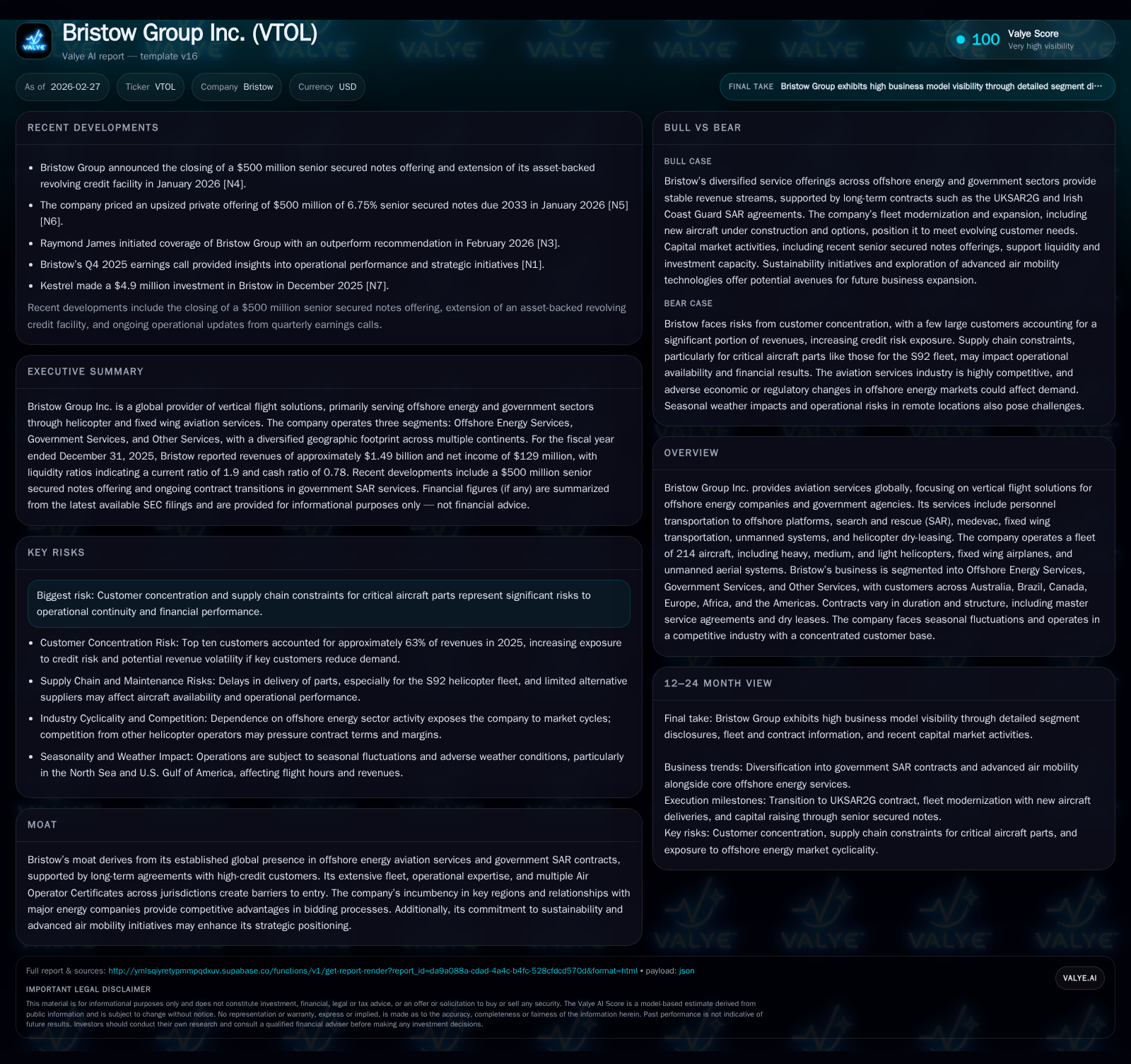
Bristow Group Inc. (VTOL) has demonstrated steady revenue growth driven by its core Offshore Energy Services and expanding Government Services segment, benefiting from long-term contracts with major energy companies and government agencies. The company leverages a sizable, diversified fleet spanning helicopters, fixed wing aircraft, and unmanned systems to serve international markets. Capital allocation remains disciplined with meaningful free cash flow generation and modest share repurchases, while operational risks related to aircraft maintenance and regulatory compliance persist. Looking ahead, Bristow’s expansion into electric vertical takeoff and landing (eVTOL) technology through partnerships signals a forward-looking strategic tilt toward sustainable aviation solutions.
Company Background and Operational Overview
Bristow Group Inc. (NYSE: VTOL) is a leading global provider of innovative vertical flight solutions primarily serving the offshore energy sector and government entities worldwide [S1][S6]. Its services encompass personnel transportation to offshore platforms, search-and-rescue (SAR), medevac, fixed wing regional airline operations in Australia, unmanned aerial systems (UAS), and helicopter dry-leasing [S1][S6].
The company operates a diverse fleet of 214 aircraft including heavy twin-engine helicopters designed for deepwater offshore missions, medium helicopters for regional transport and SAR duties, fixed wing aircraft for passenger service, and UAS platforms [S5]. Its geographic footprint spans North America (notably the U.S. Gulf of Mexico), Brazil's deepwater basins, Nigeria's Niger Delta region, the UK and Norwegian sectors of the North Sea, Canada via a significant equity stake in Cougar Helicopters serving Atlantic offshore areas, among others [S4][S9].
Historical Performance: Revenue Growth Anchored by Core Segments
Between 2023 and 2025, Bristow expanded its annual revenue from approximately $1.30 billion to $1.49 billion—a 5.3% increase year-over-year from 2024 to 2025—with Offshore Energy Services accounting for roughly two-thirds of total revenues across these years (66% in 2025) [F1][S4]. The Government Services segment grew its share to approximately 26% in 2025 from around 23% in 2024, driven largely by SAR contracts in the UK and Ireland [F1][S4]. Other Services contributed around 8%, covering fixed wing operations and dry leasing.
Long-term master service agreements underpin the revenue base with fixed monthly fees plus incremental payments tied to flight hours supporting stability amid industry cyclicality [S11].
Operating income rose nearly 20% year-over-year to $158.8 million in 2025 from $132.6 million in 2024, reflecting improved operational leverage despite inflationary cost pressures [F1]. Net income returned to profitability at $129.1 million in 2025 after prior losses reported in 2023, corresponding to an approximate ROE of 12.2% based on year-end equity levels [F1].
Historical performance (annual)
| FY | Rev ($mm) | Net ($mm) | CFO ($mm) | OpInc ($mm) | Rev YoY | Net YoY |
|---|---|---|---|---|---|---|
| 2025 | 1491 | 129 | 198 | 159 | +5.3% | +36.2% |
| 2024 | 1415 | 95 | 177 | 133 | +9.1% | +1498.2% |
| 2023 | 1297 | -7 | 32 | +40.6% | -150.1% | |
| 2022 | 923 | 14 | -13 |
Source: SEC companyfacts cache [F1].
Capital returns and efficiency (annual)
| FY | Buybacks ($mm) | ROE% |
|---|---|---|
| 2025 | 15 | 12.2 |
| 2024 | 4 | 10.6 |
| 2023 | 3 | -0.8 |
| 2022 | 11 | 1.7 |
Source: SEC companyfacts cache [F1]. *Capex data not fully available for recent years. [F1]
Capital Allocation: Strong Cash Flow Supports Modest Buybacks
Bristow generated robust operating cash flow of $198 million in fiscal year 2025 enabling free cash flow near $192 million after capital expenditures focused on fleet maintenance rather than expansion [F1]. This strong cash flow underpins modest share repurchases totaling $15 million during the year compared to $4 million previously [F1]. Dividend payments have been minimal or suspended reflecting industry capital intensity.
In early 2026, Bristow completed an upsized private offering of $500 million senior secured notes due in 2033 carrying a coupon near mid-6% range alongside an extension of its asset-backed revolving credit facility—actions enhancing liquidity for strategic investments such as eVTOL initiatives [N4][N6][N7][S29]. As of December 31, 2025, the company held approximately $286 million in cash against current liabilities of $365 million resulting in a current ratio near a healthy 1.9x [F1][S29].
Fleet Composition and Technological Initiatives
The company's fleet consists primarily of:
- Heavy twin-engine helicopters with capacities of around16-19 passengers used extensively for deepwater offshore operations; models such as Sikorsky S92 comprise nearly one-third of the fleet.
- Medium helicopters suitable for mid-range transport and SAR missions.
- Fixed wing aircraft operated mainly through subsidiary routes serving regional passenger needs.
- Unmanned Aerial Systems providing auxiliary capabilities particularly for monitoring roles.
Operational risks arise from supply chain constraints notably delays affecting parts for the S92 models sourced from limited OEMs like Sikorsky Commercial Inc., Leonardo Spa—causing grounding of multiple aircraft which impacts revenue generation [S13][S18]. Logistic challenges are compounded by geographic dispersion.
Strategically, Bristow has partnered with Vertical Aerospace aiming to commercialize electric vertical takeoff and landing (eVTOL) aircraft such as the VX4 model through a capital-light "ready-to-fly" platform bundling certified aircraft provision, trained pilots, maintenance support and insurance management—facilitating customer adoption without upfront infrastructure investment [N2][S8]. This aligns with Bristow’s sustainability commitments highlighted in its latest Sustainability Report emphasizing reduced lost workdays and expanded SAR mission capabilities [N2][S8].
End Markets: Stability from Offshore Energy Balanced by Government Service Growth
Offshore Energy Services form the core business contributing about two-thirds of revenues derived mainly from personnel transport between onshore bases and long-life production platforms which are less cyclical than exploration rigs [S4][S9]. Key geographic markets include:
- U.S Gulf of Mexico – one of the largest global offshore energy aviation markets.
- Brazil – extensive deepwater basins supported by strategically located bases.
- Nigeria – shallow water Niger Delta plus deepwater exploration activities.
- UK North Sea – extensive offshore oil fields with substantial SAR contract presence.
- Norway – operations along Norwegian Continental Shelf integrating SAR functions.
- Canada – via equity interest in Cougar Helicopters servicing harsh Atlantic environments.
Government Services account for about one-quarter of revenues primarily from search-and-rescue contracts within the UK and Ireland where specialized AW189 helicopters operate alongside fixed wing environmental monitoring assets—providing stable government-sponsored cash flows that mitigate seasonal cyclicality inherent to offshore operations [S25][S16].
Other Services are smaller but important including Australian regional airline operations serving mining/energy clients plus helicopter dry-leasing arrangements internationally where third-party operators assume operational risk under their own Air Operator Certificates (AOCs) while using Bristow equipment [S4][S9][S25].
Seasonality affects northern hemisphere operations due to shorter daylight hours reducing flight availability during winter months especially in the U.S Gulf Coast and North Sea; adverse weather events like tropical storms or Harmattan dust also impact Nigerian activity [S17].
Competitive Environment
The vertical flight services industry is highly competitive with key players such as CHC Group LLC, NHV Group, Omni Helicopters International S.A., PHI Inc., among others depending on region-specific dynamics [S22]. Competitive advantages rest on:
- Strong safety records crucial given inherent operational risks,
- Technical qualifications required for contract bidding,
- Established customer relationships facilitating long-term agreements,
- Compliance via local Air Operator Certificates enabling operations across jurisdictions,
- Scale achieved through methodical fleet management optimizing utilization.
Customer internal aviation resources occasionally create displacement risk but external providers like Bristow benefit from economies of scale especially for complex offshore missions [S22].
Risks Summary
Key risks identified include:
- Operational hazards inherent to rotary-wing/fixed-wing aviation compounded by harsh environmental conditions; accidents could materially damage reputation or result in grounding fleets causing revenue loss even if incidents involve third-party operators using similar aircraft models [S12][S18].
- Customer concentration risk with top three clients representing about one-third of revenues exposes financial results to sector downturns or policy shifts affecting these customers’ creditworthiness [S7].
- Supply chain vulnerabilities notably delays sourcing critical parts for S92 helicopters limiting fleet availability impacting contractual delivery capabilities [S13].
- Regulatory uncertainties involving foreign ownership restrictions impacting ability to operate internationally; changes to aviation laws could increase costs or restrict operations outside U.S.[S12][S14].
- Environmental regulations potentially increasing compliance costs; climate-related policies could depress upstream oil & gas activity thereby reducing demand for services [S15][S24].
Future Outlook: Areas to Monitor
While explicit forward guidance beyond financial disclosures is limited, key focus areas include:
- Offshore energy capital spending trends influencing contract renewals or volume growth particularly if global energy demand remains robust post-pandemic recovery.
- Progress on eVTOL deployments through Vertical Aerospace partnership which represents an emerging growth avenue aligned with sustainability mandates yet subject to certification progress.
- Continued discipline balancing fleet renewal against supply chain disruptions constraining availability improvements.
- Evolution of government SAR contract portfolios including potential geographic expansions enhancing recurring revenue streams.
- Ability to manage pricing pressures amid inflationary cost environments preserving margins through escalations or efficiency gains.
Summary
Bristow Group demonstrates consistent growth driven by stable offshore energy transportation contracts complemented by expanding government service engagements underpinning resilient global revenue streams across multiple continents. Financial performance reflects improving profitability coupled with strong free cash flow supporting measured capital return activities despite inherent cyclicality risks typical within asset-intensive aerospace sectors under stringent regulatory oversight.
Strategic initiatives embracing eVTOL technologies alongside conventional rotary-wing operations indicate a progressive approach toward innovation linked closely with sustainability objectives—a critical consideration amid evolving shareholder expectations and tightening regulatory frameworks globally.
Investors should observe how Bristow manages supply chain challenges around critical helicopter parts alongside maintaining operational reliability since disruptions directly affect contracted service delivery capability despite longstanding customer relationships governed by multi-year master service agreements.
This analysis is prepared solely for informational purposes without providing investment advice or recommendations regarding securities of Bristow Group Inc., relying exclusively upon publicly available information as cited herein.
Disclaimer: This is research-only, informational analysis and not investment advice. It may include AI-generated interpretation and general industry context. Always verify important details using primary sources.

Comments