
Westinghouse Air Brake Secures Fleet Modernization Momentum and Expands Inspection Capabilities
Wabtec’s 2026 Q2 filing highlights operational integration of its Inspection Technologies acquisition alongside evolving long-term project complexities affecting near-term revenue clarity.
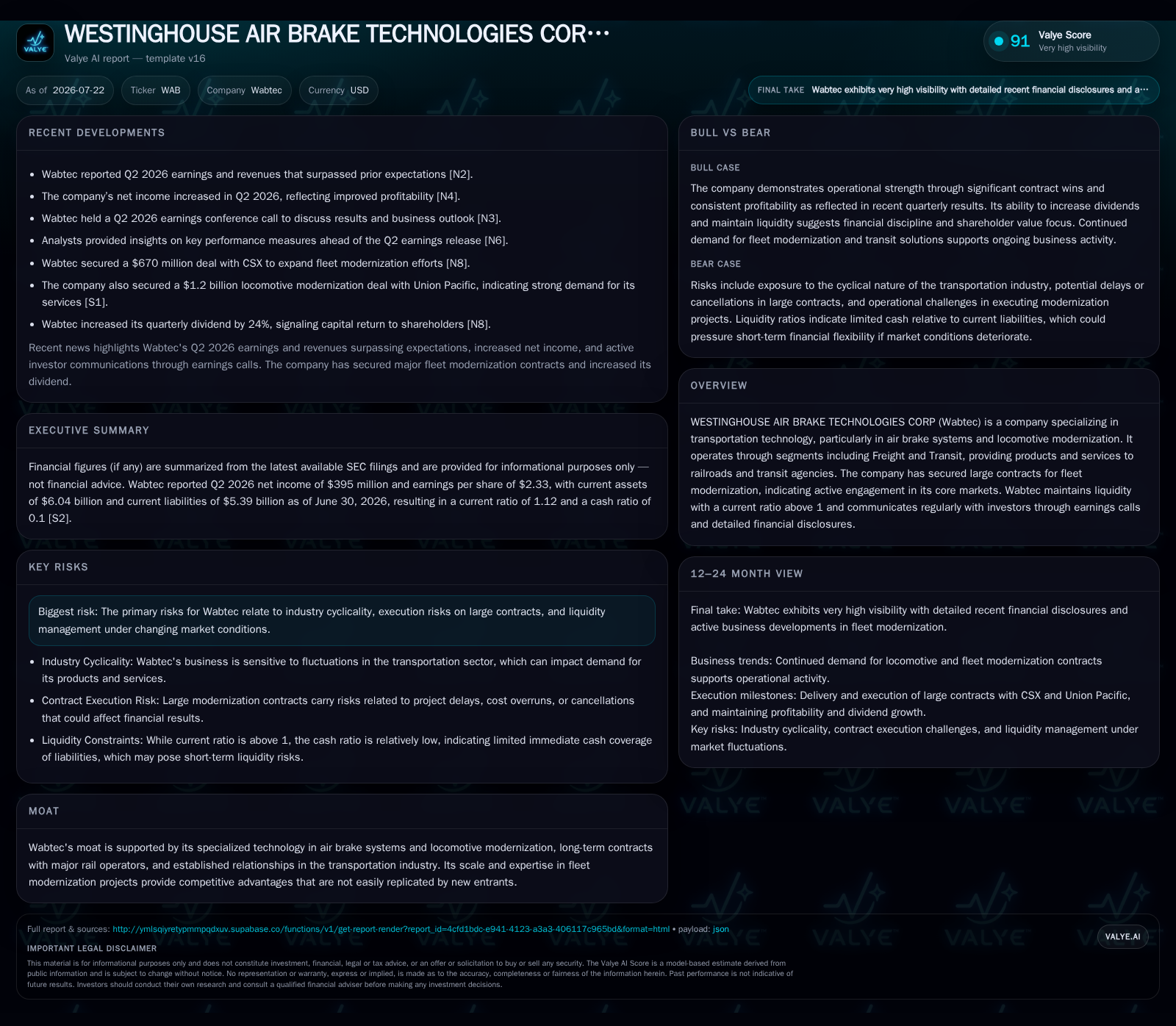
Westinghouse Air Brake Technologies Corp (Wabtec) recently completed the acquisition of Evident’s Inspection Technologies division, a move that significantly enhances its portfolio in non-destructive testing and remote visual inspection. This addition complements Wabtec’s established fleet modernization business relying on long-term contracts with railroads and transit agencies. The latest quarterly report underscores challenges in estimating total revenue from large, multi-year projects due to input cost volatility and execution complexity. Wabtec’s core is rooted in providing safety-critical air brake systems and locomotive modernization solutions, fortified by aftermarket service contracts increasingly supported by advanced inspection technologies. Financially, the company maintains a stable liquidity profile with a current ratio above 1.1 despite high net debt related to acquisition funding, supported by disciplined covenant compliance and strategic supply chain financing.
Operational Impact of Inspection Technologies Acquisition on Fleet Services Growth
In its second quarter 2026 10-Q filing dated July 22, Westinghouse Air Brake Technologies Corp confirmed the full acquisition of Evident’s Inspection Technologies division on July 1, 2025 for approximately $1.797 billion [S2]. This division specializes in non-destructive testing (NDT), remote visual inspection (RVI), and analytical instrumentation—capabilities that are highly complementary to Wabtec's existing portfolio focused on air brake systems and locomotive modernization. The integration expands Wabtec’s aftermarket services footprint to include advanced automated inspection solutions characterized by data acquisition and analytics—a growing focus area as rail operators prioritize predictive maintenance and asset reliability.
Inspection technologies enhance visibility into mission-critical asset health without disrupting operations, which dovetails with Wabtec’s long-term service contracts traditionally based on physical fleet upgrades. Bringing these capabilities in-house provides differentiation against competitors such as Knorr-Bremse AG and Siemens Mobility, who have similarly pursued technology-enhanced service models to augment recurring revenue streams [S1],[S2]. The ability to cross-sell integrated inspection services alongside capital equipment upgrades can deepen customer stickiness by embedding Wabtec more deeply within customers’ operational workflows.
Long-Term Project Complexities and Backlog’s Implications for Revenue Visibility
Wabtec’s Q2 filing highlights the inherent challenge in projecting final revenue and cost outcomes for its extensive portfolio of long-term contracts [S2]. These projects span several years and depend heavily on assumptions around raw material costs—which remain volatile globally—labor productivity variations, complexity of engineered solutions being delivered, as well as supplier performance. Each factor can materially alter the timing and magnitude of recognized revenue.
This complexity emphasizes the importance of contract backlog as a critical KPI offering directional insight into future revenue streams despite inherent estimation variability. In capital-intensive rail equipment manufacturing—where single contracts can stretch multiple years—visibility relies on ongoing operational diligence to validate assumptions underlying contract estimates [S2]. Market dynamics such as inflationary pressures on steel or electronic components intensify these risks.
Wabtec’s Core Business Model: Air Brake Systems, Modernization, and Aftermarket Integration
As articulated in the annual 10-K filing from February 2026 [S1], Wabtec generates revenues primarily from sales of specialized air brake systems—a critical safety component mandated for freight and transit railcars—and extensive fleet modernization projects commissioned by railroad operators facing aging assets. These products represent high-value capital equipment often embedded within long-term purchase agreements.
Parallel to new equipment sales is a growing emphasis on aftermarket services including maintenance contracts, parts replacement, software upgrades, and newest additions like automated inspection enabled through the acquired Evident business [S2]. Recurring service revenues mechanically lead to improved margin profiles due to lower capital intensity versus initial equipment manufacture. Customer demand is shaped by regulatory compliance needs for safety systems plus operational efficiency imperatives driving locomotive upgrades.
Competitive Landscape: Differentiation Through Technology Expansion Against Rail OEM Peers
Wabtec sits within a competitive cohort alongside major rail equipment OEMs such as Knorr-Bremse AG and Siemens Mobility; all have intensified focus on integrating digital technologies with hardware product lines [S1],[S2]. The Evident acquisition strategically enhances technological breadth in inspection automation—a domain where data analytics outputs serve as potential competitive moats by enabling superior asset uptime insights.
Switching costs remain elevated in this industry due to certification requirements for safety-critical components like air brake systems combined with entrenched relationships with major railroad operators and transit agencies. Wabtec's expanded portfolio positions it favorably relative to peers who may either lack equivalent inspection capabilities or face challenges replicating integrated service ecosystems that combine equipment manufacture with ongoing asset monitoring [S1].
Growth Prospects via Fleet Modernization Demand and Regulatory Tailwinds
Several structural growth drivers underpin Wabtec’s market opportunity. Infrastructure spending programs aimed at expanding freight capacity coupled with urban transit network expansions fuel unremitting demand for both capital replacements and technological upgrades [S1],[N2]. Aging locomotives necessitate modernization cycles often mandated by tightened emissions standards or enhanced safety regulations that can only be satisfied through certified system retrofits including air brake enhancements.
Moreover, accelerating trends around rail digitalization incentivize customers toward adopting integrated inspection technologies—offered by Wabtec post-acquisition—to realize predictive maintenance regimes lowering operational disruption risks [N2]. Monitoring KPIs such as the number of active fleet modernization projects helps quantify traction against these secular demand catalysts.
Execution Risks: Supply Chain Efficiency and Contract Delivery Challenges to Monitor
Despite positive demand tailwinds, Wabtec flags supply chain complexity as a key risk factor in its Q2 disclosures [S2]. Disruptions in component availability raise manufacturing lead times which pressure delivery schedules across long-duration projects. Additionally, rising raw material costs threaten gross margins unless offset by effective price adjustments or operational efficiencies.
Execution risks also arise given the scale and engineering complexity intrinsic to large modernization programs involving multiple subcontractors and customer coordination layers. Failures or delays could impair contract profitability or necessitate cost overruns affecting operating income metrics [S2]. Close monitoring of order backlog quality alongside operating margin trends will be essential to gauge whether these risks materialize materially.
What to Watch: Milestones in Contract Renewals, Technology Integration, and Margin Trends
Near term milestones ahead revolve around sustained contract win rates evidencing market share defense or gains within core freight/transit operator customers as renewal decisions reflect satisfaction levels post-integration of inspection services [N3],[S2]. Further confirmation will come from subsequent quarterly results addressing contribution margins from the Evident business inclusion versus legacy operations.
Supply chain stabilization remains closely watched; improvements could underpin better manufacturing throughput translating into higher on-time delivery rates—another KPI that influences customer retention prospects [N3]. Operating margin evolution reflecting a greater share of high-margin aftermarket service revenue offers another tangible signpost confirming strategic integration success
Financial Profile Discussion: Liquidity Cushion Amid Capital-Intensive Operations
Wabtec carries significant leverage primarily funded by recent acquisitions but maintains sufficient liquidity safeguards [S2],[F1]. Current assets stood at approximately $6.04 billion versus current liabilities at $5.39 billion as of June 30, 2026 yielding a current ratio of about 1.12 indicative of comfortable near-term funding flexibility [F1].
Long-term debt includes revolving credit facilities totaling $638 million plus term loans aggregating $1.95 billion drawn largely for financing the Inspection Technologies purchase; interest rates hover around 4.9% reflecting market conditions tied to financial leverage ratios [S2]. The company complies with covenants requiring minimum interest coverage ratios of 3x and maximum leverage ratios around 3.5x—both testing standards appropriate for capital equipment manufacturers operating sizable project backlogs.
Further working capital flexibility is enabled through supply chain financing arrangements allowing vendor payment enhancements without pledging assets or bearing economic guarantees—thus supporting operational cash conversion cycles during execution-heavy periods [S2]
This analysis integrates Westinghouse Air Brake Technologies Corp's latest SEC disclosures with industry context emphasizing the strategic significance of its inspection technology expansion amid multi-year fleet modernization projects characteristic of rail transportation equipment OEMs. The described risks regarding supply chain volatility and contract execution underscore important operational hurdles intrinsic to this sector while capped leverage metrics support reasonable financial resilience consistent with peer practices.
Disclaimer: This report is for informational purposes only; it does not constitute investment advice or research views.
Disclaimer: This is research-only, informational analysis and not investment advice. It may include AI-generated interpretation and general industry context. Always verify important details using primary sources.

Comments