
Walker & Dunlop Confronts Margin Compression and Cash Flow Challenges Despite Top-Line Growth
The commercial real estate finance firm's revenue rose in 2025, but earnings and cash flows weakened amid operational and credit-related headwinds.
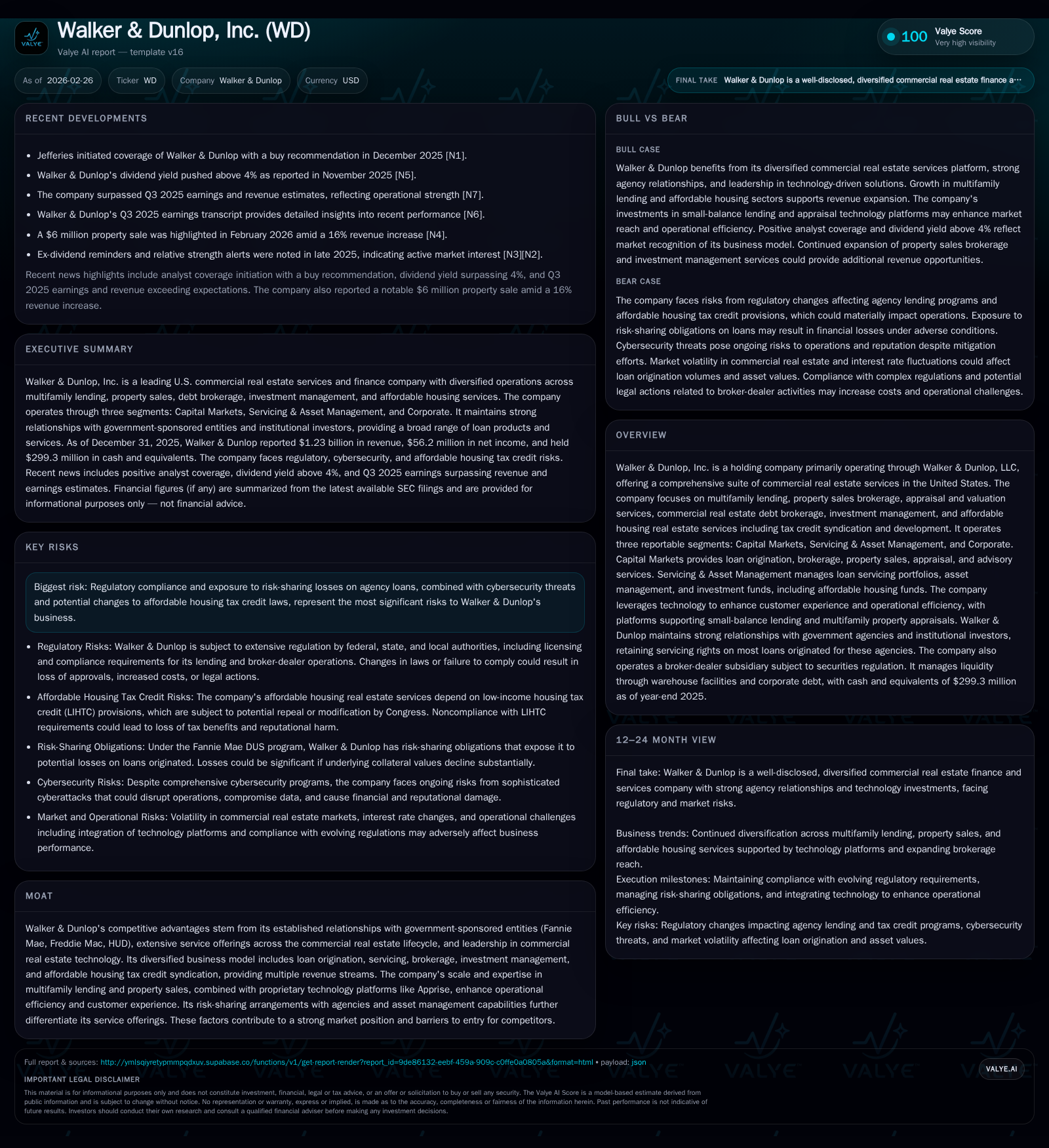
Walker & Dunlop, Inc. delivered 9% revenue growth in 2025 to $1.23 billion, supported by increased lending and property sales volumes. However, net income declined by nearly half to $56.2 million, reflecting margin compression and elevated expenses. Operating cash flow swung sharply negative to -$664 million, driven by higher loan origination volumes requiring substantial working capital alongside growing collateral requirements tied to risk-sharing loans with Fannie Mae. The company continues to benefit from deep agency relationships and diversified service offerings but faces risks from regulatory shifts, affordable housing tax credit uncertainties, and a challenging funding environment. Capital allocation remains disciplined with modest buybacks and a steady dividend payout.
Company Overview
Walker & Dunlop operates predominantly through its operating arm Walker & Dunlop, LLC, delivering a comprehensive spectrum of commercial real estate services across the U.S., focusing heavily on multifamily property finance. Its three main segments—Capital Markets, Servicing & Asset Management, and Corporate—comprehensively cover loan origination, property brokerage, servicing portfolios, asset management, tax credit syndication for affordable housing, appraisal services, and investment management.
The company has cemented its moat via entrenched relationships with government-sponsored entities like Fannie Mae and Freddie Mac, alongside HUD programs. This agency partnership combined with diversified revenue streams—ranging from loan origination to affordable housing development syndication—and key proprietary tech assets like their Apprise appraisal platform creates substantial entry barriers.
Historical Performance
Over the past four years leading into fiscal year 2025, Walker & Dunlop showed somewhat volatile financial results reflective of cyclical commercial real estate markets:
Historical performance (annual)
| FY | Rev ($mm) | Net ($mm) | CFO ($mm) | Capex ($mm) | Rev YoY | Net YoY |
|---|---|---|---|---|---|---|
| 2025 | 1234 | 56 | -664 | 16 | +9.0% | -48.0% |
| 2024 | 1132 | 108 | 129 | 13 | +7.4% | +0.8% |
| 2023 | 1054 | 107 | -1 | 16 | -16.2% | -49.8% |
| 2022 | 1259 | 214 | 1583 | 22 |
Source: SEC companyfacts cache [F1].
Capital returns and efficiency (annual)
| FY | Div ($mm) | Buybacks ($mm) | FCF ($mm) |
|---|---|---|---|
| 2025 | 92 | 10 | -680 |
| 2024 | 89 | 12 | 116 |
| 2023 | 85 | 21 | -17 |
| 2022 | 80 | 42 | 1561 |
Source: SEC companyfacts cache [F1].
The recent year marks a rebound in top-line revenue after a transitionary dip in prior years with portfolio repositioning efforts but highlights significant profit margin pressure as net income nearly halved from the previous period [F1]. Operating cash flow turned negative as massive loan origination activities demand incremental working capital investment.
Drivers Behind Past Growth
Revenue gains were principally driven by increasing debt financing volume — $690 million principal lending in latest year versus $604 million prior — alongside a surge in multifamily property sales commissions which rose about a third due to higher transaction volumes [S24]. Investment banking services also made stronger contributions given elevated M&A activity in the sector [S18].
The operational mix expanded with an ongoing strategy to grow private client or small-balance multifamily lending—a segment characterized by high transaction volume but smaller individual loan sizes—which has benefited from strategic acquisitions improving data analytics and tech infrastructure [S16][S20].
However, heightened personnel costs—including commissions tied directly to origination fee growth—and increased severance expenses constrained margin expansion [S18]. Furthermore, risk-sharing provisions under the Fannie Mae DUS program require collateral postings that materially affect liquidity needs [S4][S7].
Future Growth Prospects
Walker & Dunlop's growth prospects remain closely tied to the U.S. multifamily real estate market's health and the scale of refinancing/refinance activity within government-sponsored entity programs:
- The company aims to capitalize on expansion opportunities in the small-balance lending space via its developing technology platforms such as Apprise and client segmentation strategies targeting private investors.
- Affordable housing services provide a niche diversification angle but depend heavily on continuity of low-income housing tax credit legislation; potential changes or repeal could significantly damage this revenue stream [S1].
- Ongoing improvements in brokerage capabilities across more diverse property types beyond traditional multifamily may bolster fee income.
- Rising interest rates or altered lending standards could constrain loan origination volumes or change risk appetite.
- Regulatory compliance complexity around risk-sharing losses on loans sold through agencies demands vigilance.
These considerations imply growth potential is moderate but subject to macro factors including credit conditions, agency policy adjustments, and legislative developments affecting LIHTC [N1][S1][S26].
Forecasts and Milestones
No explicit forward-looking guidance was offered for fiscal years beyond standard commentary; however:
- Management reauthorized a new share repurchase program permitting up to $75 million stock buybacks starting February 2026 [S6][S9], indicating confidence in capital structure flexibility.
- Dividend increases (Q1’26 dividend raised by ~1.5%) suggest an intent to maintain steady shareholder returns absent unforeseen disruption [S11].
- Monitoring loan origination volumes relative to Agency risk-sharing requirements will be key milestones given their impact on liquidity requirements.
- Progression of affordable housing fund equity under management will be important given their sensitivity to tax incentives [S25].
Returns and Capital Allocation
Walker & Dunlop’s approximate return on equity for FY2025 stands near 3.2%, down from substantially higher levels in prior years reflecting net income contraction amidst steady shareholder equity [$1.7 billion] [F1]. This underscores earnings challenges against strong book value.
Capital expenditure levels have been modest (~$16 million) focusing presumably on technology and operational infrastructure improvements while preserving cash flow.
Dividend payments totaled about $91.8 million with gradual quarterly increases sustained through early ’26 [S11]; buybacks remained minimal at $10 million amid excess capacity of authorized programs not substantially utilized during the reporting period [S6][F1].
Strong liquidity management is evident given compliance with all warehouse facility covenants and Agency operational reserves despite growth-related cash flow pressure [S4][S7][S13]. Future capital return levels will be governed by covenant restrictions tied to debt agreements and internal targets balancing reinvestment versus distributions.
Additional Observations: Risk Sharing Portfolio and Collateral Requirements
The sizeable growth of Walker & Dunlop’s risk-sharing servicing portfolio—hovering over $72 billion—complicates liquidity dynamics due to formula-driven collateral must-haves mandated by Fannie Mae DUS agreements which call for multi-month amortization of collateral for Tier-2 loans secured via Agency mortgage-backed securities or U.S Treasury holdings [S4][S5][S7]. These arrangements increase working capital usage materially during periods of rising origination.
Additionally, compliance failures related to affordable housing projects’ eligibility for LIHTC benefits carry reputational risks though direct liability rests elsewhere [S1]. Cybersecurity threats and evolving regulatory regimes pose persistent operational headaches.
Industry Context Analysis (non-company specific)
Commercial real estate finance intermediaries face ongoing margin pressures linked to compressed spreads amid rising interest rate volatility post-pandemic economic normalization coupled with changing borrower behavior favoring shorter-duration loans that match limited partner equity tenure well under ten years . Technological investments become critically important as firms seek efficiency gains across underwriting, servicing, asset management, and brokerage functions while tailoring products for smaller clients needing scalable platforms.
Balancing growth initiatives against risks inherent in syndicated affordable housing tax credits will be essential since federal tax policy remains fluid post recent legislative sessions.
Summary
Walker & Dunlop posted healthy top-line growth driven by multifamily lending strength complemented by diversified service offerings yet contended with meaningful net income contraction due largely to higher personnel costs, severance charges, collateral funding burdens related to its risk-sharing loan portfolio with agencies, and asset impairments incurred last year. Liquidity remains well-managed though challenged by increased working capital demands linked to escalated loan origination rates. Future prospects hinge on maintaining agency partnerships amidst regulatory flux while expanding small-balance lending segments through enhanced technological offerings such as Apprise. Shareholders receive steady dividends supported by conservative capital allocation policies allowing optionality on share repurchases. Risk areas center chiefly around dependency on LIHTC policies for affordable housing operations alongside cyber exposure inherent in tech-enabled financial services firms operating at scale.
This analysis is based exclusively on documented financial statements and official disclosures without offering any recommendation or price forecast.
Disclaimer: This is research-only, informational analysis and not investment advice. It may include AI-generated interpretation and general industry context. Always verify important details using primary sources.

Comments