
Weis Markets Confronts Margin Pressure and Rising Capex While Maintaining Steady Cash Flow
The regional supermarket operator reported declining profit margins and rising capital expenditures despite incremental sales growth in 2025.
Weis Markets, with its strong regional footprint and integrated supply chain, delivered modest top-line growth in 2025 but saw operating income decline by nearly 14% year-over-year due to higher labor and overhead costs. The company increased capital spending significantly to expand and remodel stores while generating solid operating cash flow that supported dividends and a sizable stock repurchase program. Going forward, key challenges include managing cost inflation, sustaining sales momentum amid competitive pressures, and executing strategic store expansions. Close monitoring of margins, employee costs, and efficient capital deployment will be critical for maintaining shareholder returns.
Company Overview
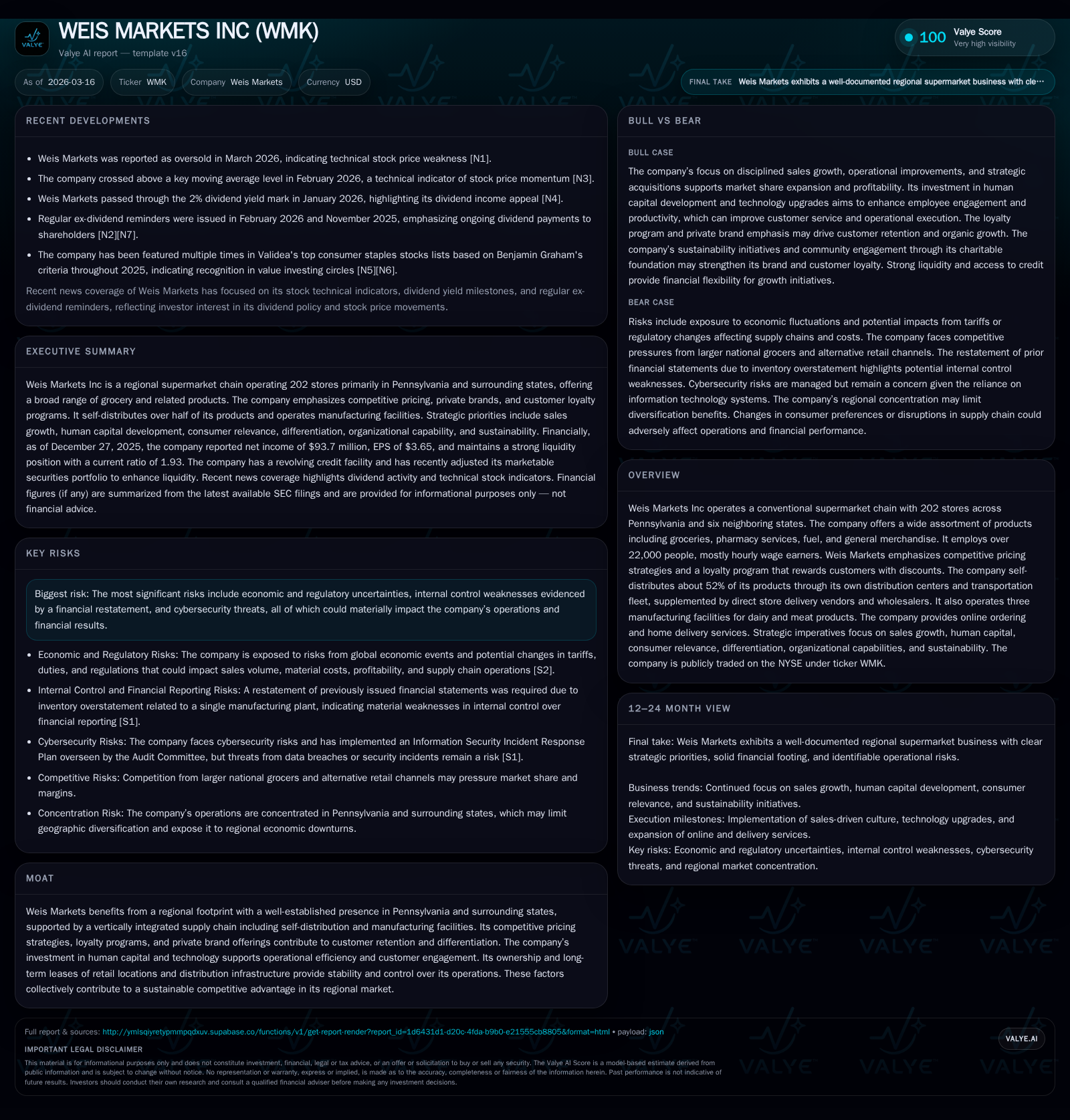
Weis Markets Inc is a regional supermarket chain operating 202 stores primarily across Pennsylvania and six contiguous states. Founded in Sunbury, Pennsylvania in 1912, Weis emphasizes a conventional grocery format offering groceries, pharmacy services, fuel stations, general merchandise, private label products, and online ordering with home delivery options available at nearly all locations. Approximately half of the product assortment is self-distributed through two large distribution centers complemented by third-party deliveries. The company also operates three manufacturing plants producing dairy items, water, ice cream, and fresh meats — underscoring a vertically integrated supply chain aimed at operational control.
Historical Performance
Weis has demonstrated steady revenue growth over recent years with total revenue rising from roughly $4.71 billion in fiscal year 2023 to about $4.94 billion in fiscal year 2025 ([F1]). This growth reflects an incremental organic lift alongside expansion through new store openings (four new stores added between 2024-2025) plus acquisition activity enhancing market presence ([S10], [S16]).
However, this topline progression masked some margin pressures resulting in compressing profitability trends. Operating income decreased from approximately $137 million in 2023 down to $114 million by the end of 2025 — a decline of more than 13% CAGR over two years ([F1]). Similarly, net income was lower at around $93.7 million in FY25 versus about $104 million two years prior.
This erosion relates to increased wage expenses from ongoing labor tightness affecting mostly hourly store employees — who represent the majority of Weis’ workforce of over 22,000 people — alongside heightened health insurance benefit costs and inflationary increases across utilities and maintenance ([S5], [S15]). For instance, direct store labor costs rose as a percentage of sales slightly by about 0.1 points year-over-year into 2025 with healthcare-related expenses adding further burdens.
Operating expenses also expanded due to depreciation charges reflecting investments in capital assets — driven partly by remodeling efforts — which now consume roughly 2.3% of net sales compared to under 2.2% prior periods ([F1], [S15]). Despite these cost headwinds limiting margins (operating margin slid from ~2.8% to ~2.3%), gross profit margins remained stable around 25.1%, helped by targeted merchandise category improvements.
Financial Summary (Annual)
Historical performance (annual)
| FY | Net ($mm) | CFO ($mm) | OpInc ($mm) | Capex ($mm) | Net YoY |
|---|---|---|---|---|---|
| 2025 | 94 | 207 | 114 | 202 | -14.8% |
| 2024 | 110 | 187 | 132 | 161 | +5.9% |
| 2023 | 104 | 202 | 137 | 104 | -17.1% |
| 2022 | 125 | 218 | 157 | 122 |
Source: SEC companyfacts cache [F1].
Capital returns and efficiency (annual)
| FY | Div ($mm) | FCF ($mm) | ROE% |
|---|---|---|---|
| 2025 | 35 | 5 | 6.9 |
| 2024 | 37 | 26 | 7.6 |
| 2023 | 37 | 98 | 7.6 |
| 2022 | 35 | 96 | 9.6 |
Source: SEC companyfacts cache [F1].
Note: Buybacks shown for FY25 only; none material for recent prior periods; dividends stable year-over-year at $1.36 per share equivalent.
Future Growth Prospects
Looking ahead into FY26 and beyond, Weis Markets plans continued emphasis on growing sales through both organic store expansion — including new store builds primarily in Maryland and Delaware — and opportunistic acquisitions ([S16]). The rollout of "Weis 2 Go Online" across nearly all stores supports e-commerce penetration paired with third-party delivery partners enhancing consumer accessibility.
Strategic priorities center on six imperatives: driving sales growth; human capital investment focused on talent development; bolstering consumer relevance through merchandising innovation; sharpening differentiation via private brands and pricing programs; enhancing organizational capabilities including technology upgrades; and advancing sustainability practices within operations ([N/A overview]).
Nevertheless, margin challenges loom if wage inflation intensifies or if supply chain disruptions raise input costs or erode competitive pricing flexibility ([S25]). Regulatory uncertainty regarding tariffs remains a watch point as it could affect suppliers’ cost structures directly impacting Weis’ product pricing ability ([S2]). Furthermore, cybersecurity vulnerabilities require ongoing management oversight given rising digital threats overseen by the board’s audit committee ([S1]).
Forecasts / Operational Milestones
The latest filings do not provide explicit forward guidance numbers nor formal milestone timelines beyond ongoing projects such as opening three new stores within Maryland plus one Delaware location during the past year ([S16]). Investors should monitor subsequent quarterly disclosures for updates on same-store sales trends post-COVID normalization effects as well as execution progress on Lowe price initiatives integrated into loyalty programs.
Capital expenditure plans remain robust with about $200 million spent annually aimed at remodeling existing units plus technology refreshes intended to improve efficiencies ([F1], [S18]). These investments are expected to continue supporting operational effectiveness although potential macroeconomic headwinds could delay discretionary expansion moves.
Returns / Capital Allocation
Return metrics reflect moderate profitability constrained by cost pressures; approximate return on equity based on latest net income divided by equity stood near an estimated ~6.9% for FY25 ([F1]). Operating cash flows improved modestly year-over-year by about +10%, reaching above $207 million—generating free cash flow after capex of roughly $5 million indicating tight but positive cash generation capacity.
Capital allocation has leaned heavily towards shareholder returns through an active stock repurchase program amounting to around $140 million shares repurchased during FY25 against no buybacks executed since early decade levels ([F1], [S26]). Dividend payments held steady at $35 million total with consistent payout levels maintained despite earnings softness reflecting prioritization of shareholder distributions.
Liquidity is strong with more than $117 million held in cash equivalents alongside short-term investments approximating $97 million largely invested in high-grade bonds providing near-term financial flexibility ([F1], [S11], [S14]). Revolving credit lines totaling up to $30 million plus discretionary extension rights further underpin available funding sources.
Industry Context & Competitive Positioning (Analysis)
The traditional supermarket segment remains intensely competitive with pressure from national chains expanding discount formats alongside emerging roles for e-commerce giants encroaching on grocery sales distribution channels via digital platforms and partnerships.
Regional players like Weis attempt differentiation through local market knowledge augmented by vertically integrated supply chains lowering input volatility risk relative to pure retailer models reliant solely on wholesalers or third parties for inventory fulfillment.
Weis' investment in own manufacturing units producing perishable goods such as dairy/meats indicates a strategic positioning enabling fresher products with cost control advantages versus competitors outsourcing all perishables—critical segments given margin sensitivities there.
The ongoing focus on loyalty programs incorporating fuel discounts plus community-centric pricing strategies helps sustain customer stickiness amid aggressive couponing wars prevalent among comparable regional grocers.
Risks Highlighted by Management
- Economic fluctuations unpredictable impacts consumer spending patterns impacting volume/mix.
- Regulatory changes including tariff regimes introduce unpredictability in procurement costs posing margin pressure risks.[S2]
- Cybersecurity incidents pose data breach risks handled proactively but remain an area requiring constant vigilance.[S1]
- Previous financial restatements related to inventory valuation errors underline importance of robust internal controls especially within manufacturing facets.[S25]
- Labor market tightness creates wage inflation challenges balancing cost management with service expectations.[F1],[S15]
Summary
Weis Markets navigates moderate growth juxtaposed against persistent margin pressures characteristic of regional supermarkets facing evolving consumer demands against cost inflation backdrops.[F1] The company’s strategy leverages vertical integration complemented by select geographic expansions combined with solid liquidity management allowing shareholder returns through dividends plus aggressive repurchases.[F1],[S26] Ongoing challenges include cost containment amid wage inflation risks plus sustaining competitive differentiation amid national discount rivals.[N/A overview][S29]
Stakeholders should monitor future earnings releases closely for trends around same-store sales growth sustainability alongside efficiency gains from capital projects driving long-term operating leverage potential.
This report is based solely on publicly available information as of March 16, 2026, including Weis Markets’ SEC filings and reputable news sources without any extrapolation beyond documented data points or non-public knowledge.
Disclaimer: This is research-only, informational analysis and not investment advice. It may include AI-generated interpretation and general industry context. Always verify important details using primary sources.

Comments