
W. R. Berkley Corporation's Growth Sustained by Decentralized Niche Underwriting and Strong Capital Discipline
Berkley leverages a decentralized model focused on niche markets to drive steady premium growth, supported by disciplined underwriting and robust capital management.
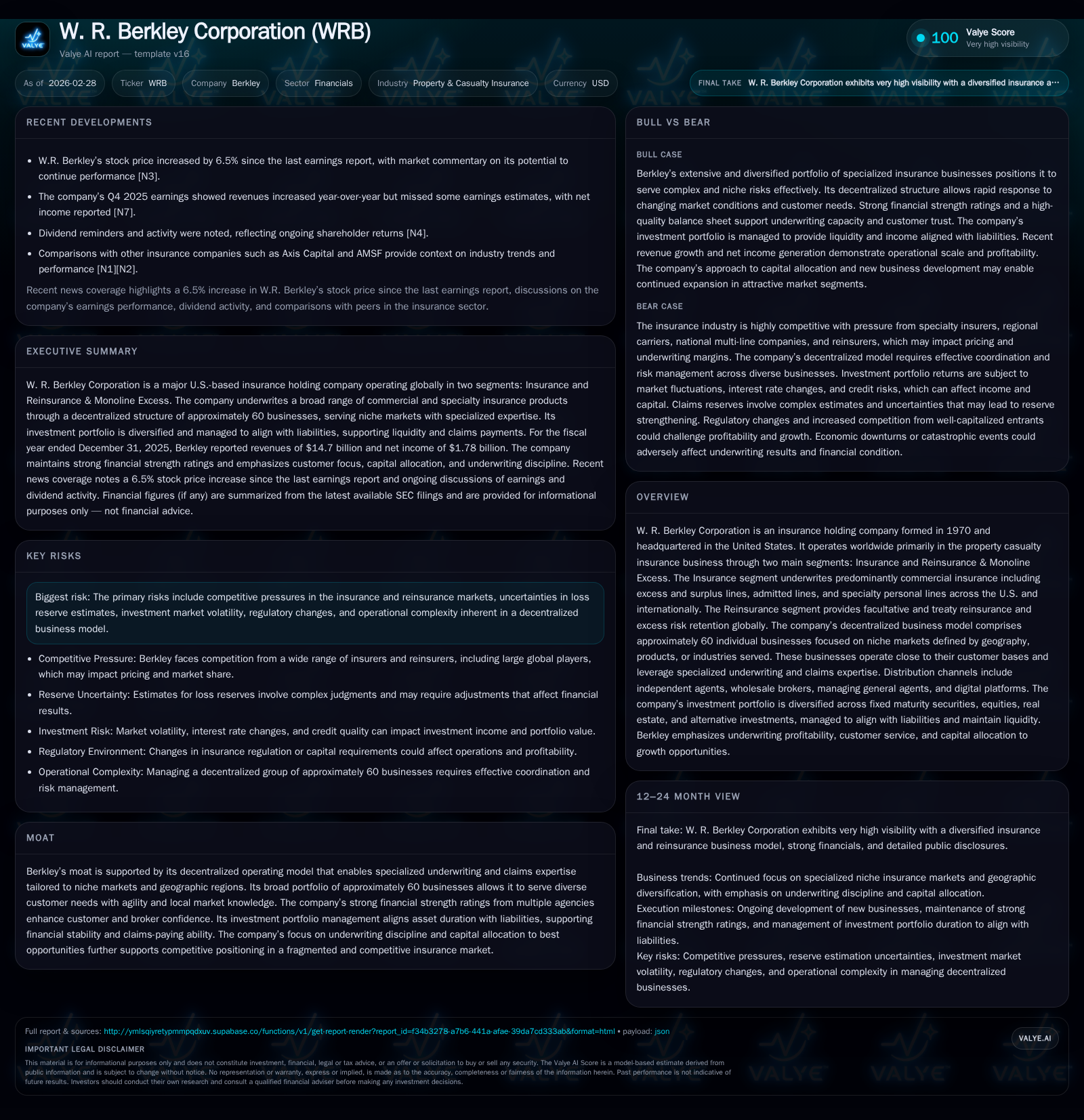
W. R. Berkley Corporation stands as a major player in commercial lines property casualty insurance and reinsurance with a unique decentralized structure enabling specialized, local market-driven underwriting. Over the past three years, Berkley has sustained premium and revenue growth driven by both organic expansion in targeted niches and geographic regions worldwide. Despite recent pressure from moderating insurance rate increases and competitive market dynamics, the company maintains underwriting discipline and prudent capital deployment, reflected in a strong equity base and continued share repurchases. Investors should monitor upcoming developments in loss reserves adequacy amid social inflation trends and evolving competition levels for insights into near-term profitability.
Company Overview and Business Model
W. R. Berkley Corporation is a leading insurance holding company specializing predominantly in U.S. commercial lines of property casualty insurance while also maintaining an international presence through its two principal operating segments: Insurance, and Reinsurance & Monoline Excess [S1][S17]. Since its founding in 1970, Berkley has developed a highly decentralized business model comprising about 60 individual companies serving narrowly defined niches by geography, product line, or customer industry sector [S1][S7][S18]. These autonomous entities operate close to their customer bases allowing for specialized underwriting expertise and agile local responses. At the same time, the group benefits from centralized capital management, reinsurance strategies, actuarial support, financial controls, and compliance oversight [S1]. This combination fosters nimble risk selection while maintaining financial discipline.
The company underwrites a broad set of coverages—excess and surplus lines, admitted lines commercial insurance, specialty personal lines through the Insurance segment—and offers facultative and treaty reinsurance globally plus monoline excess risk retention via its Reinsurance segment [S1][S7][S8]. Distribution channels primarily involve independent agents and brokers domestically with Lloyd’s syndicate participation internationally [S1][S17]. The company’s market presence extends across the United States including regional platforms (e.g., Acadia Insurance in New England, Berkley Southeast), complemented by operations in Asia Pacific, Canada, Europe, Latin America, Scandinavia and Australia [S7][S14].
Historical Growth & Performance
Between fiscal years 2023 and 2025, Berkley demonstrated consistent growth in net premiums written (NPW), total revenue, and net income (see Table below). NPW increased from approximately $10.95 billion to $12.71 billion—an effective compounded annual growth rate of around 7.8%, driven mainly by expansion within the core Insurance segment which accounted for nearly 88% of premiums in each year [S18][F1]. The Reinsurance & Monoline Excess segment showed modest but consistent premium growth as well.
Revenue followed similar upward trajectory growing roughly 7.8% year-over-year to $14.7 billion in FY2025 [F1]. Net income advanced more modestly (+1.3%) to just under $1.78 billion as elevated claims severity partly offset premium gains amid competitive pricing conditions impacted by moderating rate increases across many property casualty lines [F1][S9]. Operating cash flow remained robust at over $3.58 billion but slightly decreased relative to prior year reflecting increased claims payments partially offset by stronger premium collections [F1][S10]. Capital expenditures stayed relatively low as typical for an insurance company focused on underwriting rather than heavy capital investment.
Historical performance (annual)
| FY | Rev ($bn) | Net ($mm) | CFO ($bn) | Rev YoY | Net YoY |
|---|---|---|---|---|---|
| 2025 | 14.7 | 1779 | 3.6 | +7.8% | +1.3% |
| 2024 | 13.6 | 1756 | 3.7 | +12.3% | +27.1% |
| 2023 | 12.1 | 1381 | 2.9 | ||
| 2020 | 11.2 | 1381 | 2.6 |
Source: SEC companyfacts cache [F1].
Capital returns and efficiency (annual)
| FY | Div ($mm) | Buybacks ($mm) | ROE% |
|---|---|---|---|
| 2025 | 700 | 270 | 18.3 |
| 2024 | 532 | 304 | 20.9 |
| 2023 | 501 | 537 | 18.5 |
| 2020 | 235 | 94 | 20.5 |
Source: SEC companyfacts cache [F1].
Note: Revenue YoY calculated versus prior year; Buybacks reflect share repurchase cost.
The company’s equity base grew significantly reaching nearly $9.7 billion by end-2025 up from $7.46 billion just two years prior—a reflection of retained earnings accumulation along with measured share buyback programs [F1][S13]. This translates into an approximate trailing ROE near an attractive ~18%, indicating effective utilization of shareholder equity combined with disciplined risk selection [F1].
Drivers Behind Past Growth
Berkley's historical top-line growth has hinged upon several pillars:
- Its decentralized footprint enables nimble entry into underserved or specialized niches such as technology E&O coverage (Berkley Technology Underwriters), transportation (Carolina Casualty), environmental risks (Berkley Specialty Excess), or professional liability for small-to-mid sized firms (Berkley Select) [S17][S21].
- Geographic diversification across U.S., Europe, Asia-Pacific regions limits exposure to any single economic cycle or catastrophe event.
- Strong underwriting discipline which looks to price for profit rather than mere volume growth remains part of corporate culture preventing erosion of margins even when insured markets soften [S1][S9].
- Targeted acquisitions have supplemented organic expansion; although internal start-ups represent most businesses (53 out of ~60 entities), select tuck-in acquisitions broadened product suites or filled coverage gaps.
Future Growth Prospects
Looking forward, Berkley's growth will likely continue being propelled by its ability to identify specialized insurance needs within segments experiencing rapid structural change — such as cybersecurity liability demand expansion following increased data breach incidents or program management business servicing niche commercial segments requiring bespoke policy structures [N3][S17]. Management has articulated intentions to create new businesses that capitalize on emerging opportunities when expert leadership is available—underscoring a continuous pipeline approach rather than passive market participation [S1].
Geographically expanding further into growing Asia-Pacific or Latin American markets where insurance penetration remains below U.S./Europe norms provides avenues for incremental premium gains without excessive price competition pressure seen domestically [S18][N3]. In addition, ongoing innovation in risk analytics leveraging data and technology platforms (evident through offerings like Berkley Small Business Solutions) may improve balance sheet profitability over time by enhancing risk selection [S17].
However, several factors could cap near-term growth:
- Moderation or retreat in current commercial property rates due to competitive supply dynamics challenges volume-based premium expansion.
- Higher claim frequency/severity driven by social inflation trends (increased litigation costs/settlements) or natural catastrophe frequency could suppress underwriting margins if not matched by adequate rate hikes [S9][N20].
- Regulatory shifts both domestically (e.g., state-level admissibility rules) and abroad could increase compliance costs or reduce flexibility.
- Intense competition particularly from large reinsurers or well-capitalized entrants using alternative distribution models (“insurtech”) intensifies price pressure risks [S5][N13].
Investors should watch for updates on loss reserve developments as changes might materially affect earnings given undiscounted claim liabilities exceeding $22 billion reported for FY2025 [S9]. Claims litigation environment particularly regarding mass tort exposures remains an area of uncertainty requiring close monitoring of reserve adequacy disclosures.
Forecasts & Milestones
While explicit forward guidance has not been detailed publicly beyond general strategic statements [N3], key near-term milestones include:
- Monitoring quarterly results for loss ratio trends reflecting claims inflation impacts.
- Tracking premium renewal rates especially within excess/surplus lines critical for maintaining book quality.
- Observing regulatory developments affecting allowed rates or reserving requirements.
- Outcomes from pending litigation recoupment efforts such as the lawsuit filed against reinsurers related to event cancellation losses (~$90 million claim)—resolution could impact reserve assumptions but is unlikely material overall [S12].
Analysts will also gauge operational efficiency given some softening top-line momentum amid market capacity easing indicated by recent industry reports other insurers also face challenging pricing environments [N6][N10].
Returns & Capital Allocation
The company’s capital allocation strategy balances return generation with shareholder returns:
- ROE approximated at about 18% demonstrates solid underlying profitability supported by high-quality underwriting returns combined with disciplined investment yields on a portfolio largely composed (~83%) of liquid fixed maturities aligned in duration to liabilities minimizing asset-liability mismatch risks [F1][S4][S6].[F1]
- Operating cash flow exceeded $3.5 billion in FY2025 while capex remained minimal (<0.05% of revenues extrapolated), resulting in free cash flow availability above $3.5 billion providing robust funding capacity for ongoing operations plus external capital returns.
- The Board declared total dividends aggregating about $700 million during FY2025 including special dividends alongside regular quarterly payouts indicating strong cash return commitment to shareholders alongside capital preservation priorities [F1][S13].
- Share repurchases totaled approximately $270 million in FY2025 continuing a multi-year pattern designed to enhance per-share economics while maintaining balance sheet strength evident through manageable leverage levels estimated around ~23% debt-to-total capitalization as of Dec ‘25 [F1][S19][S22].
This balanced approach underscores governance focus on sustaining long-term value creation versus short-term return maximization especially pertinent amid cyclical insurance market conditions.
Competitive Position & Moat Considerations
Berkley’s competitive moat arises from:
- Its decentralized architecture which enables precise tailoring of underwriting strategies locally unlike less nimble insurers managing centrally controlled portfolios lacking regional nuances.
- The breadth of specialty niche businesses collectively reduces reliance on any single product or geography while increasing cross-selling opportunities within complex enterprise accounts.
- Investment grade financial strength ratings (A+ by AM Best among others) underpin customer trust essential for markets relying on carrier solvency reliability particularly reinsurance buyers seeking highly rated counterparties.[S11]
- Capital discipline combined with sophisticated risk management practices mitigate adverse deviations common in property casualty cycles bolstering resilience during soft market phases.[S26]
At the same time competition is intense ranging from large integrated global reinsurers—Swiss Re, Munich Re—to emerging insurtech disruptors leveraging automation potentially lowering acquisition costs creating margin pressures.[S5][N13]
Risks Summary
Key risks highlighted include:
- Pricing environment uncertainty amid persistent softening or uneven rate recoveries particularly within property lines plus workers’ comp segments impacting underwriting results.[S9]
- Challenges estimating ultimate loss reserves owing to claims development latency subject to social inflation influences judicial trends making actual liabilities volatile.[S9]
- Market volatility affecting investment portfolio returns though mitigated by duration matching strategies yet potential losses remain during credit spread shocks.[S4]
- Regulatory complexities spanning multiple jurisdictions increasing administrative burden and limiting operational flexibility.[S16]
- Operational risks inherent to managing numerous semi-autonomous businesses requiring uniform culture commitment despite decentralization.[N3]
Monitoring developments against these backdrops remains critical for evaluating fundamental business health going forward.
This analysis presents factual observations drawn from Berkley's regulatory filings and documented industry context without provision of investment recommendations or price targets.
Disclaimer: This is research-only, informational analysis and not investment advice. It may include AI-generated interpretation and general industry context. Always verify important details using primary sources.

Comments