
Waterstone Financial Leverages Community Roots and Mortgage Scale to Drive 2025 Profit Surge
Robust loan portfolio focus and mortgage origination scale underpin Waterstone Financial's improved earnings and capital returns in 2025.
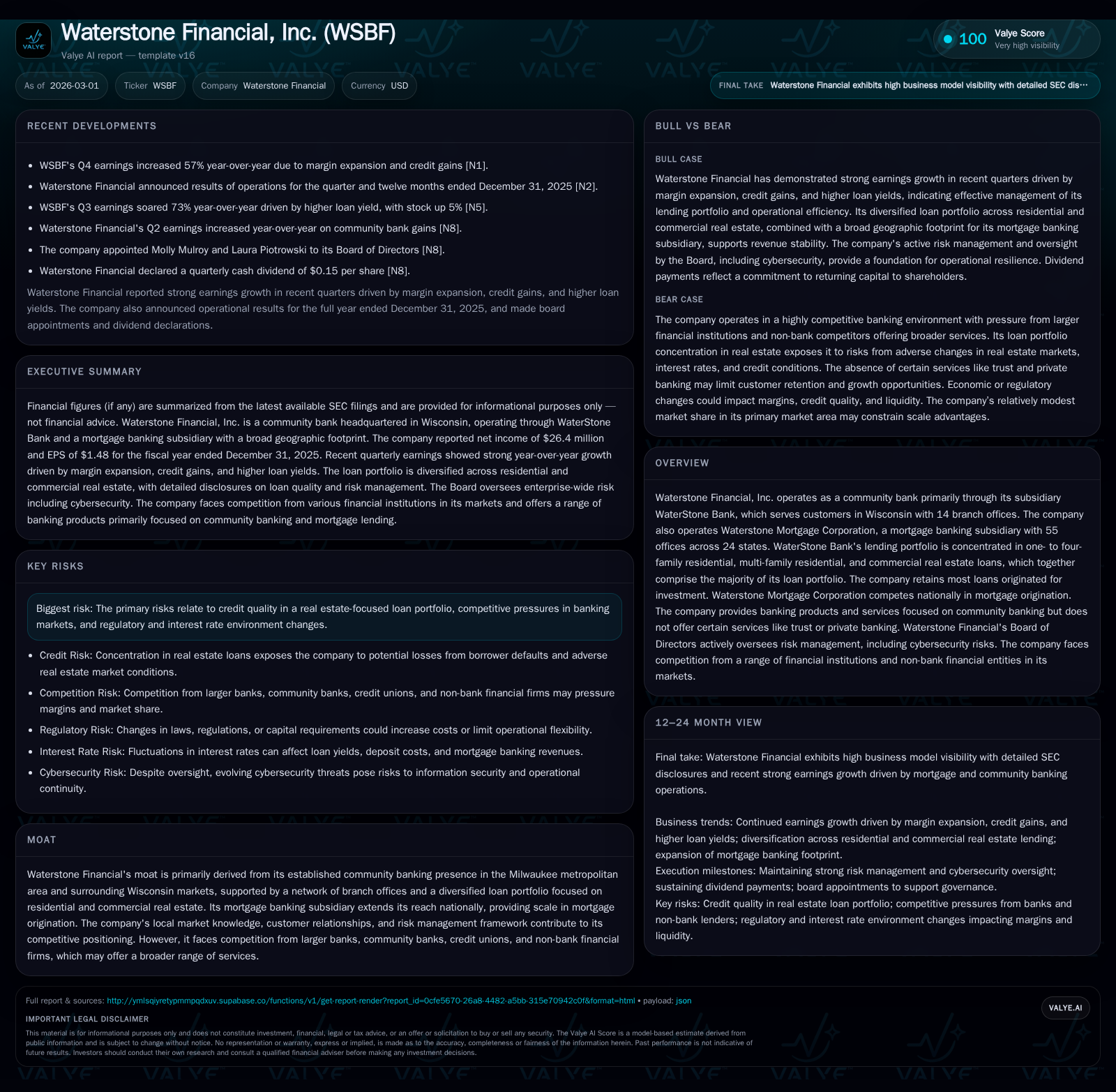
Waterstone Financial, through its subsidiary WaterStone Bank, maintains a concentrated loan portfolio heavily weighted toward residential and commercial real estate in Wisconsin, complemented by a mortgage banking arm with national reach. In 2025, the company achieved a 41% increase in net income driven by margin expansion and improved credit performance. Despite softer operating cash flow relative to 2024, Waterstone sustained steady capital allocation, including dividends and share buybacks. Key risks stem from credit quality sensitivity to real estate exposure and competition from larger banks and fintech entrants.
Company Overview and Moat
Waterstone Financial, Inc. operates principally through WaterStone Bank, a community bank rooted in Wisconsin markets since 1921, serving customers via 14 branches within the Milwaukee metropolitan area and surrounding counties [S1]. The core lending portfolio at WaterStone Bank is specialized: approximately one- to four-family residential mortgages form about 29% of loans; multi-family residential loans represent nearly half (45%), while commercial real estate accounts for roughly 20%. This concentration reflects a niche expertise in real estate financing within its regional footprint [S16].
Complementing this localized banking business is Waterstone Mortgage Corporation, a mortgage banking subsidiary with a much wider national presence—55 offices spread over 24 states—focusing exclusively on mortgage loan origination primarily for sale into secondary markets [S16]. This dual structure blends deep community knowledge with scale economies in mortgage origination.
Waterstone’s moat derives largely from its established local deposit franchise combined with its focused lending expertise in Wisconsin's real estate market. Its mortgage banking operations benefit from broad geographic reach yet face intense competition from both traditional financial institutions and non-bank lenders that leverage digital platforms heavily. The company does not offer trust or private banking services, which limits revenue diversification but emphasizes its community-focused brand.
Historical Performance and Growth Drivers
Waterstone’s financial results reveal solid profitability improvements over recent years despite operating challenges facing many regional banks.
Historical performance (annual)
| FY | Net ($mm) | CFO ($mm) | Capex ($) | Net YoY |
|---|---|---|---|---|
| 2025 | 26 | 24 | 1165000 | +41.3% |
| 2024 | 19 | 48 | 1099000 | +99.3% |
| 2023 | 9 | -28 | 700000 | -51.9% |
| 2022 | 19 | 207 | 701000 |
Source: SEC companyfacts cache [F1].
Capital returns and efficiency (annual)
| FY | Div ($mm) | Buybacks ($mm) | FCF ($mm) |
|---|---|---|---|
| 2025 | 11 | 16 | 23 |
| 2024 | 11 | 15 | 47 |
| 2023 | 15 | 26 | -28 |
| 2022 | 30 | 48 | 206 |
Source: SEC companyfacts cache [F1].
Source: [F1] financials; the large swings in operating cash flow reflect timing differences common in banking operations related to deposits and loan portfolios.
The jump in net income in recent years culminated with $26.4 million reported for FY2025, up an impressive 41% from $18.7 million the prior year [F1]. This was driven by notable margin expansion as well as credit gains linked to disciplined underwriting and selective loan portfolio growth [N1]. Operating cash flow softened almost 50% relative to a strong base in 2024 but remained positive at $24 million after accounting for modest capex expenditure near $1.16 million.
Portfolio Composition Nuances
The largest portion of WaterStone’s lending portfolio remains its multi-family residential segment at around $758 million or 45% of total loans held for investment at year-end 2025 [S16]. One- to four-family loans comprise about $486 million or nearly one-third of loans, while commercial real estate completes the bulk at approximately $327 million.
Smaller loan categories include construction and land development ($56 million), home equity ($13 million), and commercial business loans ($33 million) [S16]. This concentration reflects careful risk segmentation emphasizing collateralized real estate credit exposure mainly aligned with Wisconsin markets.
Credit quality metrics indicate manageable non-accrual loans reflective of industry norms without significant impairment trends [S14][S25], albeit ongoing vigilance remains vital given cyclical risks inherent to real estate lending.
Mortgage Banking Subsidiary Expansion
Waterstone Mortgage Corporation complements the core bank by competing nationally in mortgage origination facilitated through a distributed office network spanning diverse U.S. states including Florida, Texas, New Mexico, Arizona, Virginia, among others totaling 55 offices across 24 states as of December 31, 2025 [S16].
In aggregate, this unit originated approximately $2 billion in loans held for sale during the year—critical to driving fee revenue independent from the core loan portfolio retained by the bank [S16]. Funding largely relies on secured lines of credit from WaterStone Bank itself supplemented by additional financial institution borrowing lines as needed.
This scale positions Waterstone advantageously amid rising digitization pressure on mortgage origination markets, albeit competitive dynamics persist from both non-bank lenders such as Rocket Mortgage alongside traditional commercial banks that have widened service offerings beyond regional footprints.
Returns and Capital Allocation
Waterstone reported approximate return on equity around 7.6% for FY2025 based on net income relative to shareholders' equity totaling $349 million at year-end—a reasonable level within the context of community banking standards balancing growth against capital preservation demands [F1].
Capital allocation remained active:
- Dividends paid totaled about $10.8 million during fiscal year 2025, down slightly from prior years but consistent with steady shareholder distributions.
- Share repurchases amounted to approximately $16.2 million reflecting opportunistic capital return under current regulatory frameworks allowing flexible buyback programs post-pandemic liquidity conservatism [F1].
Capex expenditures maintained modest upward trend aligned mainly with branch upgrades and technology investments supporting cybersecurity protocols overseen directly by the Board through dedicated committees emphasizing information security risk controls [S1].
Risk Considerations
Key risks inherent to Waterstone’s profile revolve primarily around credit exposure tied closely to Wisconsin’s real estate market cycles where substantial portions of its portfolio reside—multi-family and residential concentrations render it sensitive to downturns or unexpected valuation declines.
Interest rate fluctuations remain a factor impacting net interest margins as well as secondary market conditions affecting mortgage banking revenue streams; tightening regulatory requirements could impose further compliance costs or capital demands restricting aggressive balance sheet expansion plans [S25][S29].
Competition includes both large entrenched banks commanding more diversified service lines—such as trust or private banking products not offered by Waterstone—and nimble fintech entrants competing vigorously in mortgage origination channels nationally leveraging technology-based underwriting models outside traditional branch networks [N2][S22].
Cybersecurity remains a heightened risk vector given expanding digital footprints; however, proactive board-level oversight provides governance assurance mitigating incident impact potentials [S1].
Outlook Analysis
Explicit forward guidance has not been provided beyond reporting milestones related to quarterly earnings releases for Q4 2025 highlighting margin improvements and credit performance strength [N1][N2].
Going forward:
- Sustaining robust mortgage origination volumes nationally will be critical to offset any softness locally.
- Maintaining underwriting discipline protecting credit quality is paramount amid economic uncertainties including inflationary cost pressures and potential softening housing demand.
- Effective capital management balancing shareholder returns against buffer buildup ahead of possible regulatory shifts will require continual monitoring.
- Incremental technology investments centered on cybersecurity defenses bolster resilience against evolving threats impacting operational continuity.
Industry context suggests that community banks like Waterstone face strategic choices between geographic specialization versus breadth expansion possibly via acquisitions or partnerships—a factor not explicitly addressed but relevant to watch for potential strategic developments.
Conclusion
Waterstone Financial exemplifies a hybrid model blending localized community banking intensity focused on real estate lending within Wisconsin alongside a growing national mortgage banking operation broadening its earnings base through scale effects. The significant jump in profitability realized in 2025 underscores effective management actions driving margin enhancement alongside credit asset quality improvements despite headwinds affecting cash flows. Active capital returns via dividends and buybacks reflect confidence supported by a solid equity foundation combined with prudent liquidity management detailed extensively within regulatory disclosures. Nonetheless, concentration risks rooted in real estate credits coupled with intensifying competition mandate vigilant monitoring especially as economic cycles evolve. Taken together, Waterstone remains positioned as a niche player leveraging differentiated strengths but navigating challenges typical for mid-sized financial institutions operating across increasingly complex industry dynamics.
Disclaimer: This analysis summarizes public financial disclosures including SEC filings and recent news reports without providing investment advice or specific recommendations.
Disclaimer: This is research-only, informational analysis and not investment advice. It may include AI-generated interpretation and general industry context. Always verify important details using primary sources.

Comments