
Wolverine World Wide’s Turnaround: From Losses to Profitability and Capital Efficiency
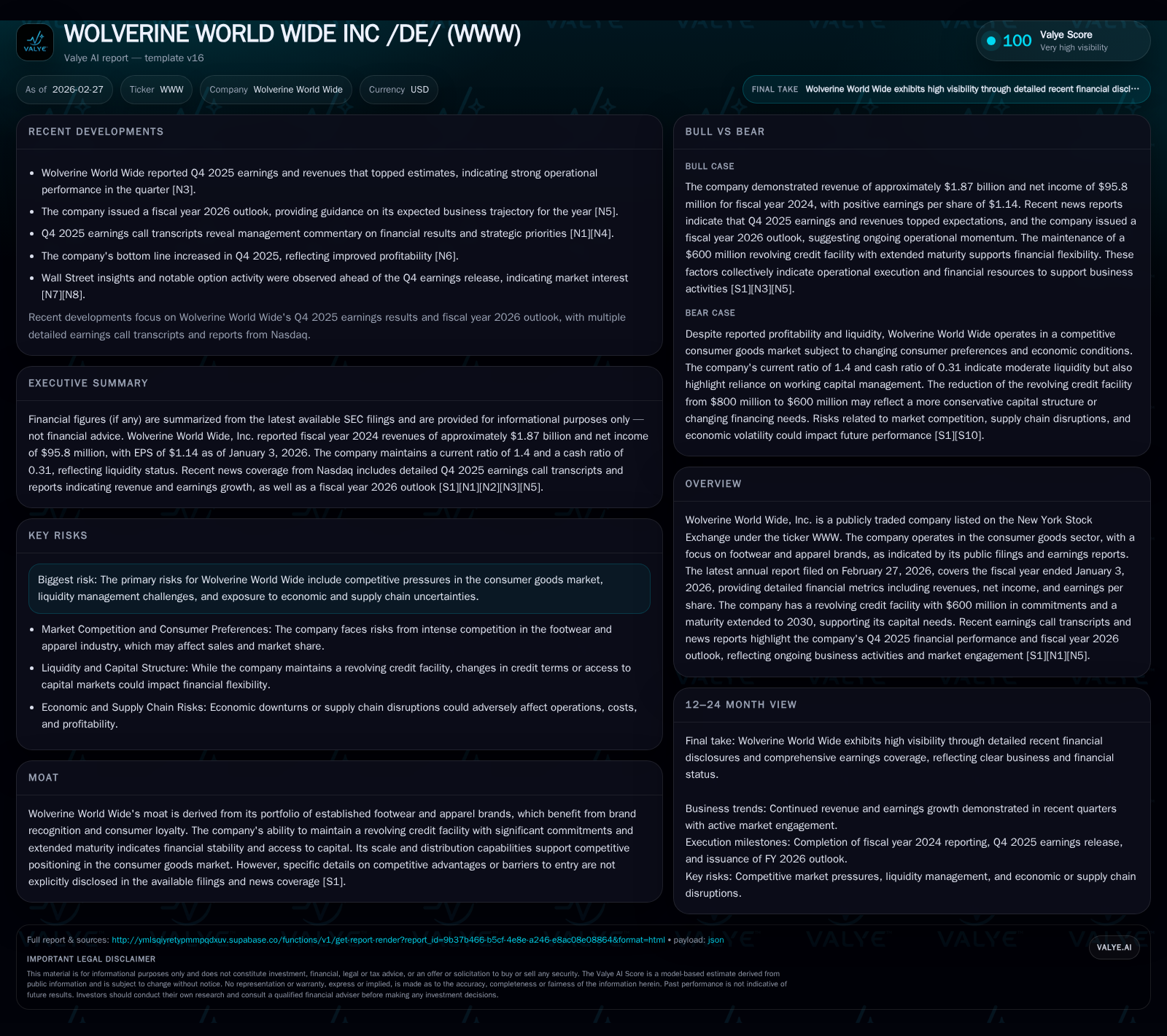
Wolverine World Wide reversed substantial operating losses in FY2023 and FY2022, achieving improved profitability and cash flow despite declining revenue.
The company faced revenue declines from FY2022 through FY2024 but notably swung operating income from negative $208M in FY2022 to positive $150M in FY2024, reflecting effective cost management and operational adjustments. Liquidity remains stable with a renewed $600 million revolving credit facility maturing in 2030, enhancing financial flexibility. Capital returns continue through dividends and modest buybacks amid improving free cash flow generation. The outlook for FY2026 emphasizes cautious growth amid competitive pressures and supply chain risks balanced against strong brand equity.
Historical Financial Performance and Key Growth Drivers
Wolverine World Wide's recent financial profile reveals significant volatility driven largely by macroeconomic headwinds impacting its footwear and apparel segments. Revenue declined consecutively from $2.68 billion in FY2022 to $1.87 billion in FY2024, marking a combined shrinkage of roughly 30% over two years [F1]. The sharpest single-year drop was -16.4% from FY2023 to FY2024, underscoring shrinking consumer demand or competitive pressures.
However, beneath this revenue contraction lies a notable recovery trajectory on profitability measures. Operating income swung dramatically from a heavy loss of $208.4 million (FY2022) to positive $150.2 million (FY2024), reversing a multi-year downward trend and reaffirming management's emphasis on cost control and operational efficiency [F1]. Net income mirrored this reversal with a move from losses exceeding $188 million to earnings near $96 million.
Operating cash flow also improved commensurately; after a negative outflow of $178.9 million in FY2022, fiercer cash discipline fostered positive cash generation reaching approximately $140 million by FY2024—a nearly 15% increase over the prior fiscal year. This improvement enabled the company to sustain moderate capital expenditures around $15 million annually despite shrinking sales volumes.
Historical performance (annual)
| FY | Rev ($bn) | Net ($mm) | CFO ($mm) | OpInc ($mm) | Rev YoY | Net YoY |
|---|---|---|---|---|---|---|
| 2024 | 1.9 | 96 | 140 | 150 | -16.4% | +341.9% |
| 2023 | 2.2 | -40 | 122 | -68 | -16.5% | +79.0% |
| 2022 | 2.7 | -188 | -179 | -208 | +11.2% | -374.5% |
| 2021 | 2.4 | 69 | 87 | 156 |
Source: SEC companyfacts cache [F1].
Capital returns and efficiency (annual)
| FY | Div ($mm) | Buybacks ($mm) | FCF ($mm) |
|---|---|---|---|
| 2024 | 33 | 15 | 126 |
| 2023 | 33 | 0 | 107 |
| 2022 | 33 | 81 | -215 |
| 2021 | 34 | 40 | 69 |
Source: SEC companyfacts cache [F1].
Table: Wolverine World Wide Historical Financial Summary (FY2021–FY2024) [F1]
Pivotal Factors Behind the FY2024 Profit Rebound
The operational turnaround in FY2024 hinged largely on stringent expense management alongside portfolio adjustments noted during the Q4 earnings call [N1][S3]. The company highlighted improvements in gross margins supported by selective price realization strategies despite volume pressures.
SG&A expenses were consciously optimized through workforce rationalizations and tightened marketing spend without diluting brand impact—an approach cited as critical for restoring profitability after multi-year losses [N1]. Enhanced supply chain efficiencies also contributed by reducing inventory holding costs—a subtle yet meaningful margin lever in footwear retailing.
Alongside base business improvements, incremental benefits emerged from divestitures or reduced underperforming product lines, allowing Wolverine to allocate resources toward higher-margin core brands with loyal consumer followings [S1][N1]. Margins expanded sufficiently to offset the ongoing top-line contraction.
Revenue Contraction: Challenges in Consumer Goods Footwear and Apparel
Despite operational advances, the company’s top line reflected persistent headwinds stemming from evolving consumer preferences, increased competition both online and offline, and macroeconomic uncertainties dampening discretionary spending [S1][N2]. Market commentators emphasized shifting trends toward athleisure disrupting traditional footwear channels impacting companies like Wolverine [N3].
In addition, channel mix shifts complicated inventory management—balancing wholesale partners' demand fluctuations against direct-to-consumer initiatives posed execution complexities [S1]. The footwear industry’s cyclical nature compounded these challenges as seasonal demand softened amid inflationary pressures.
Liquidity Position and Credit Facility Renewal
On the liquidity front, Wolverine showed deliberate prudence by amending its credit arrangements during calendar year 2025, reducing its revolving credit commitments from $800 million to $600 million but extending maturity until September 2030 [S5][S9][S10]. This refinancing removed term loan A exposure while ensuring ample financial flexibility amid volatile earnings.
The interest margin on borrowings now ties dynamically to net leverage ratios, ranging from roughly 0.25% to 1.25% over base rates or SOFR-based benchmarks—typical for investment-grade consumer goods firms managing debt service efficiently under sector norms [S9]. Commitment fees for undrawn portions also scale within conservative curves ensuring cost-effective standby liquidity.
Current assets exceeding current liabilities—$729 million vs. $521 million respectively—yield a healthy current ratio near 1.4 indicating solid short-term solvency at fiscal year-end January 2026 [F1]. Such liquidity stability supports ongoing working capital needs critical given supply chain complexity.
Capital Allocation: Dividends, Buybacks, and Cash Flow Generation
Post-turnaround capital allocation reflects balance between rewarding shareholders and preserving financial agility. Dividends remained consistent near $33 million annually throughout the downturn into recovery [F1][S19], signaling management’s commitment to steady income streams despite episodic earnings swings.
Stock buybacks reinitiated modestly with about $14.5 million repurchased during FY2024 after a hiatus since prior years where repurchases peaked at over $81 million in FY2022 before suspension amid losses [F1]. This cautious resumption aligns with prudent capital deployment given ongoing top-line uncertainty.
Free cash flow, approximated as operating cash flow less capital expenditures (~$125.5 million), supports sustainable dividend coverage while enabling selective reinvestment opportunities without reliance on external funding sources [F1]. Return on equity measured roughly at 23.5% by year-end underscores enhanced shareholder value creation efficacy post-turnaround.
FY2026 Outlook and Market Expectations
Public statements surrounding fiscal year 2026 project revenue growth remaining challenged against competitive market backdrops but with margin stabilization anticipated due to ongoing operational efficiencies [N8][N5][S3]. Analysts highlight monitoring comparable store sales trends alongside SG&A leverage as key cues for validating sustainable recovery paths.
Absent precise numeric guidance in filings or press releases, watchpoints include inventory turnover rates impacted by channel shifts, foreign exchange volatility effects on sourcing costs, and strategic brand investments offsetting structural demand changes [N8].
Risks Amplified by Competitive Pressures and Supply Chain Dynamics
Wolverine's risk landscape remains multifaceted with intensifying peer competition threatening market share within athletic and casual segments [S1][N1]. Supply chain disruptions coupled with component scarcity pose inventory management risks that can erode margin gains if unmitigated [S6].
Liquidity management continues under scrutiny given fluctuations in net income affecting covenant thresholds tied to credit agreements—debt service burden requires careful balancing as interest costs adjust dynamically per leverage metrics [S4][S9]. Channel mix evolution also introduces complexity in forecasting demand accurately which could magnify write-down risks or promotional pressures [S1][S6].
Strategic Brand Leverage as a Moat in an Evolving Retail Landscape
Despite external headwinds, Wolverine leverages its portfolio diversification across well-known footwear brands offering defensible market positioning through strong brand equity premiums [S1]. Consumer loyalty anchored via established distribution scale remains foundational moats protecting against new entrants.
Maintaining this advantage involves continuous innovation aligned with evolving lifestyle trends while executing disciplined cost frameworks enabling margin capture even amid revenue softness—a balancing act requiring precision across product development, marketing sophistication, and channel partnerships.
Disclaimer: This report is for informational purposes only; it does not constitute investment advice nor an offer or solicitation to buy or sell securities of Wolverine World Wide Inc. All data referenced are sourced directly from publicly filed documents without extrapolation beyond reported figures.
Disclaimer: This is research-only, informational analysis and not investment advice. It may include AI-generated interpretation and general industry context. Always verify important details using primary sources.

Comments