
X-Energy Advances Advanced Nuclear Tech Despite First-of-a-Kind Challenges
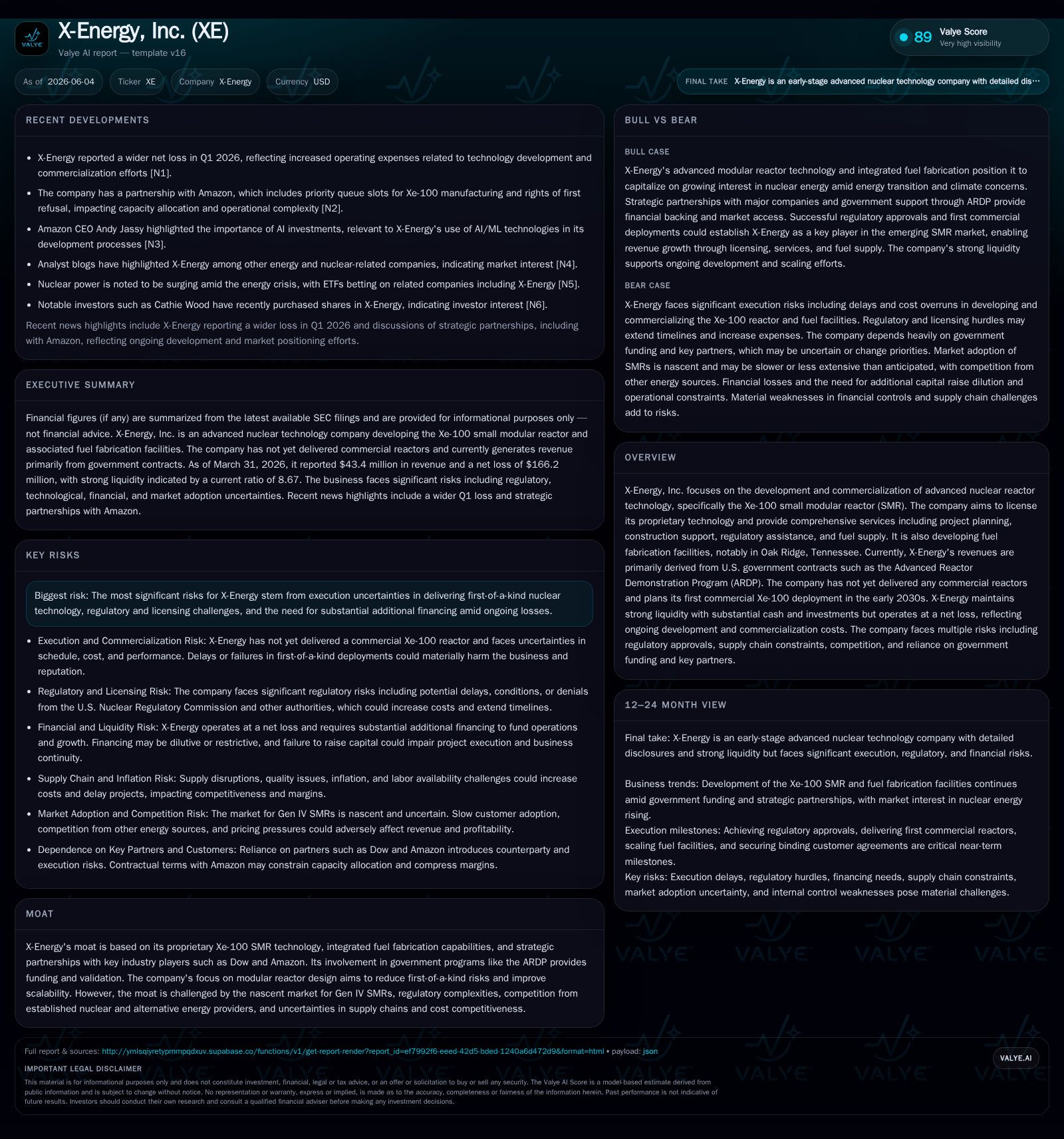
Q1 2026 results confirm robust government funding and liquidity while spotlighting the inherent complexities in scaling X-Energy's Xe-100 SMR technology and fuel services.
X-Energy’s latest quarterly filing reinforces its dependency on substantial U.S. government contracts, particularly the ARDP, as it continues advancing its proprietary Xe-100 small modular reactor technology and associated fuel fabrication infrastructure. Despite a wider operating loss reflecting ongoing R&D and development expenditures, the company maintains a strong balance sheet with over $224 million in cash and no debt, providing financial runway for near-term commercialization activities. However, execution risks tied to regulatory approvals, supply chain constraints—especially HALEU fuel availability—and first-of-a-kind deployment uncertainties remain significant hurdles. X-Energy’s integrated business model, combining reactor licensing with vertically integrated fuel services and strategic partnerships, positions it well within the nascent Gen IV SMR industry but requires careful navigation of regulatory timelines and cost management to achieve its early 2030s commercial ambitions.
Quarterly Operating Update: Progress and Challenges
X-Energy's Q1 2026 filings detail progress underpinned by steady revenues of approximately $43.4 million derived largely from the U.S. Department of Energy’s Advanced Reactor Demonstration Program (ARDP), demonstrating sustained government support critical for early-stage nuclear technology development [S2][F1]. However, the quarter also saw an operating loss expand to $66 million alongside a net loss surpassing $166 million, reflecting escalated investments in advanced nuclear research, design finalization efforts for the Xe-100 small modular reactor (SMR), and facility development including fuel fabrication capabilities [S2][F1].
Concurrent event filings disclosed no fundamental changes in program funding but reiterated ongoing risk areas such as regulatory approval timelines and supply-chain robustness [S3]. The company continues to emphasize milestones related to reactor design optimization coupled with preparatory work on its Oak Ridge fuel facility licensing [S2]. This combination underlines X-Energy's dual-track approach targeting both technology readiness and integrated fuel-cycle control necessary for commercial deployments.
X-Energy’s Business Model: Technology Licensing and Fuel Services
X-Energy generates revenue currently through cost-share government contracts like the ARDP but anticipates transitioning towards a licensing model where fees arise from intellectual property use in Xe-100 reactor construction alongside comprehensive project support services including regulatory navigation, construction supervision, procurement assistance, and long-term operations [S11]
A distinct competitive lever is the proprietary TRISO-X pebble fuel technology manufactured at dedicated facilities such as the Texas-based TX-1 plant near Oak Ridge [S2][S26]. By vertically integrating fuel production—a historically bottlenecked component in advanced nuclear supply chains—X-Energy aims to secure critical inputs like High-Assay Low-Enriched Uranium (HALEU) which remains scarce yet indispensable for Gen IV reactors [S12][S25]. This integration offers potential cost advantages and reliability over peer companies reliant on third-party fuel suppliers or less mature fuel designs.
The business model is capital intensive with significant R&D expenses driving negative margins presently; however, it is structured to leverage future economies of scale anticipated from Nth-of-a-kind deployments where repeatability should drive unit cost reductions [S20]. Strategic partnerships with major industrial players provide validation while potentially anchoring initial orders through priority allocations or rights of first refusal—mechanisms that support revenue visibility but impose operational discipline to deliver contracted capacity [S24].
Market Positioning in Advanced Nuclear Reactors
Operating in the fast-evolving Gen IV small modular reactor segment, X-Energy competes with other advanced nuclear developers who are similarly navigating unproven regulatory frameworks and emerging customer bases [S12]. The Xe-100's high-temperature gas-cooled pebble-bed design differentiates it technologically by promising operational safety enhancements and modular scalability compared with more traditional light-water reactors [S2].
The company's collaboration agreements with industrial heavyweights such as Dow Inc. serve as strategic endorsements enhancing credibility while fostering market pull through early-stage commitments [N1][S24]. Moreover, partnership alignments with firms like Amazon illustrate X-Energy's efforts to diversify its commercial engagement beyond utilities into broader industry sectors potentially seeking clean energy solutions.
Despite these advantages, the overall SMR market remains nascent with significant adoption barriers including complex NRC licensing processes, public perception biases around nuclear energy, unresolved spent fuel policy frameworks, and competitive pressures from renewables plus conventional nuclear incumbents [S16][S25]. Hence, X-Energy's moat resides largely in its integrated technical platform combined with government program endorsement—but this moat faces external vulnerabilities typical of pioneering energy technologies.
Growth Drivers: Government Support and Technology Scaling
X-Energy’s immediate growth trajectory is closely tied to continued appropriations under ARDP which provide both funding stability and de-risking validation for institutional investors [S2][F1]. Successful vertical scaling of fuel fabrication facilities under NRC licenses will underpin reliable delivery of TRISO-X fuel pebbles essential for both pilot projects and commercial Xe-100 deployments progressing toward the early 2030s timeline [S27].
Learning curve effects stand to materially improve economics post first-of-a-kind units by compressing capital expenditure requirements through design standardization, enhanced manufacturing processes, supplier base maturity, and streamlined regulatory interactions—a critical value inflection for revenue margins going forward [S20][S25]
Additionally, binding contractual arrangements including priority slots for customers such as Amazon offer potential early cash flow cushioning while signaling market acceptance if those options convert upon final investment decisions—a milestone yet to be reached but pivotal for revenue scaling [N1][S24]
Risks to Successful Commercialization: Execution, Regulation, Supply Chain
The foremost risks involve navigating first-of-a-kind engineering challenges where unexpected design modifications or manufacturing setbacks could delay schedules or inflate costs beyond estimates leading to adverse reputational impact [S25]. These execution uncertainties are exacerbated by complex NRC regulatory pathways that may extend lead times through public hearings or conditional approvals with expensive compliance mandates [S12][S16].
Supply chain fragility especially concerning procurement of nuclear-grade graphite components and stable HALEU sources adds another layer of vulnerability; limits on HALEU availability or price volatility directly threaten fuel fabrication timelines thus impacting reactor deployment feasibility [S12][S28][S27].
Furthermore, reliance on a limited number of specialized suppliers concentrates operational risks; disruptions such as geopolitical events or material shortages could cause cascading project delays or cost overruns [S28][S24]. Contractual obligations tied to strategic partners add margin pressure due to fixed pricing terms or performance guarantees potentially exposing X-Energy to financial strain if deliveries slip beyond schedules [S24]. Lastly public perception shifts or policy reversals on nuclear incentives could introduce regulatory unpredictability further complicating market expansion prospects [S16][S25].
Key Milestones to Monitor Next
Investors should closely watch upcoming NRC submissions related to Xe-100 design certification updates along with incremental approvals for the TX-1 fuel facility expansion as harbingers for controlled scaling progress [S2][S3]. Progress updates on long-lead procurement activities provide leading indicators on schedule adherence toward demonstrator reactor builds.
Commercially significant markers include conversions of existing priority commercial partner options into binding purchase orders or final investment decisions that would signal tangible demand traction beyond government funding phases [S2][F1]. Monitoring legislative developments affecting US federal budget appropriations concerning ARDP extensions remains equally crucial given direct impact on near-term liquidity support
Financial Health: Capital Structure and Cash Position
As of March 31, 2026, X-Energy held $224.1 million in cash plus substantial short- and long-term investments equating to an exceptionally robust liquidity position without any outstanding debt obligations—a rare profile within capital intensive nuclear technology developers [F1][S7]. This strong current asset cushion supports a very healthy current ratio around 8.7x illustrating ample coverage over near-term liabilities totaling $89.3 million [F1].
Despite widening quarterly losses driven by heightened R&D expenditures aligned with commercialization ramp-up plans (€66 million operating loss Q1), this liquidity base affords significant runway extending into multiple future quarters provided cost discipline persists without abrupt capital needs spikes [F1][S29]. The financing strategy involves ongoing equity raises complemented by potential future debt issuances planned prudently around project milestones balancing dilution risk against growth funding necessities [S22][S26].
Capital expenditure focus remains concentrated on next-stage prototype engineering costs alongside preparatory outlays for longitudinal supply chain investments in raw materials procurement reflecting long lead time cycles typical for nuclear projects [S20]. However prudent cash management amidst inevitable development lags will be essential given evolving macroeconomic uncertainties.
Disclaimer: This analysis is based strictly on information provided through June 4, 2026 SEC filings and publicly available sources. It does not constitute investment advice or research views. Readers should consider company disclosures holistically alongside sector developments when evaluating X-Energy's business prospects.
Disclaimer: This is research-only, informational analysis and not investment advice. It may include AI-generated interpretation and general industry context. Always verify important details using primary sources.

Comments