
Chiron Real Estate’s Healthcare-Focused Portfolio Drives Steady Revenue Growth Amid Capital Allocation Shifts
Specializing in diversified healthcare real estate, Chiron leverages stable leases and targeted acquisitions to support moderate growth and dividend consistency.
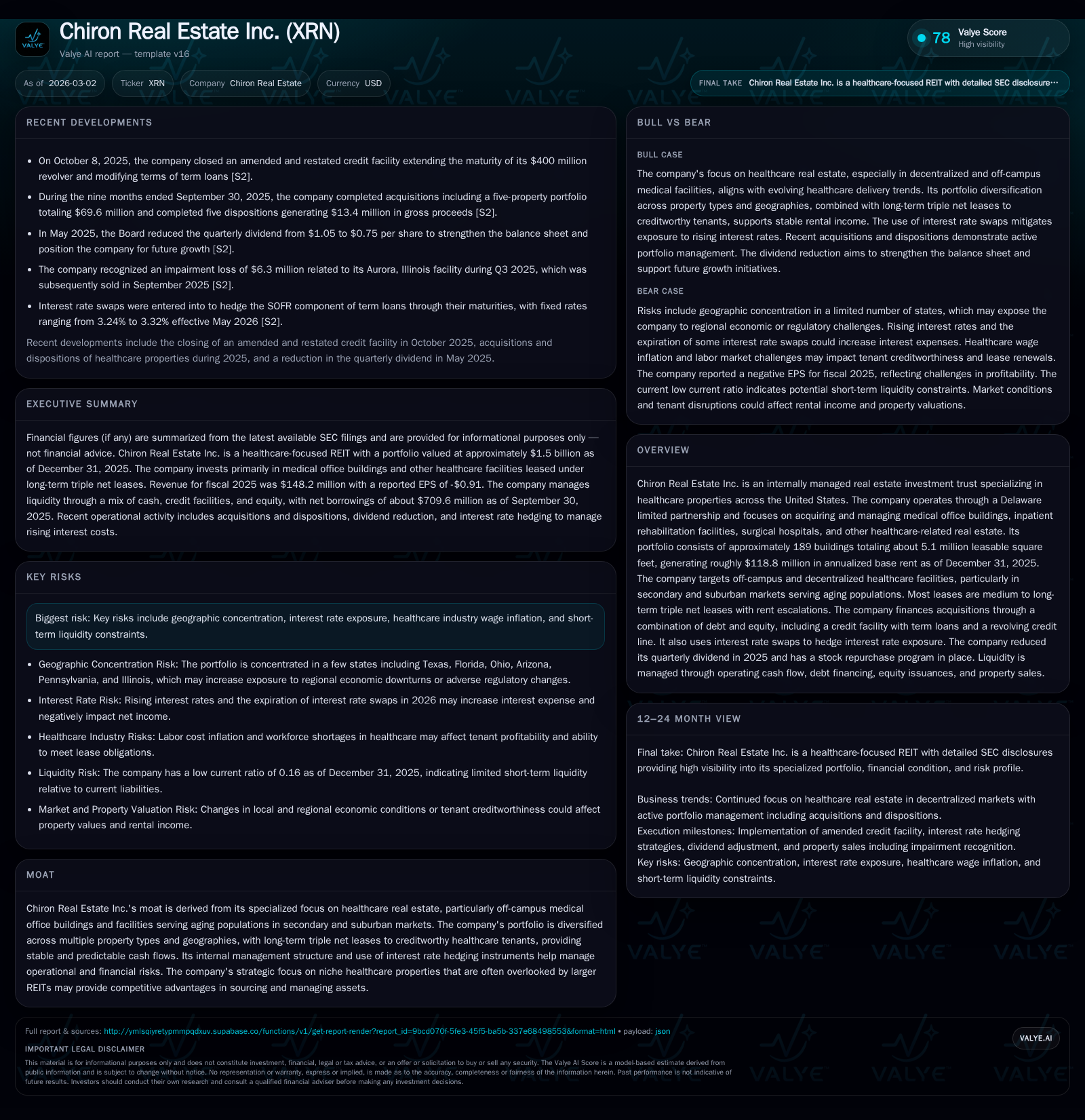
Chiron Real Estate Inc. (XRN) is an internally managed REIT focused solely on healthcare properties such as medical office buildings and inpatient rehab facilities across the U.S., emphasizing secondary and suburban markets with aging populations. Over recent years, the company has exhibited consistent revenue growth driven by acquisitions and lease escalations amid a stable operating cash flow environment. Chiron maintains a conservative capital structure with a refinanced credit facility and actively manages interest rate risk through hedging. While challenged by geographic concentration and exposure to interest rates, the company sustains dividend payments and moderate share repurchase programs to balance growth investments with shareholder returns.
Company Overview
Chiron Real Estate Inc., trading under ticker XRN, operates as a specialized healthcare-focused real estate investment trust (REIT) managing a diverse portfolio of properties including medical office buildings (MOBs), inpatient rehabilitation facilities (IRFs), surgical hospitals, and other health-related real estate assets across the United States [S1][S16]. The REIT's investment thesis centers on off-campus medical facilities located primarily in secondary markets and suburban areas that serve aging demographics — niches often overlooked by larger healthcare REITs.
As of December 31, 2025, Chiron's portfolio comprised approximately 189 buildings aggregating roughly 5.1 million leasable square feet (LSF), generating stable annualized base rents close to $118.8 million [S1][S23]. The portfolio is diversified by property type but is dominated by medical office buildings which represent about 79% of LSF and nearly 72% of annualized base rent [S23]. The remainder includes IRFs at ~10% of LSF and smaller portions allocated to surgical hospitals and other specialized healthcare facilities.
Historical Performance and Growth Drivers
Chiron has demonstrated steady top-line revenue progression over recent years. Total revenues increased from about $138.8 million in FY2024 to $148.2 million in FY2025, reflecting a year-over-year growth rate of approximately 6.8% driven by incremental acquisitions as well as contractual rent escalations embedded in triple net leases with creditworthy healthcare tenants [F1]. This steady increase points to an effective strategy deploying capital into accretive assets that fit the company’s niche.
Operating cash flows have remained robust relative to revenues; CFO rose modestly from approximately $70 million in FY2024 to $73.6 million in FY2025, signaling stable property-level operating performance underlying cash generation capacity amidst modest capex spending [F1][S17]. Net income figures are not available beyond FY2021 where net income was reported at about $18.3 million; however, given the leverage employed and recent investments, earnings quality appears consistent.
Historical performance (annual)
| FY | Rev ($mm) | CFO ($mm) | Rev YoY |
|---|---|---|---|
| 2025 | 148 | 74 | +6.8% |
| 2024 | 139 | 70 | -1.6% |
| 2023 | 141 | 68 | +2.7% |
| 2022 | 137 | 77 |
Source: SEC companyfacts cache [F1].
Capital returns and efficiency (annual)
| FY | Div ($mm) |
|---|---|
| 2025 | 6 |
| 2024 | 6 |
| 2023 | 6 |
| 2022 | 6 |
Source: SEC companyfacts cache [F1].
Note: Net Income only publicly available through FY2021 at $18.3 million.
Portfolio Composition and Geographic Exposure
Chiron’s emphasis on secondary markets seeks to capture the growing demand for accessible outpatient healthcare services driven by demographic shifts toward older populations requiring cardiovascular care, rehabilitation services, oncology treatment, orthopedics, among other niches [S16]. This focus also offers cost advantages compared to primary urban centers.
By geography, the largest concentrations cumulatively reside in six states: Texas (14% LSF; ~17% ABR), Florida (10%; 11%), Ohio (8%; 8%), Arizona (7%; 7%), Pennsylvania (6%; 7%), and Illinois (5%; ~5%) [S19]. These regional clusters expose Chiron to state-specific economic cycles or policy impacts but also provide operational scale within these key locations.
Lease Structure and Tenant Profile
The majority of leases are medium-to-long term triple net leases (NNN), placing property operating expenses largely on tenants — predominantly physician groups or regional/national healthcare systems — mitigating landlord exposure to operational volatility while securing predictable cash flow streams [S16]. Rent escalation clauses further support organic base rent growth over lease terms.
Some multi-tenant properties exist under modified gross or gross lease formats but represent a minor portion of total portfolio ABR.
Capital Structure and Interest Rate Management
Chiron's financing strategy blends secured term loans with revolving credit components under an Amended and Restated Credit Facility initiated in October 2025 [S4][S5][S6]. This facility features three Term Loan A tranches totaling $350 million with staggered maturities extending to April 2031 alongside a $150 million Term Loan B maturing February 2028, complemented by a $400 million unsecured revolving credit line enhanced by a $500 million accordion feature for future borrowing flexibility.
Net borrowings on this facility were approximately $708 million as of November 3, 2025 with unutilized revolver capacity remaining around $171 million — indicative of prudent liquidity management [S6][S10]. The weighted average borrowing cost on fixed-rate debt hovers around mid-single digits after factoring interest rate swaps fixing SOFR exposures at rates between roughly 1.36% and 3.32%, elevated modestly when combined with borrowing spreads totaling near or under 4.9% effective rates depending on tranche maturity [S4].
Interest rate swaps covering $350 million notional amount hedge Term Loan A tranches through respective maturities ensuring predictable interest expense profiles amid fluctuating SOFR benchmarks [S4][S11]. However, about $212 million remains on floating rate unfixed revolver borrowings susceptible to market rate changes posing cash flow variability risks.
Capital Allocation: Dividends and Buybacks
The company pays dividends quarterly but reduced its common stock dividend payout from $1.05 per share per quarter to $0.75 during Q2-2025 aiming at rebalancing capital priorities towards growth investments and bolstering liquidity cushions amid changing market conditions [S7]. The dividend payment has since remained steady at this level through year-end.
Share repurchases are authorized under a formal program approved mid-2025 permitting up to $50 million buyback capacity though no shares had been purchased in H1/H2-2025 indicating cautious deployment given other capital needs [S6][S10].
Operating cash flow covers dividend obligations comfortably with free cash flow (CFO less capex) estimated around $41.8 million for FY2025 based on capex trends discussed but not explicitly detailed quantitatively herein — providing room for reinvestment while maintaining shareholder returns balance [F1][S15].
Risk Considerations
Despite the blueprint for stability and niche targeting, Chiron faces several identifiable risks:
- Geographic concentration exposes it disproportionately to regional economic downturns or regulatory changes in core states like TX, FL, OH, AZ, PA, IL where more than half its portfolio resides [S19].
- Approximately one-third of debt remains floating rate thereby exposing cash flows to rising interest rates; although swaps mitigate some risk this leaves sensitivity related to revolver fluctuations intact [S11][S20].
- Tenant financial health could be impacted by rising wage inflation pressure within healthcare settings potentially affecting rent collections or lease renewals [N/A meaning only reported general risk from SEC filings S2].
- Short-term liquidity requirements include scheduled principal repayments along with property acquisition commitments stressing ongoing access to capital markets particularly if volatile conditions curtail equity issuance or debt refinancings ([S7],[S9],[S12]).
Industry Context Analysis (Not Company-Specific)
Healthcare real estate represents a specialized subset where operators must understand evolving delivery system models emphasizing outpatient care migration from centralized hospitals toward convenient neighborhood settings — trends well-aligned with Chiron’s strategic focus on off-campus properties serving older adults needing ambulatory specialty care services across lower-cost suburban locales instead of urban hospital complexes.
Healthcare REITs focusing solely on these niches tend to navigate competitive headwinds differently compared to broad-based multifamily or office landlords due to their tenant mix quality but face unique regulatory risks alongside demographic shifts influencing utilization patterns.
Interest rate environments strongly shape valuations since these assets typically depend heavily on leverage; proactive hedging strategies by firms like Chiron help insulate earnings volatility though absolute debt cost levels remain determinative for ROE sustainability.
What To Watch Next (Forecasts / Milestones Analysis)
Chiron does not provide explicit forward guidance in available filings but key monitoring points include:
- Acquisition activity pacing — given reliance on accretive deals for top-line growth maintaining disciplined yet opportunistic buying will be critical.
- Lease renewal outcomes amidst inflationary pressures determining rent roll stability.
- Refinancing terms as upcoming loan maturities approach their respective dates affecting capital availability beyond existing facilities.
- Dividend sustainability given capital expenditure demands balanced against free cash flows amidst market conditions shifts.
- Changes in tenant creditworthiness tied closely with macroeconomic health impacting collections profiles. These factors serve as barometers for assessing whether recent strategic capital repositioning culminates in enhanced longer-term value creation or challenges emerge from tighter liquidity or rate environments.
Conclusion
Chiron Real Estate Inc.'s deliberate concentration on healthcare real estate assets tied predominantly through long-term NNN leases provides largely stable cash flows supported by an internally managed platform adept at navigating niche market segments underserved or overlooked by larger peers.[F1][S16] Its steady historical revenue growth married with conservative yet flexible leverage positions it well for moderate expansion provided execution risks are kept under control.[F1]
However, careful monitoring is warranted concerning geographic concentrations and susceptibility to upward interest rate movements given the non-insignificant floating-rate component of debt.[S11] Dividend reductions implemented reflect prudent balancing between shareholder distributions and funding future investment opportunities.[S7]
Overall,the company embodies the specialized characteristics typical among healthcare REITs leveraging off-campus facility demand drivers rooted in fundamental demographic trends while employing financial discipline through hedging initiatives.[F1][S4]
This analysis is based entirely on information derived from public sources including SEC filings and company disclosures as available as of March 2, 2026 ([F1],[S#]). It does not constitute investment advice or recommendations.
Disclaimer: This is research-only, informational analysis and not investment advice. It may include AI-generated interpretation and general industry context. Always verify important details using primary sources.

Comments