
XMax Inc. Expands from Furniture into AI Amid Tariff Pressures and Market Diversification
Latest quarterly filings detail XMax's strategic pivot to AI while managing cyclical furniture market and tariff challenges.
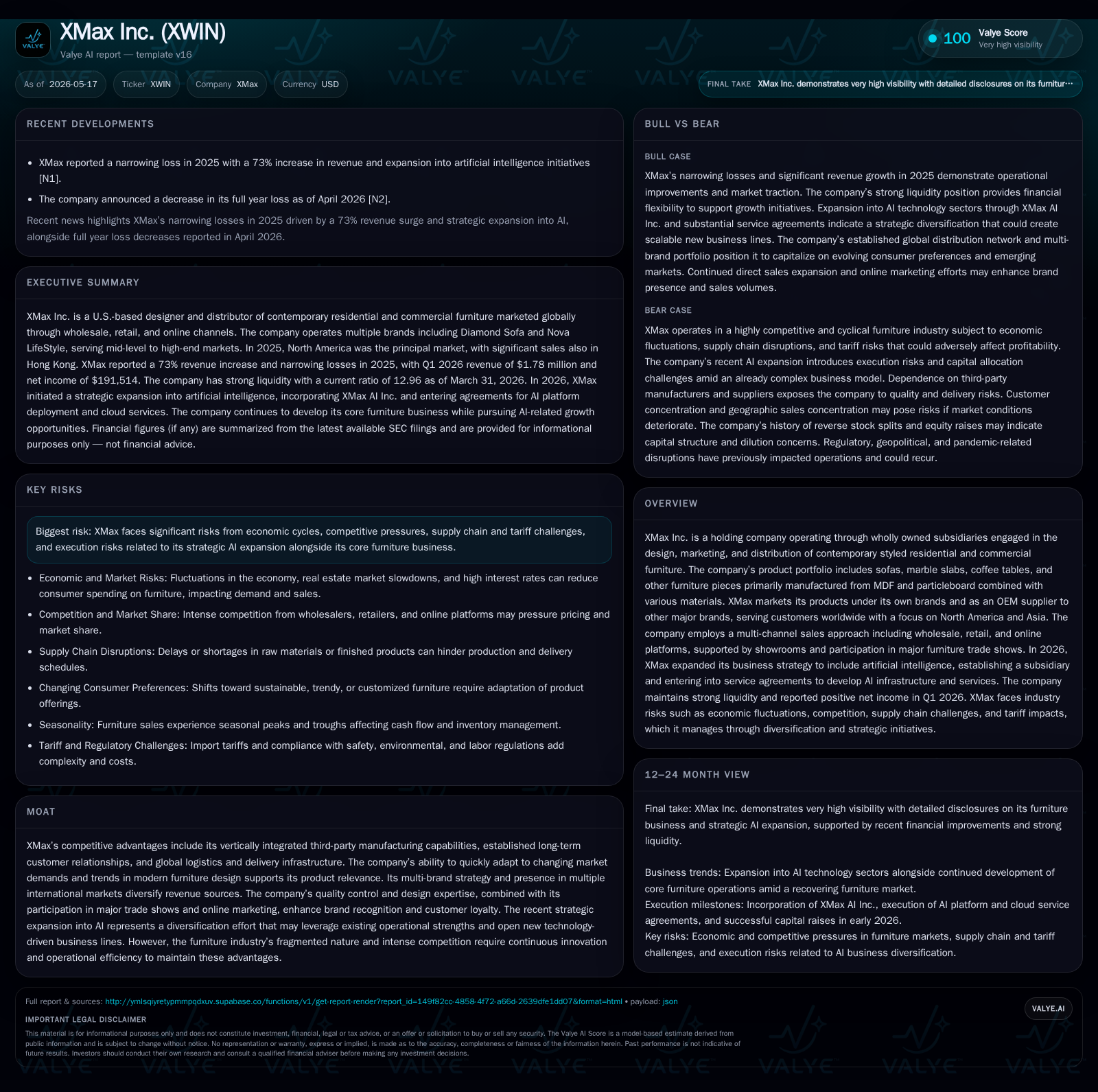
XMax Inc. announced in its May 2026 quarterly filings a significant strategic expansion into artificial intelligence (AI) alongside its ongoing furniture business operations. The company leverages its vertically integrated manufacturing and global logistics capabilities to serve a diverse international customer base, primarily in North America and Asia. Facing industry headwinds including tariff impacts and economic cyclicality, XMax aims to diversify revenue streams through AI-focused software, hardware, and infrastructure projects, supported by recent capital raises. Execution risks remain around this nascent segment amid a complex competitive landscape.
Recent Operating Update
XMax Inc.'s most recent quarterly filing dated May 15, 2026 ([S2]) reveals the company's formal entry into the artificial intelligence sector through the incorporation of XMax AI Inc. in April 2026 ([S4]). A cornerstone event was the execution of an AI Inference Platform Deployment and Service Agreement with Cloud Alliance Inc. for the development of an AI inference platform hosted on Amazon Web Services at a fixed fee of $400,000 ([S4]). This development marks a material business model expansion beyond their traditional furniture design and distribution operations.
In parallel with this technology pivot, the company has continued to operate its furniture business serving a broad international market but faces ongoing pressures from tariffs levied primarily on furniture products imported from China (27-70%) and India (up to 50%) since February 2025 ([S1], [S4], [S18]). These tariffs have amplified sourcing costs and created incentives within the company to rationalize product mix by favoring higher-margin lines and more creditworthy customers ([S8]).
Alongside operational updates, XMax executed multiple capital raises during April 2026 totaling over $34 million in private placements with both U.S. and non-U.S. investors ([S15], [S21], [S23]). These actions appear directed at financing the nascent but capital-intensive AI business as well as supporting working capital needs for furniture operations.
Business Model
XMax functions as a holding company overseeing wholly owned subsidiaries that specialize in the design, marketing, and distribution of contemporary residential and commercial furniture with a particular emphasis on innovative designs constructed from materials like MDF and particleboard combined with marble and other components ([S1], [S17]). The product portfolio spans sofas, coffee tables, marble slabs, and other pieces primarily sold under proprietary brands such as Diamond Sofa or produced as an OEM supplier for major global brands.
The company's revenue mechanics are anchored in furnishing distributors, retailers, designers, and online channels who pay for high-quality products backed by customization capabilities. Pricing is typically negotiated annually under supplier agreements but supplemented by standard purchase orders ([S9]). Volumes fluctuate with broader consumer demand trends linked to housing markets and discretionary spending. Profitability hinges on pricing discipline amidst tariffs pressures and successful migration towards premium product lines.
Vertical integration is a distinct strength; although XMax outsources manufacturing to third parties, it maintains stringent quality control protocols ensuring products meet relevant ANSI/BIFMA/CARB standards across geographies ([S10], [S18]). Additionally, global logistics infrastructure facilitates delivery flexibility to multiple markets including North America—which comprises over half of recent sales—and expanding Asian markets ([S7], [S9]).
Notably in early 2026, XMax expanded its model by launching a dedicated AI subsidiary pursuing several technology-driven revenue streams such as GPU compute infrastructure provisioning hosted on scalable cloud environments alongside enterprise-grade AI agent deployment platforms ([S4]). This represents a diversification aimed at offsetting cyclicality inherent in furniture demand.
Industry Structure and Competitive Position
The furniture industry is notably fragmented but characterized by intense competition among wholesalers, retailers, private-label manufacturers, as well as emerging e-commerce direct-to-consumer players ([S1], analysis). XMax's competitive moats lie in established long-term customer relationships leveraged through recognized brands (especially Diamond Sofa), combined with its ability to control production quality through vertical integration of third-party manufacturers. This structure supports the ability to adapt swiftly to evolving design trends—a critical factor given shifting consumer preferences towards modern styles.
Pricing power remains pressured due to tariff-induced cost inflation which can lead to either margin compression or price increases that dampen demand. The company's deliberate strategy to eliminate low-margin customers partially addresses this risk but introduces transitional revenue volatility ([S8]).
Logistics capabilities spanning continents reinforce customer retention by ensuring timely deliveries tailored to specific regional requirements. Furthermore, XMax’s incremental move into online sales channels offers potential uplift from growing internet-based furniture shopping behavior while balancing traditional wholesale models.
Entering into the AI sector places XMax within highly competitive high-tech markets dominated by specialized hardware providers (NVIDIA et al.), cloud service giants (AWS), software developers focused on machine learning frameworks, plus emergent startups offering niche AI services (). Success here depends on securing resource-efficient GPU compute capacity amid supply constraints alongside developing scalable commercial offerings—a risky but potentially high-growth extension beyond legacy retail models.
Growth Drivers
- Artificial Intelligence Expansion: The addition of an AI subsidiary targeting multiple segments including software/hardware development for AI systems; cloud GPU computing infrastructure; access/orchestration of proprietary plus third-party AI models; enterprise-focused agent deployment platforms forms a new growth vector aligned with secular trends in digitization ([S4], [N1]).
- Product Mix Optimization: Transition towards higher-margin furnishing products away from commodity styles benefits profitability even amid variable demand ([S8]).
- Geographic Diversification: Increasing penetration into North American retail chains combined with expansion into Asian markets reduces concentration risk—evidenced by reduced dependency on any single customer in recent years ([S7], [S9]).
- E-commerce Development: Growing online sales channels under Diamond Sofa brand targeting direct-to-consumer touchpoints offer scalability without corresponding physical store costs ([S9], [N1]).
- Trade Management: Active evaluation of sourcing alternatives amid tariff uncertainties helps mitigate cost pressures though outcomes remain uncertain ([S1], [S18]).
- Capital Infusion: Recent private placements injecting significant cash support expansion plans for R&D in AI as well as working capital for furniture sales growth initiatives ([S15], [S21], [N2]).
Risks / Watchpoints / Growth Constraints
- Economic Cyclicality: Furniture demand remains highly sensitive to macroeconomic variables including housing market activity, consumer confidence indices, inflationary pressures impacting discretionary spending capacity ([S1], [S5]).
- Tariff Uncertainties: Sustained or escalated tariffs on Chinese/Indian imports increase input costs; shift sourcing patterns; may provoke retaliatory trade actions impacting US buyers; elevates price volatility risk ([S1], [S16], analysis).
- AI Execution Risk: Entering deep tech fields exposes the company to capital intensity challenges along with fierce competition; scaling hurdles related to securing GPU/cloud access; uncertainty in commercial adoption rates poses financial strain risks ([S8]).
- Customer Concentration: Although reducing reliance on top customers historically accounting for >10% sales reduces some counterparty risk; failure to develop sufficiently broad client base for internet sales channels could impact sales stability ([S7], [S8]).
- Legal Proceedings History: While prior derivative lawsuits have been settled without material financial impact currently reported,[S22] any future litigation or regulatory investigations could divert management focus.
- Supply Chain Disruptions: Global logistics remain vulnerable to delays or shortages especially given complex international sourcing which could impair fulfillment schedules.
- Limited Human Capital Base: With only 22 full-time employees primarily located in the U.S., scaling operational complexity especially within new technology initiatives may strain organizational bandwidth ([S6]).
What To Watch Next
Investors should monitor forthcoming quarterly filings for updates on:
- Progression of AI initiatives including capital deployment cadence related to research partnerships or technology acquisitions.
- Changes in product mix contribution ratios reflecting shift toward higher-margin items versus volume erosion.
- Execution success ramping online direct-to-consumer sales channels particularly under Diamond Sofa brand.
- Impact trajectory of tariffs—any announcements regarding adjustments or mitigation via alternative sourcing strategies.
- Customer base diversification metrics tracking reductions in concentration risk or increase in direct retail partnerships.
- Legal or regulatory disclosures that might affect corporate governance or financial liability exposure.
- Liquidity position evolution post capital raises supporting aggressive R&D ( see Financial Snapshot below).
Financial Snapshot Q1 2026 [F1]
Latest financial snapshot
| Metric | Value | Period |
|---|---|---|
| Cash & equivalents | $10mm | |
| 2026-03-31 | ||
| Current assets | $20mm | |
| 2026-03-31 | ||
| Current liabilities | $1520695 | |
| 2026-03-31 | ||
| Current ratio | 12.96x | |
| 2026-03-31 |
Source: SEC companyfacts cache [F1].
| Metric | Value | Period End |
|---|---|---|
| Cash & Equivalents | $9.91M | |
| 2026-03-31 | ||
| Current Assets | $19.7M | |
| 2026-03-31 | ||
| Current Liabilities | $1.52M | |
| 2026-03-31 | ||
| Current Ratio | 12.96x | |
| 2026-03-31 | ||
| Total Debt | $80k | last available |
Liquidity remains robust with nearly $10 million in cash against moderate current liabilities suggesting financial flexibility at quarter-end. Debt levels are minimal relative to asset base indicating low leverage risk entering new business segments.[F1]
The company’s net losses narrowed in recent years even as revenues surged (~73% surge reported for FY25 per news sources) reflecting investment-heavy expansion phases including new subsidiaries targeting AI ventures.[N1],[N2]
Disclaimer
This analysis is based solely on publicly available information up to mid-May 2026 including SEC filings and contemporaneous news reports. It does not constitute investment advice or recommendations regarding buying or selling securities. Readers should conduct their own due diligence before making any decisions regarding XMax Inc.
Disclaimer: This is research-only, informational analysis and not investment advice. It may include AI-generated interpretation and general industry context. Always verify important details using primary sources.

Comments