
Zoom Communications Leads AI-Driven Workforce Collaboration with Robust Quarterly Growth
Zoom’s Q1 fiscal 2027 results highlight solid enterprise customer expansion and enhanced AI integration, reinforcing its platform leadership despite macroeconomic challenges.
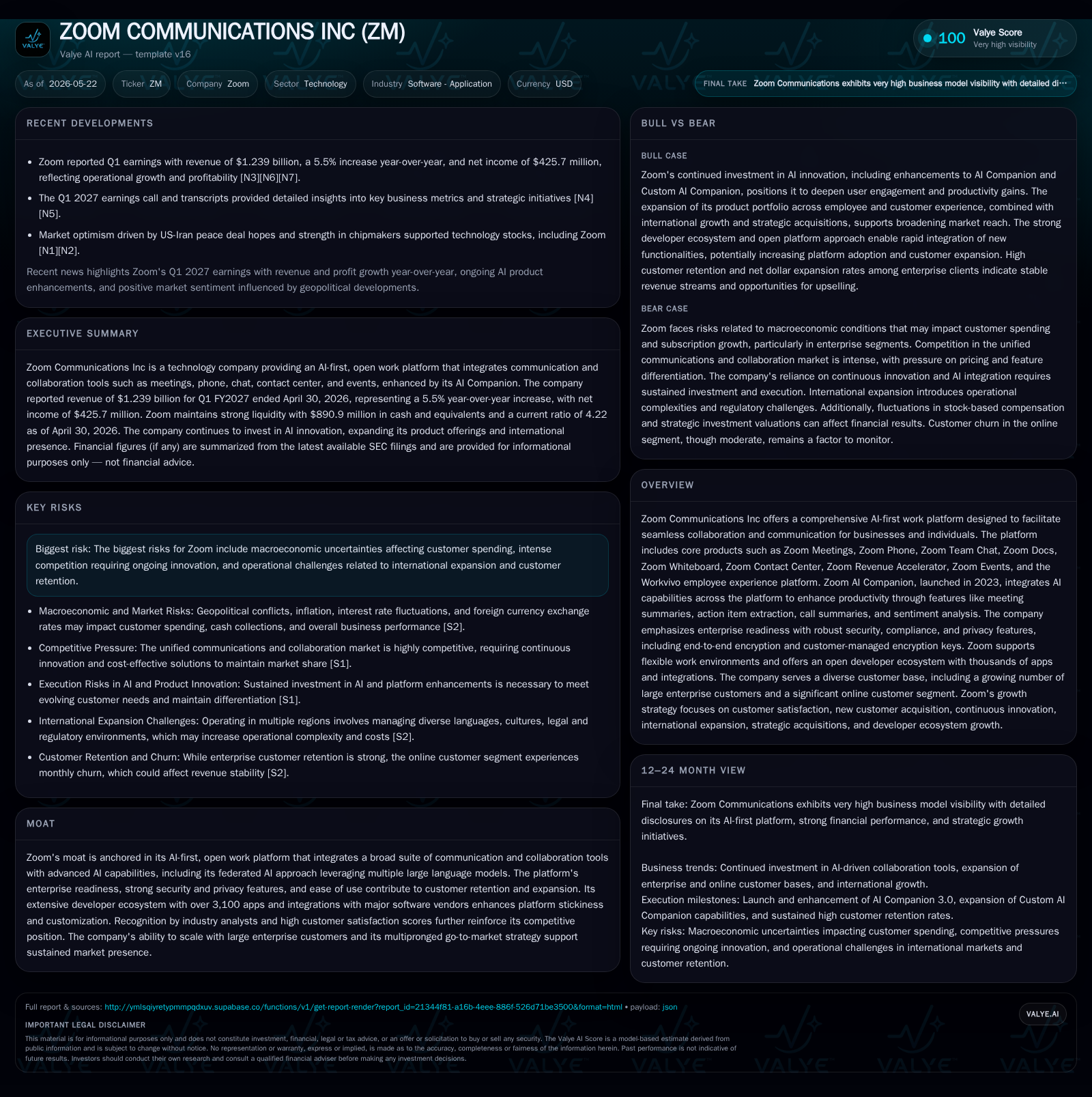
In the latest quarter ended April 30, 2026, Zoom Communications posted a 5.5% revenue increase driven by growth in large enterprise customers and broader adoption of its AI-powered collaboration tools. The company recorded a rise in the number of $100K+ revenue contributing customers and maintained strong gross margins supported by operational efficiencies. Zoom’s business model combines an AI-first open work platform with a broad product suite and developer ecosystem to sustain sticky customer relationships amidst intensifying competition and macro pressures. Key growth drivers include expanding enterprise penetration, continuous AI innovation, and ecosystem extensibility, balanced against risks from macroeconomic headwinds and international expansion complexity. Liquidity remains strong with nearly $891 million in cash equivalents at quarter-end.
Recent Quarterly Results Signal Strengthening Position
Zoom Communications reported Q1 fiscal year 2027 revenue of $1.239 billion, reflecting a 5.5% year-over-year increase from $1.175 billion in the prior-year period [S2], [N1]. Enterprise segment revenue grew 7.2%, accounting for the lion’s share of growth, while smaller online customers contributed modest increases. The company expanded its cohort of large enterprise customers (defined as those generating more than $100K in trailing twelve months revenue) to 4,534 from 4,192 one year prior [S2]. This represents improved penetration within larger organizations despite prevailing macroeconomic headwinds.
Gross margin improved to 77.9%, up from 76.3% last year, benefiting from lower stock-based compensation expenses and operational efficiencies [S21]. Cost of revenue declined slightly by 1.5%. Operating expenses saw mixed trends: research & development increased as Zoom invests heavily in AI innovation (+11% R&D spend), while sales and marketing costs decreased slightly amid efficiency efforts [S21].
The net dollar expansion rate within the Enterprise segment remained below 100%, primarily due to seat count downsells influenced by slower hiring trends among corporate clients. However, this was partially offset by adoption of Zoom's new AI-driven features embedded across the platform [S2]. Overall customer retention remains sound with evidence pointing to continued opportunity to upsell broader capabilities.
Zoom’s Business Model: AI-First Open Work Platform for Enterprise Collaboration
Zoom monetizes via subscription access to an AI-powered collaborative work platform encompassing core communication products (Zoom Meetings, Zoom Phone, Zoom Team Chat, Zoom Docs, Zoom Whiteboard) [S1], augmented by business services including Zoom Contact Center, Revenue Accelerator, Events, and Workvivo employee experience tools. This integrated suite is unified under the Zoom AI Companion launched in 2023 which delivers productivity enhancers such as automated meeting summaries, action item extraction, real-time call analytics, conversational assistants, and sentiment analysis—all designed to streamline workflows across diverse organizational functions.
Subscription fees scale primarily with paid license counts per customer plus incremental purchases of add-on services. This "land and expand" model facilitates expanding usage breadth within existing accounts alongside acquisition of new ones [S1]. Margins benefit from cloud-optimized hosting costs spread at scale combined with continuously improving operational efficiencies.
Critical to Zoom’s value proposition is its open developer ecosystem featuring over 3,100 third-party apps on its marketplace that integrate tightly with major software vendors like Microsoft and Google. This extensibility promotes stickiness through tailored customer deployments and elevated switching costs. The platform also emphasizes enterprise-grade security controls including end-to-end encryption options and compliance certifications fostering trust among regulated industries.
Competitive Landscape and Industry Structure in Enterprise Communication Software
The market for enterprise communication software is intensely competitive with major players offering overlapping suites aimed at hybrid and remote work collaboration. Peers range from Microsoft Teams to Cisco Webex and Google Meet—each differentiated around integration breadth or niche functionality.
Zoom’s competitive edge derives from balancing ease-of-use with robust security features and a broad product ecosystem aligned around an AI-first operating philosophy. Its penetration into larger enterprises (accounting for approximately 61% of total revenue) underscores effective targeting of high-value customers [S2], [S5]. The company employs a hybrid sales strategy combining direct field sales for larger deals alongside reseller partnerships for broader geographic coverage especially internationally.
Its subscription-based SaaS economics hinge on annual recurring revenues (ARR), low churn rates supported by platform reliability/security credentials, and capacity to upsell new products within installed bases—pillars that underpin sustainable competitive advantage if execution is maintained [S19]
Drivers of Growth: Enterprise Penetration, AI Innovation, and Platform Ecosystem
Key growth engines include consistently increasing the number of large (>$100K ARR) customers—a proxy for deeper organizational embedding—and expanding usage intensity within these accounts through additional seats or product lines [S2]. Despite short-term macro softness causing some downsells impacting net dollar retention rates (<100%), ongoing AI-driven innovation generates fresh value propositions driving upsells such as the Contact Center’s agent assistance or automated transcription features embedded across meetings and calls.
The expanding developer ecosystem further fuels stickiness; customers can integrate communications fluidly into bespoke workflows leveraging APIs/SDKs while benefiting from enhanced user experiences powered by embedded AI capabilities,[S1],[S2].
Zoom also targets horizontal expansion within existing clients—growing adoption across departments beyond initial teams—creating multi-touchpoint relationships that raise switching friction and lifetime account value.
Risks and Constraints: Macroeconomic Headwinds and Expansion Challenges
The principal near-term risk involves ongoing macroeconomic uncertainty which depresses overall IT spending momentum among large enterprises leading to slower seat count growth or occasional downsells [S2], [S16],[S17]. These factors directly suppressed net dollar expansion below unity in recent quarters despite partial mitigation from new feature uptake.
Zoom faces persistent competitive pressure necessitating sustained investment in R&D particularly in AI capabilities—this intensifies cost demands even as it must carefully balance pricing power not to erode client goodwill [S22]
International expansion opportunities remain sizable but entail complexity from navigating regulatory compliance regimes (e.g., data privacy laws), cultural nuances, multi-lingual support needs, local partnerships, and operational scalability [S18],[S25]. Missteps could limit growth or require trade-offs in product offerings or pricing strategies.
Additional risks stem from litigation exposure related to privacy/security investigations ongoing with US authorities which could impose financial or reputational costs if adverse outcomes arise [S16], [S17]. Intellectual property disputes also pose uncertainties bearing potential impact on operations or licensing burdens.[S25]
Outlook and Key Milestones to Monitor
Zoom’s upcoming performance will be anchored on maintaining momentum in growing its large enterprise customer base (> $100K ARR segment) as well as improving net dollar expansion trajectories back toward or above breakeven levels through further AI-driven upsells [N2],[N6],[N7],[S3]. Monitoring adoption rates of AI Companion features across distinct customer segments will be crucial to gauge sustained differentiation impact.
Additional key indicators include visibility on pipeline conversions at field sales level particularly for large deals; international revenue growth patterns; retention stability; satisfaction scores reflecting ongoing service reliability; and any shifts in regulatory or litigation developments that may affect strategic flexibility.
On shareholder returns front, management has demonstrated capital discipline via regular stock buybacks—with $361.7 million retired during Q1 alongside new $1 billion authorization approved recently—signaling confidence while maintaining balance sheet strength [S20]
Summary Financial Highlights from Latest Quarterly Filing
As of April 30, 2026, Zoom held approximately $891 million in cash and cash equivalents with current assets exceeding current liabilities by over four times (current ratio ~4.22), providing ample liquidity cushion for near-term operational investments or opportunistic acquisitions [F1], [S14]. Operating cash flow generation remains positive supporting reinvestment capacity.
Total revenue for the quarter grew steadily by 5.5%, while gross margins expanded due to lower stock-based compensation charges—a reflection of evolved equity programs—and efficiency gains achieved in cloud operations [S21]. Research & development expenses rose notably driven by increased personnel cost aligned with the company’s intensified focus on artificial intelligence innovation.
Sales & marketing spend declined slightly suggesting effectiveness improvements despite ongoing investments protecting customer acquisition funnels amidst competition [S21]
This analysis compiles information solely based on publicly filed SEC documents dated through May 22, 2026 () combined with recent news transcripts () as well as validated financial facts ([F1]). It is intended exclusively as a detailed industry-focused business assessment without expressing investment advice or research views.
Disclaimer: This is research-only, informational analysis and not investment advice. It may include AI-generated interpretation and general industry context. Always verify important details using primary sources.

Comments