
Zscaler Inc’s Evolution Amidst Cloud Security and AI-Driven Threat Landscape
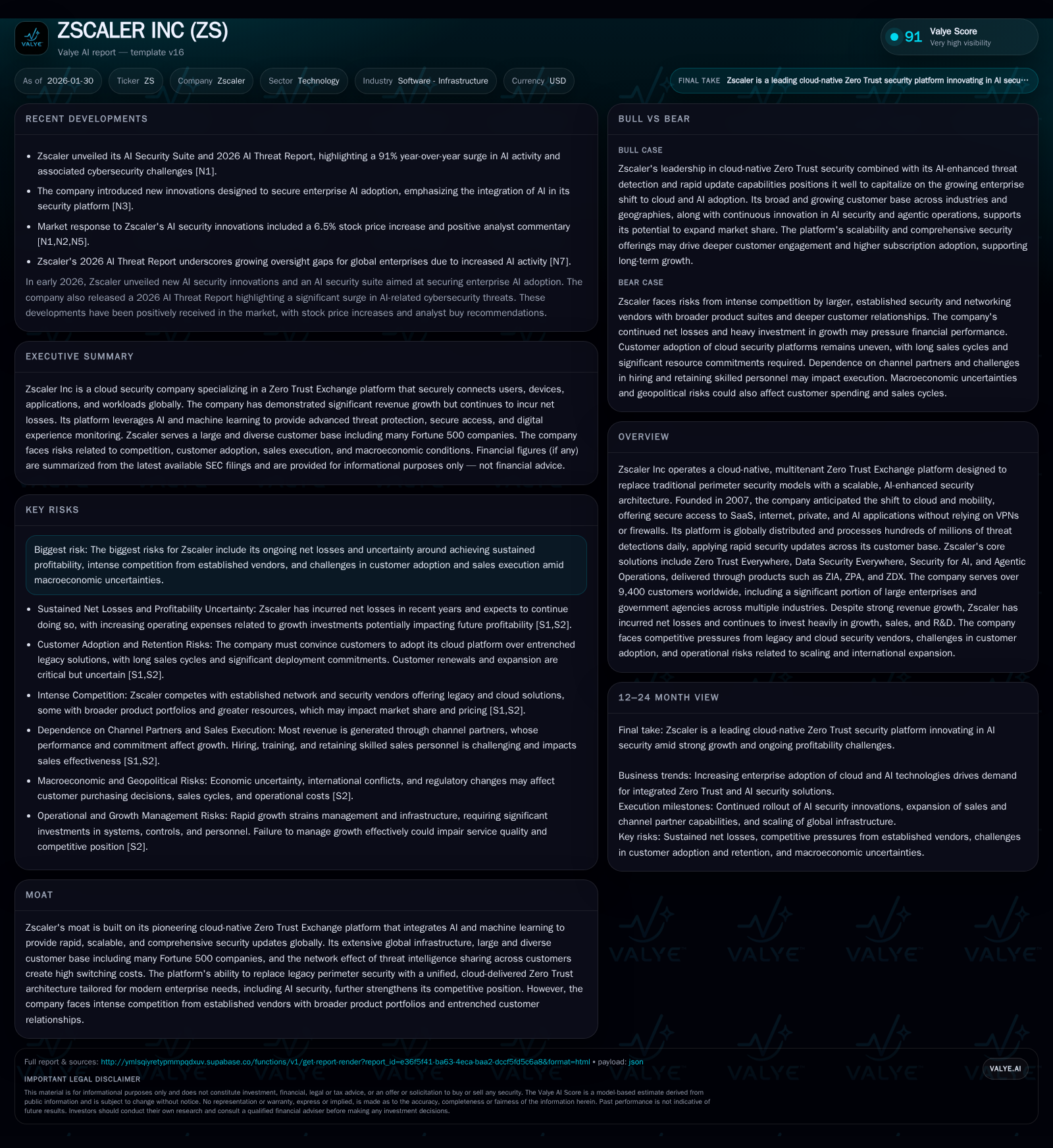
Zscaler advances its cloud-native Zero Trust platform with AI innovations while navigating competitive and operational challenges in the evolving cybersecurity market.
Zscaler continues to solidify its position as a pioneer in cloud-based security with recent introductions targeting AI security risks. The company’s business model hinges on its Zero Trust Exchange platform, leveraging a global cloud infrastructure and direct sales complemented by channel partnerships. However, long sales cycles, intense competition from entrenched vendors, and ongoing profitability challenges persist. The increasing prevalence of AI threats offers growth opportunities but also raises complexity in securing enterprise environments.
What Changed Recently
In late January 2026, Zscaler announced a suite of AI security innovations integrated into its Zero Trust platform designed to address the rapidly growing AI threat landscape. The company released its 2026 AI Threat Report, which documented a 91% year-over-year increase in AI activity posing new security challenges for enterprises, highlighting a burgeoning oversight gap in AI adoption. These innovations aim to secure enterprise AI workloads alongside traditional SaaS and internet traffic, signaling Zscaler’s strategic emphasis on AI as a new security frontier [N1][N2][N3][N4][N5]. This launch was met with a positive market reaction, with the stock rising 6.5% upon announcement, underscoring investor interest in the company’s AI security initiatives [N1][N3].
However, despite these product advances, questions remain about the company’s path to sustained profitability amidst heavy investment in sales and R&D, as highlighted in recent financial analyses [N6]. The company continues to navigate macroeconomic uncertainty, elongated sales cycles, and competitive pressures from legacy and cloud security incumbents [N7].
Business Model as a System
Zscaler operates a cloud-native, multi-tenant Zero Trust Exchange platform that broadly replaces traditional perimeter security with a cloud-delivered security fabric. The platform secures access to SaaS applications, internet destinations, private applications, and now AI-driven workloads without reliance on VPNs or fixed firewalls [S4]. This model aligns with the enterprise shift toward cloud and hybrid work models, enabling seamless, secure connectivity independent of user location.
The company sells primarily via a direct sales force supplemented by a global network of channel partners, including systems integrators and telecom providers. Though channel partners drive a significant portion of revenue, direct engagement by Zscaler’s own sales reps remains crucial, particularly for enterprise and government accounts [S1][S6][S9]. Sales personnel require sophisticated technical understanding and consultative selling skills to articulate the transformative value of replacing appliance-based security with the cloud platform, which contributes to a long ramp-up time for new hires and significant sales cycle length [S1][S5].
Customer contracts are subscription-based, typically spanning one to three years, with revenue recognized ratably. The model depends heavily on customer renewals and expansions, with large enterprises often negotiating stringent terms and longer approval processes. Budget constraints and macroeconomic factors can delay deals and compress pricing power [S2][S5][S11].
International operations constitute roughly half of revenue, exposing Zscaler to currency risk, political instability, and localization challenges. The company invests to manage these risks but must navigate complexities inherent in expanding cloud services globally [S7][S15].
Zscaler invests heavily in research and development to maintain technology leadership and in sales and marketing to grow its customer base. However, despite strong revenue growth, the company has yet to achieve sustained profitability, a function of ongoing investments and sales execution lags [S17][N6].
Industry Map & Competitive Battlefield
The network security industry is intensely competitive and rapidly evolving. Zscaler competes against both legacy appliance vendors and emerging cloud-native security providers. Larger incumbents such as Cisco, Palo Alto Networks, and Check Point offer broader security portfolios and maintain entrenched customer relationships, potentially bundling services to limit Zscaler’s penetration [S10][S25]. These competitors benefit from established brand recognition, deeper sales and support resources, and extensive channel networks.
Zscaler’s differentiation centers on its cloud-native Zero Trust Exchange, offering real-time threat intelligence shared across its vast customer base and rapid application of AI and machine learning for threat detection and response. This network effect creates switching costs and underpins its moat. Still, widespread adoption of cloud security platforms remains in progress, as many organizations continue to rely on on-premises or hybrid security architectures due to legacy investments and IT familiarity [S4][S10].
The rise of AI-powered cyber threats has opened a new battlefield, with Zscaler recently positioning its platform to secure AI workloads and mitigate novel risks. This emerging niche could be a growth vector but also invites competition from both traditional players expanding AI capabilities and specialized AI security startups [N1][N2][N5].
Channel partners are a double-edged sword: while they accelerate market reach and provide value-added services, they also represent potential conflict as partners may represent competing products, affecting Zscaler’s revenue growth and customer experience [S9].
Where the Economics Become Real
Zscaler’s unit economics hinge on subscription revenue growth through new customer acquisition, retention, and upselling. The long, complex sales cycles inherent to cloud security transformations—especially in large enterprises and government—pose challenges to predictable revenue and margin expansion [S2][S5]. Sales personnel productivity is critical but difficult to scale rapidly due to the specialized nature of the platform and required customer education [S1][S5].
Customer renewals are vital as subscriptions are ratably recognized over contract terms. Churn or failure to expand customer usage can impair deferred contract acquisition cost amortization and profitability [S11]. Macro factors like budget tightening can lead to shorter contract terms, reduced seat counts, or pricing concessions.
Operating leverage is constrained by continued heavy investments in R&D and sales/marketing to maintain competitive differentiation and fuel growth. Rising wages, especially in India where a significant portion of R&D and operations workforce resides, add cost pressure [S17]. Moreover, geopolitical risks, currency fluctuations, and international market complexities add variability to operating results [S7][S15].
While the platform’s scalable cloud infrastructure supports handling hundreds of millions of threat detections daily, the incremental cost to serve additional users is expected to be lower than revenue growth, offering potential margin expansion if sales execution and retention improve.
Intellectual property protection and litigation risks also represent a non-trivial cost and uncertainty factor, given the crowded cybersecurity patent landscape and competitors’ defensive tactics [S19][S20][S21][S23].
Diligence Questions / Disconfirming Signals
- How effective is Zscaler’s current sales force in converting the large pipeline of AI security opportunities into revenue, given the long sales cycles and required technical expertise?
- To what extent can Zscaler expand its channel partner network without diluting brand and customer experience, considering partners sell competing solutions?
- How resilient is customer renewal and expansion behavior amid macroeconomic uncertainty and tightening IT budgets?
- Is the company’s investment pace in R&D and sales sustainable without clear visibility on when profitability will be achieved?
- How differentiated and defensible are Zscaler’s AI security capabilities relative to large incumbents and emerging startups?
- What contingency plans exist for geopolitical risks impacting international operations, especially in regions with ongoing conflicts?
- Are there any early warning signs of increased churn or pricing pressure due to competitive or macroeconomic headwinds?
- How robust is Zscaler’s intellectual property portfolio and legal strategy in fending off or managing infringement claims?
This analysis is based on publicly available information and does not constitute investment advice. The company’s future performance depends on multiple uncertain factors, including market acceptance, competitive dynamics, and execution capabilities.
Disclaimer: This is research-only, informational analysis and not investment advice. It may include AI-generated interpretation and general industry context. Always verify important details using primary sources.

Comments