
Cloud Security Expansion at Zscaler Contrasts with Lingering Net Losses and Capital Strategy
Zscaler reports robust revenue growth driven by AI-enhanced Zero Trust offerings while managing persistent operating deficits amid strategic investments.
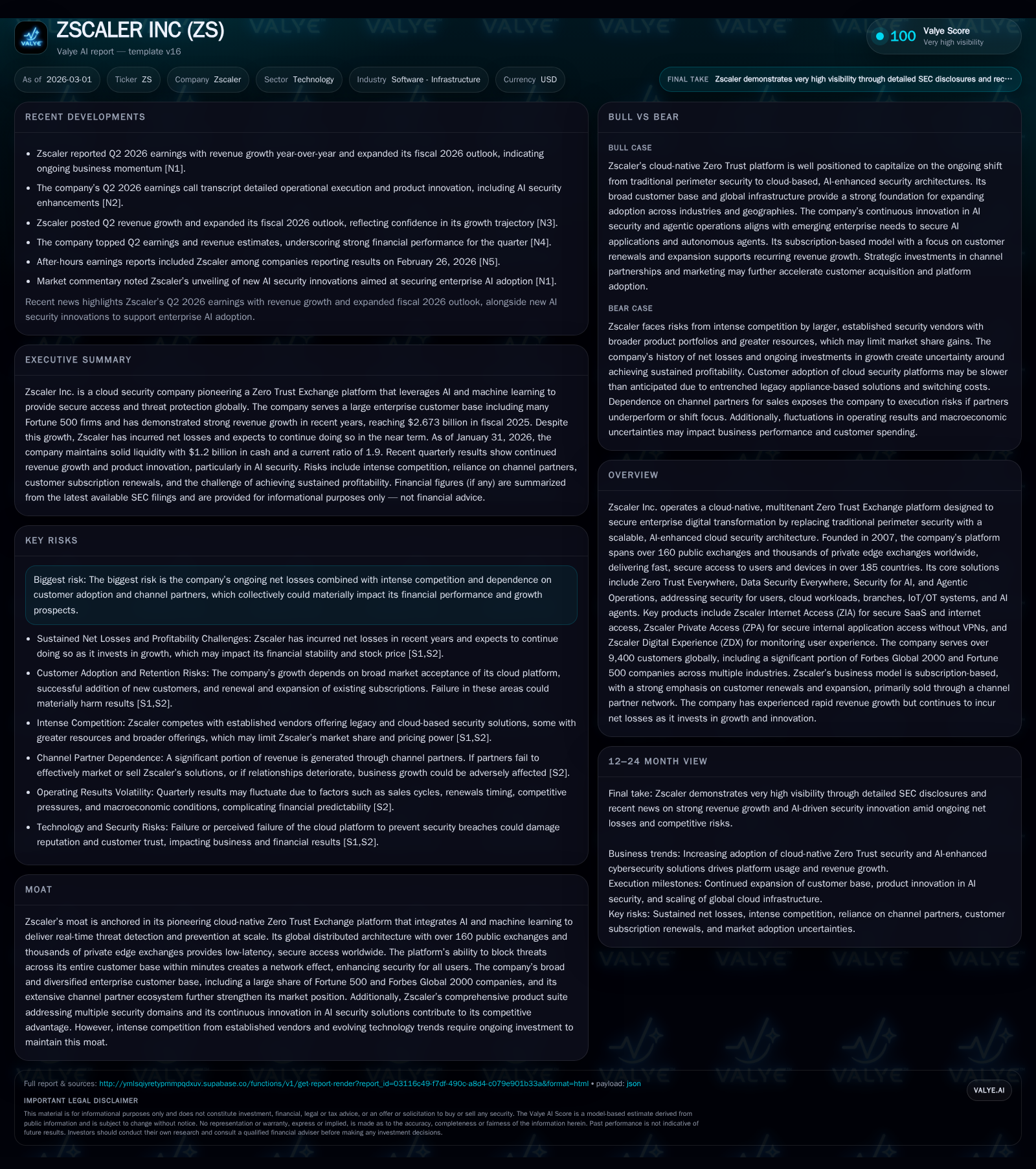
Zscaler Inc. has demonstrated strong top-line momentum, expanding revenues from $1.6 billion in FY2023 to $2.67 billion in FY2025, powered by increasing enterprise adoption of its cloud-native Zero Trust Exchange platform integrated with cutting-edge AI security features. Despite this growth, the company continues to post net losses, albeit with improvement in operating income and notable free cash flow generation enabling ongoing investment in product innovation and global infrastructure expansion. Key risk factors include competitive pressures, reliance on channel partners, and regulatory compliance challenges that may impact growth sustainability and capital allocation decisions.
Evolution of Zscaler's Revenue Growth and Profitability Trajectory
Zscaler's financial trajectory over the past four fiscal years underscores its rapid expansion within the cloud infrastructure security industry, particularly its leadership stance in Zero Trust architecture. Its revenue surged notably from approximately $1.6 billion in FY2023 to around $2.67 billion in FY2025, representing compound annual growth rates exceeding 20% [F1]. This acceleration reflects strong enterprise uptake of Zscaler's cloud-native Zero Trust Exchange platform, which replaces traditional perimeter-based security with a distributed architecture optimized for modern digital environments.
Despite this revenue surge, profitability challenges persist. Operating income losses have narrowed from a significant deficit of nearly $327 million in FY2022 to approximately $128 million by FY2025 [F1]. Similarly, net losses have improved from around $390 million in FY2022 down to roughly $42 million as of FY2025 [F1]. This trend highlights a gradual progression towards operational scalability but also emphasizes continued reinvestment into R&D and sales capabilities as strategic growth enablers.
Operating expenses have increased alongside revenue due primarily to investments in technology innovation and global sales expansion efforts. Capital expenditures expanded consistent with infrastructure buildout supporting over 160 public and thousands of private edge exchanges worldwide [S1].
Historical Financial Summary FY2022-FY2025
Historical performance (annual)
| FY | Net ($mm) | CFO ($mm) | OpInc ($mm) | Capex ($mm) | Net YoY |
|---|---|---|---|---|---|
| 2025 | -41 | 972 | -128 | 164 | +28.1% |
| 2024 | -58 | 780 | -121 | 145 | +71.5% |
| 2023 | -202 | 462 | -235 | 97 | +48.2% |
| 2022 | -390 | 322 | -327 | 69 |
Source: SEC companyfacts cache [F1].
Capital returns and efficiency (annual)
| FY | FCF ($mm) | ROE% |
|---|---|---|
| 2025 | 808 | -2.3 |
| 2024 | 635 | -4.5 |
| 2023 | 365 | -27.9 |
| 2022 | 253 | -68.1 |
Source: SEC companyfacts cache [F1].
Note: Revenue figures are sourced directly from SEC filings; operating income and net income YoY calculations are derived from reported values [F1].
The Role of AI Enhancements in Expanding Zscaler’s Security Platform Offerings
Zscaler is actively integrating artificial intelligence (AI) capabilities into its platform suite to address evolving cybersecurity threats amplified by widespread AI adoption [N9][N10][N11][S1]. The emerging products, such as 'Security for AI' and 'Agentic Operations', augment the Zero Trust Exchange by embedding real-time threat detection powered by machine learning (ML), automation for operational efficiencies, and advanced controls tailored for safeguarding AI agents and workloads.
This AI integration represents a competitive differentiator by enabling Zscaler’s cloud platform to rapidly identify novel attack vectors—particularly those leveraging generative AI—and propagate threat intelligence globally within minutes through its multitenant architecture [S1]. The platform thus benefits from network effect externalities where detection improvements within one customer environment bolster protection across the entire ecosystem.
Given the rapid evolution of AI-driven cyber threats—as evidenced by a reported year-over-year surge exceeding 90% in AI activity—Zscaler’s strategic focus on embedding AI securely aligns with both customer demands for comprehensive defenses and regulatory expectations evolving around responsible AI deployment [N12][S13]. However, operating responsibly within a complex regulatory landscape for AI also necessitates additional internal controls and compliance investments highlighted within risk disclosures [S7][S14].
Revenue Expansion Drivers: Enterprise Adoption and Channel Partner Influence
A cornerstone of Zscaler's revenue growth is widespread enterprise adoption across diverse sectors including financial services, healthcare, government, manufacturing, technology, and telecommunications [S1]. The company counts approximately 40% of the Forbes Global 2000 companies and more than 45% of Fortune 500 firms among its customers [S1], demonstrating significant penetration into high-value accounts driving subscription upsells.
Zscaler’s global distributed network architecture offers low-latency secure access spanning over 185 countries via its extensive footprint of public and private exchanges [S1], supporting complex multinational deployments essential for large enterprises undertaking cloud transformation journeys.
The company heavily leverages an extensive channel partner ecosystem comprising global systems integrators and regional telecommunications providers critical for customer acquisition and expansion [S2][S25]. Sales through its top five channel partners accounted for about 28% of total revenue in FY2025 [S25], underscoring dependencies on these relationships.
However, channel partnerships introduce execution risks since agreements are generally non-exclusive; partners may promote competing solutions or promptly discontinue marketing efforts without penalties [S25]. Additionally, variability in channel partner effectiveness can affect renewal rates and service quality impacting customer satisfaction.
Subscription renewals remain a key performance indicator as contracts typically span one to three years with some provisions allowing early termination subject to penalties [S11]. The company's ability to maintain or improve renewal rates while growing user counts within existing accounts will materially influence future revenue trajectories.
Financial Health and Capital Allocation: Balancing Operating Losses with Strong Cash Flow
While Zscaler has yet to consistently report net profits, its strong cash flow profile considerably enhances operational flexibility [F1]. Operating cash flow increased from approximately $322 million in FY2022 to about $972 million in FY2025—a compound annual growth rate near +50%—reflecting improved collections efficiency amid scaling revenues [F1].
Capital expenditures rose steadily alongside cash flow demands—from $69 million in FY2022 up to $164 million by FY2025—invested primarily into platform infrastructure expansions supporting global edge deployments integral to maintaining service levels [F1][S1]. The incremental capex supports high availability commitments backed by service level agreements exceeding industry norms [S15].
Free cash flow (operating cash flow less capex) approximated $808 million in FY2025—highlighting robust liquidity despite ongoing operating losses—and funds internal R&D initiatives including AI feature sets without immediate reliance on external financing [F1]. Current assets surpassed current liabilities nearly twofold at the start of calendar year 2026 (current ratio ~1.9), indicating solid short-term liquidity preservation [F1][S5].
Notably absent are share repurchases or dividends since IPO-era periods indicating capital allocation remains focused on reinvestment rather than shareholder return at this stage [F1]; management commentary suggests continuing prioritization of scaling efforts over distributions given market opportunity size and competitive dynamics.
Competitive Pressures and Risk Factors Impacting Growth Sustainability
Zscaler faces intensifying competition across multiple fronts including independent IT security vendors offering point solutions (e.g., firewalls, CASB), larger incumbent networking providers bundling proprietary security features, as well as emerging players leveraging advances in AI technologies to disrupt cloud security paradigms [S13][S17][S19]. Such competitors often bring broader product portfolios, deeper pockets for R&D investment, established client relationships, or entrenched on-premise appliance deployments challenging customer migration toward Zero Trust models.
The highly fragmented market also sees smaller innovative startups accelerating feature development cycles enabled by advanced ML tooling raising barriers for incumbents like Zscaler who must balance innovation pace against scale requirements.
Additional headwinds stem from channel partner risks where partners might pivot toward competing offerings or face operational disruptions due to geopolitical tensions or macroeconomic volatility affecting their business models [S25][S24]. Regulatory burdens tied to data privacy laws including GDPR-like regimes outside the US introduce complexity requiring ongoing compliance investments with potential fines or reputational damage if mishandled [S4][S14][S22]. Intellectual property disputes pose further uncertainty with patent infringement claims requiring defensive posturing that can divert resources away from core innovation initiatives[S6][S8][S10].
The combination of these factors compels vigilance over competitive differentiation through superior platform capabilities—especially those incorporating sophisticated AI analytics—and maintaining resilient customer relationships backed by scalable delivery models.
Strategic Outlook: What to Monitor in Zscaler’s Growth and Profitability Path
Recent quarterly results released February 26, 2026 indicate continued outperformance relative to consensus revenue estimates alongside an upward revision of full fiscal year guidance for FY26 revenue growth rates suggesting confidence in sustained demand trends for the company’s expanded cloud security offerings inclusive of AI-enabled modules [N1][N3][N4].
Key areas investors should watch include:
- Subscription renewal rates–critical metrics reflecting customer retention resilience amid economic fluctuations;
- Expansion within existing accounts through cross-selling additional modules like Security for AI or Data Security Everywhere;
- Pricing power enabling margin improvement despite competitive pricing pressure;
- Progress toward narrowing operating losses via operational leverage stemming from scale efficiency after heavy upfront investments;
- Execution against channel enablement strategies minimizing dependency risks while broadening reach;
- Developments in regulatory compliance especially around evolving international frameworks governing AI applications.
These factors collectively shape market sentiment around the sustainability of Zscaler’s robust revenue momentum transitioning eventually toward profitability inflection points.
Disclaimer: This is research-only, informational analysis and not investment advice. It may include AI-generated interpretation and general industry context. Always verify important details using primary sources.

Comments