
Abpro Holdings Faces OTC Transition and Scientific Challenges in Insulin Development
Abpro’s delisting from Nasdaq and ongoing R&D efforts highlight liquidity pressures amid evolving biopharma regulatory hurdles.
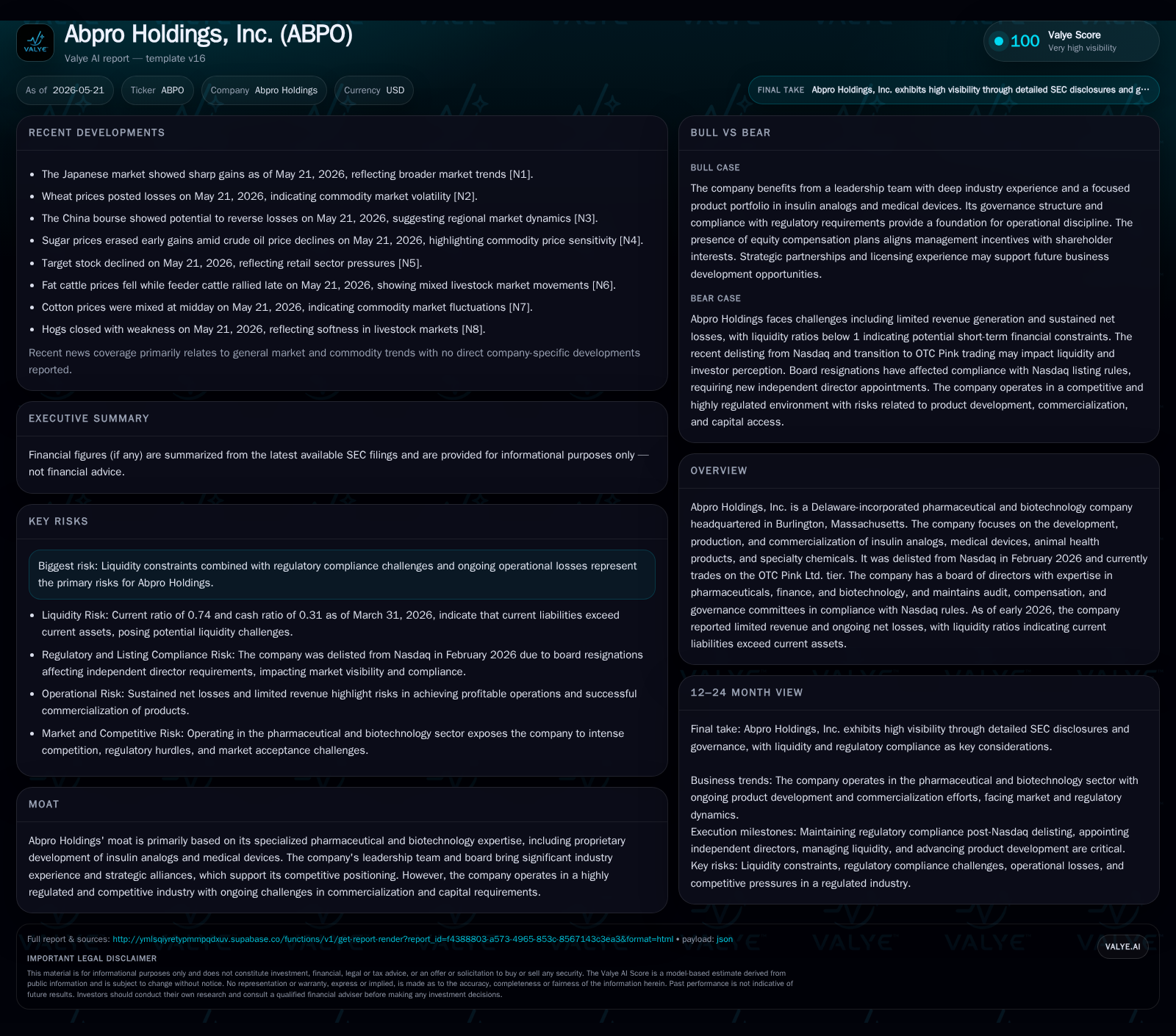
In its latest quarterly filing, Abpro Holdings disclosed continuing operational losses and a transition to OTC Pink trading following Nasdaq delisting due to minimum equity compliance failures. The company’s diversified pharmaceutical portfolio includes insulin analogs, medical devices, and specialty chemicals, but faces steep challenges from regulatory rigor and capital intensity typical of biotech development. Growth depends on advancing product candidates through clinical and regulatory milestones and forging strategic alliances, while liquidity constraints and limited revenue generation pose significant risks to execution.
Latest Operating Update: Post-Nasdaq Status and Quarterly Results
The most immediate development shaping Abpro Holdings’ outlook is its delisting from the Nasdaq Stock Market in February 2026 due to failure to meet minimum equity requirements under Nasdaq Listing Rule 5550(b)(1) [S19]. Following this action, the company’s common stock transitioned to OTC Pink Ltd. tier quotation as of February 23, 2026 [S1][S4]. This shift significantly reduces trading liquidity, investor accessibility, and overall market transparency—factors that inherently increase share price volatility and complicate capital-raising efforts. Although Abpro continues timely SEC filings including its May 20, 2026 10-Q which reconfirms no material updates in risk factors compared to its prior annual report [S2], this status signals operational headwinds.
Additionally, recent governance shifts evidenced by two director resignations early 2026 triggered non-compliance with Nasdaq independence rules for board composition; however, appointments of new directors with pharmaceutical finance expertise suggest attempts to stabilize oversight [S8][S26]. These moves indicate an ongoing internal effort to address structural corporate governance criteria despite public-market setbacks.
Business Model and Product Portfolio: Insulin Analogs, Devices, and Specialty Chemicals
Abpro Holdings operates a multi-pronged pharmaceutical biotechnology business model centered on specialized biotech product development. Its core offerings include proprietary insulin analogs designed to address diabetes management—a sector demanding complex biological molecule engineering combined with precise delivery mechanisms [S1]. Beyond human therapeutics, Abpro also develops complementary medical devices aimed at patient treatment facilitation, alongside animal health adjunct products indicating diversified biopharma exposure. Further breadth comes from specialty chemical manufacturing targeting niche industrial or pharmaceutical applications.
Revenue generation primarily derives from sales or licensing agreements with hospitals, pharmaceutical partners, or distributors who value product efficacy tied to extensive regulatory approval [F1][S1]. Switching costs for customers remain elevated due to strict FDA or global health authority certifications governing biosimilars and medical devices; thus product differentiation through molecular innovation is critical. However, biologic drug development demands substantial R&D capital investment over long timelines with inherent technical risk—this shapes Abpro’s need for sustained funding amid modest current revenue reported in the low hundreds of thousands as of year-end 2024
Industry Context: Competition, Regulation, and Market Dynamics
Abpro's insulin analogs place it squarely within a competitive landscape dominated by large pharmaceutical incumbents wielding extensive manufacturing scale and entrenched market share. Such players benefit from economies of scale that can pressure pricing power for smaller entrants attempting market penetration with novel biologics [S1]. Regulatory scrutiny in developing biosimilars and innovative molecules remains stringent globally; adherence necessitates expensive clinical trials and rigorous validation processes.
Capacity constraints in biologic manufacturing add complexity across the value chain—from sourcing raw materials to ensuring GMP-compliant production facilities—limiting swift scalability once commercialized. These factors collectively produce a challenging operating environment typical for emerging biotechnology firms striving for commercial viability beyond initial research stages.
Growth Drivers: Product Development, Strategic Alliances, and Market Opportunities
Key growth avenues for Abpro hinge on successfully navigating clinical development pathways for lead candidates through regulatory approval thresholds [S9][S11]. For example, the FDA's clearance of an Investigational New Drug (IND) application in early 2026 for ABP-102/CT-P72—a multispecific antibody oncology program co-developed with Celltrion Inc.—represents tangible pipeline progress suggesting potential new therapeutic entries outside diabetes products
Strategic partnerships or licensing deals remain critical levers to augment distribution capabilities and share development risk with established industry participants possessing broader sales networks or capital resources. Additionally, commercialization prospects exist within its medical device portfolio and animal health segment once regulatory approvals are secured.
Board-level enhancements bringing financial strategy acumen aim to optimize funding structures supporting such developmental milestones [S8], potentially enabling refined capital allocation focused on highest-value projects.
Risks and Constraints: Liquidity Pressures, Regulatory Hurdles, and Commercial Traction
Despite promising scientific initiatives, Abpro confronts acute risks primarily tied to its constrained liquidity profile. As of March 31, 2026 quarter-end data reveal current liabilities ($9.12 million) exceed current assets ($6.7 million), yielding a current ratio of approximately 0.74—a structural shortfall indicative of working capital strain [F1][S2]. This gap exacerbates financing risk amid ongoing net operating losses documented since prior periods.
Operating on the OTC Pink tier following Nasdaq delisting elevates these risks by limiting institutional investor participation due to reduced reporting visibility and thin trading volumes that impair stock price stability. Further regulatory compliance demands inherent in biologic drug approval processes—often protracted by unpredictable clinical trial outcomes—increase timeline uncertainty that can delay commercial revenue realization.
Limited top-line performance—with reported revenues last under $200k as of December 2024—reflects the early-stage commercial ramp typical for biotech pioneers but underscores dependence on successful milestone achievements and external funding infusion [F1][S1]. Governance disruptions also pose execution hazards when correlating leadership capacity to navigate multifaceted scientific workflows.
What to Monitor Next: Compliance Milestones, Product Approvals, and Financial Health
Upcoming indicators warrant careful observation include any reverse trajectory toward Nasdaq relisting compliance driven by equity improvements or board restructuring initiatives detailed in regulatory disclosures [S2][S19]. Regulatory communications concerning pivotal trial initiations or progression timelines—especially tied to antibody programs or device approvals—serve as proxies for validating technical feasibility.
Financially, quarterly cash flow trends relative to burn rate will reveal sustainability over successive quarters absent major financing rounds. Announcements regarding strategic collaborations or licensing arrangements could further evidence pathway commercialization effectiveness.
Further assessment should focus on internal control audits or management commentary shifts that might prelude fundamental operational turnaround or signal deteriorating fundamentals within the volatile early-stage biopharma context.
Financial Position Snapshot: Liquidity, Capital Structure, and Cash Burn
Although detailed recent quarter income statement data are not explicitly cited here beyond operating loss tracks from previous filings (operating income was -$8.45 million as of December 2025) [F1], balance sheet metrics tell a critical story about near-term survival challenges. Cash & equivalents stood at $2.85 million at end-2024 with total debt relatively low at $170k (mid-2025), producing net debt effectively negative but overshadowed by large current liabilities accrued by early 2026 quarter-end ($9.12 million), surpassing current assets ($6.7 million) (current ratio ~0.74) [F1].
This structural imbalance highlights pressing liquidity risks necessitating fresh capital inflows or cost containment strategies; otherwise maintaining R&D spend essential for product pipeline advancement becomes untenable without dilution effects or creditor concessions.
This analysis is based solely on publicly filed SEC disclosures up to May 2026 combined with sector-contextual insights relevant to biotechnology firms engaged in insulin analog development and related specialty pharma businesses. It does not constitute investment advice.
Disclaimer: This is research-only, informational analysis and not investment advice. It may include AI-generated interpretation and general industry context. Always verify important details using primary sources.

Comments