
American Clean Resources Navigates Permitting and Financing Hurdles to Launch Specialized Toll Milling
ACRG remains focused on developing a niche precious metals processing facility amid significant regulatory and financial constraints.
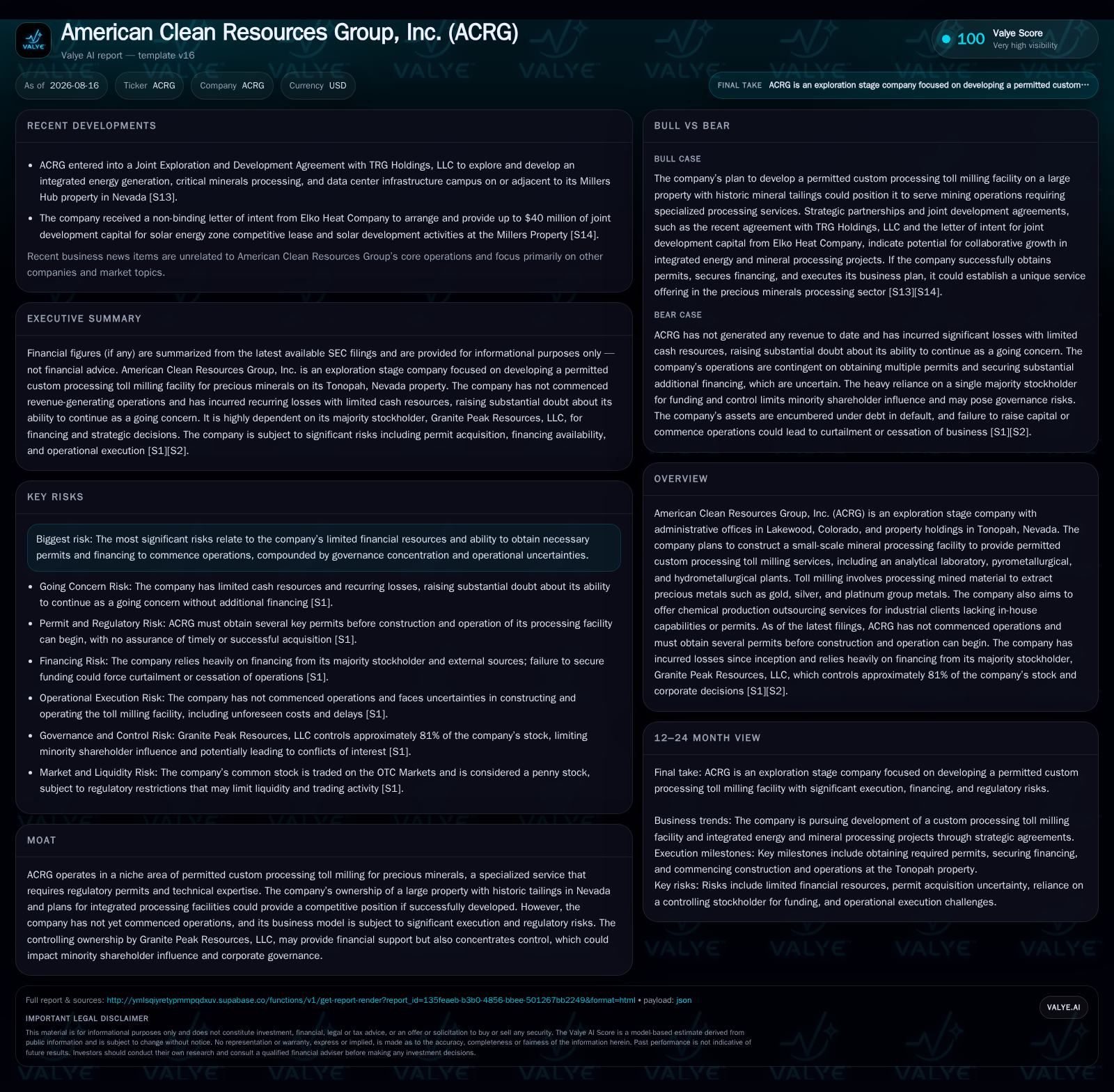
American Clean Resources Group, Inc. (ACRG) is an exploration stage company planning to build a permitted custom toll milling facility for precious metals extraction in Nevada. Despite owning valuable property with historic tailings, the company has yet to commence operations and faces substantial regulatory and financing challenges. Recent developments include a Joint Exploration and Development Agreement aimed at critical minerals recovery and ongoing reliance on its majority owner for capital support. Operational commencement hinges critically on permit acquisitions, capital funding, and execution of the construction plan.
Recent Operating Update
American Clean Resources Group, Inc. (ACRG) filed its latest quarterly report on August 14, 2026, confirming that the company continues as an exploration stage entity with no commencement of revenue-generating operations [S2]. The filing reinforces that ACRG must obtain significant environmental and operational permits before construction can begin on its planned small-scale mineral processing toll milling facility located in Tonopah, Nevada. This delay directly impacts the timeline for revenue generation and operational scale-up.
Key recent progress includes a material July 2026 announcement of a Joint Exploration and Development Agreement (Elko JEDA) with TRG Holdings focused on developing a critical mineral processing hub in northern Nevada [S3]. The agreement aims to jointly explore federally designated critical minerals recoverable from geothermal brine without conventional hardrock mining. While not constituting an operating joint venture yet, this binding framework showcases ACRG's strategic shift toward integrating emerging critical mineral streams relevant to clean energy transitions.
Another noteworthy development is ACRG's ongoing pursuit of financing arrangements; a July 2026 letter of intent from Elko Heat Company indicates potential access to up to $40 million in joint development capital directed toward solar energy zone competitive lease activities related to the Millers Property in Esmeralda County, Nevada [S12]. Although non-binding, these capital commitments hint at possible financial support for associated infrastructure that could indirectly benefit ACRG's processing ambitions
Business Model Overview
ACRG aims to operate as a permitted custom processing toll milling service provider focusing primarily on precious metals such as gold, silver, and platinum group metals [S1]. The company's business plan entails constructing an integrated site comprising an analytical laboratory, pyrometallurgical plant, and hydrometallurgical recovery plant. Toll milling involves treating ore owned by third parties without ownership transfer; ACRG would charge fees based on tonnage processed or ounces of metal recovered.
This fee-for-service model allows mining operators or mineral owners to outsource complex metallurgical extractions without investing in costly infrastructure themselves. By tailoring processes specifically to each ore type—employing crushing, grinding, chemical leaching, smelting, or refining methods—ACRG expects to maximize precious metal recovery rates while controlling operational costs.
Complementing toll milling services is a planned chemical production outsourcing arm designed to serve industrial customers lacking licensing or operational capacity for onsite chemical manufacturing [S1]. This diversification could mitigate revenue volatility inherent in toll milling contracts by adding contracted steady cash flows from bulk chemical handling agreements
Industry Structure and Competitive Position
ACRG situates itself within the mineral processing and custom toll milling industry—a capital intensive, technical niche downstream of active mining extraction. Companies in this sector typically serve as intermediaries converting raw mined ore into marketable concentrates or pure metals through specialized processing steps including pyrometallurgy (high-temperature metal extraction), hydrometallurgy (chemical leaching), and comprehensive assaying via analytical laboratories.
Key metrics defining operational success include processing throughput capacity (tons per day), metal recovery efficiency percentages that determine extractable value profitability, utilization rates of processing plants indicating contract pipeline strength—and compliance with stringent permitting regimes governing environmental impact.
Peers include established integrated precious metals processors like Hecla Mining Company which control upstream mining assets as well as downstream facilities; Coeur Mining operates toll milling units targeting similar metals with broader geographic diversification. Smaller custom mill operators like Heath & Sherwood provide tailored services but generally lack scale compared with ACRG's ambitious hub plans.
Geographically, operating permitted facilities in regulated jurisdictions like Nevada demands rigorous environmental review processes causing development timelines often measured in years—not months—thus shaping competitive entry barriers around strategic permitting capabilities. Technical expertise availability in metallurgical engineering further differentiates operators capable of managing diverse ore types effectively.
Growth Drivers
Growth prospects for ACRG hinge primarily on several structural industry trends:
- Rising global demand for precious metals driven by increasing use cases in electronics, automotive catalytic converters (platinum), jewelry, and investment hedges sustains mining activity expansion.
- Increasing outsourcing by mid-tier miners seeking capital-light models encourages utilization of third-party toll mill processors rather than direct infrastructure investments.
- Regulatory incentives promoting environmentally compliant processing foster demand for permitted facilities incorporating advanced hydrometallurgical techniques that reduce emissions relative to traditional smelting.
- Expansion into critical minerals linked to clean technology (e.g., lithium precursors) through partnerships like the Elko JEDA could unlock new feedstock streams beyond conventional tailings or carbon concentrates.
- Construction milestones such as permit acquisition completions, financing closures delivering capex for plant buildout, securing initial toll milling contracts will materially validate growth trajectory.
Effective commissioning leading to ramp-up will be signaled by improving projected KPIs such as tracking throughput scaling towards design capacity tons per day alongside incremental metal recovery rate enhancements ensuring economic margins.
Risks and Constraints
The company faces acute execution risks shaped by its early-stage development profile:
- Regulatory: No permits have yet been secured for construction or operations at Tonopah; delays or denials in obtaining necessary air quality licenses, water use permits, hazardous materials handling authorizations pose existential hurdles [S1].
- Financial: Chronic net losses totaling approximately $115 million accumulated since inception alongside near zero working capital availability undercut organic funding ability, making sustained reliance on its majority stockholder Granite Peak Resources LLC indispensable but potentially limiting financial flexibility.
- Ownership Concentration: Granite Peak owns ~81% stock voting power enabling unilateral control over corporate governance matters which raises minority shareholder governance risk especially regarding strategic decisions or related party transactions [S1].
- Operational: Constructing technically complex pyrometallurgical and hydrometallurgical plants requires skilled labor plus effective project management; any cost overruns or delays can further strain liquidity.
- Market: Fluctuations in commodity prices can reduce mining volumes sent for toll milling; competition from vertically integrated miners owning their own processing reduces addressable contract opportunities.
- Contractual: Lack of disclosed signed toll milling contracts leaves revenue backlog visibility opaque until facility commissioning approaches.
What To Watch Next
Stakeholders should monitor several milestones turning points indicating material progress:
- Permit Developments: Any public milestones regarding securing conditional use permits or environmental approvals validating project viability timelines would reduce uncertainty.
- Financing Announcements: Confirmation of definitive funding arrangements beyond letters of intent—especially capital deployed toward physical plant construction—would materially improve financial outlook.
- Construction Progress: Initiation of groundwork or procurement contracting signals pathway toward commercial operations commencement impacting future revenue visibility.
- Contract Signings: Reported agreements with mining operators providing ore feedstock under contractual tolling terms reflect growing utilization backlog critical for cash flow scaling.
- Strategic Partnerships: Further development or formalization around the Elko JEDA or similar partnerships affecting critical minerals extraction scope may suggest business model expansion beyond precious metals alone.
Tracking improvements across operating KPIs such as throughput capacities installed/commissioned or assay lab utilization also provide operational insights once active.
Financial Profile Discussion
As per the latest available balance sheet data dated June 30, 2026 [F1], American Clean Resources maintains current assets approximating $8,642 versus current liabilities exceeding $5.24 million—a severely negative working capital position reflected in an effectively zero current ratio indicative of acute liquidity constraints. Cash balances reported earlier year-end March 31 stood at about $2,119 which underscores limited cash runway absent fresh capital injections [F1].
Operating losses persist reflecting ongoing expense absorption related to administrative costs supporting permit filing activities rather than productive operations which drive no revenues yet recorded [F1].
Capital expenditure requirements loom large given the planned construction of highly specialized ore crushing/grinding plants coupled with pyrometallurgical furnaces and hydrometallurgical tanks—all necessitating significant up-front capex before meaningful cash flow generation can occur. Unless supplemented by external funding sources or definitive joint venture proceeds consistent with recently initiated development agreements [S3], financial risk remains high.
This report synthesizes publicly available filings up to August 2026 without extrapolation beyond disclosed facts. It aims to contextualize American Clean Resources Group’s business within the mineral processing industry dynamics essential for assessing operational progress sans investment research view.
Disclaimer: This is research-only, informational analysis and not investment advice. It may include AI-generated interpretation and general industry context. Always verify important details using primary sources.

Comments