
RemSleep Holdings Restructures Commercial Strategy with DeltaWave Product Launch
Recent quarterly disclosures reveal RemSleep’s strategic shift to e-commerce sales and key regulatory approvals for DeltaWave amid leadership and financial restructuring.
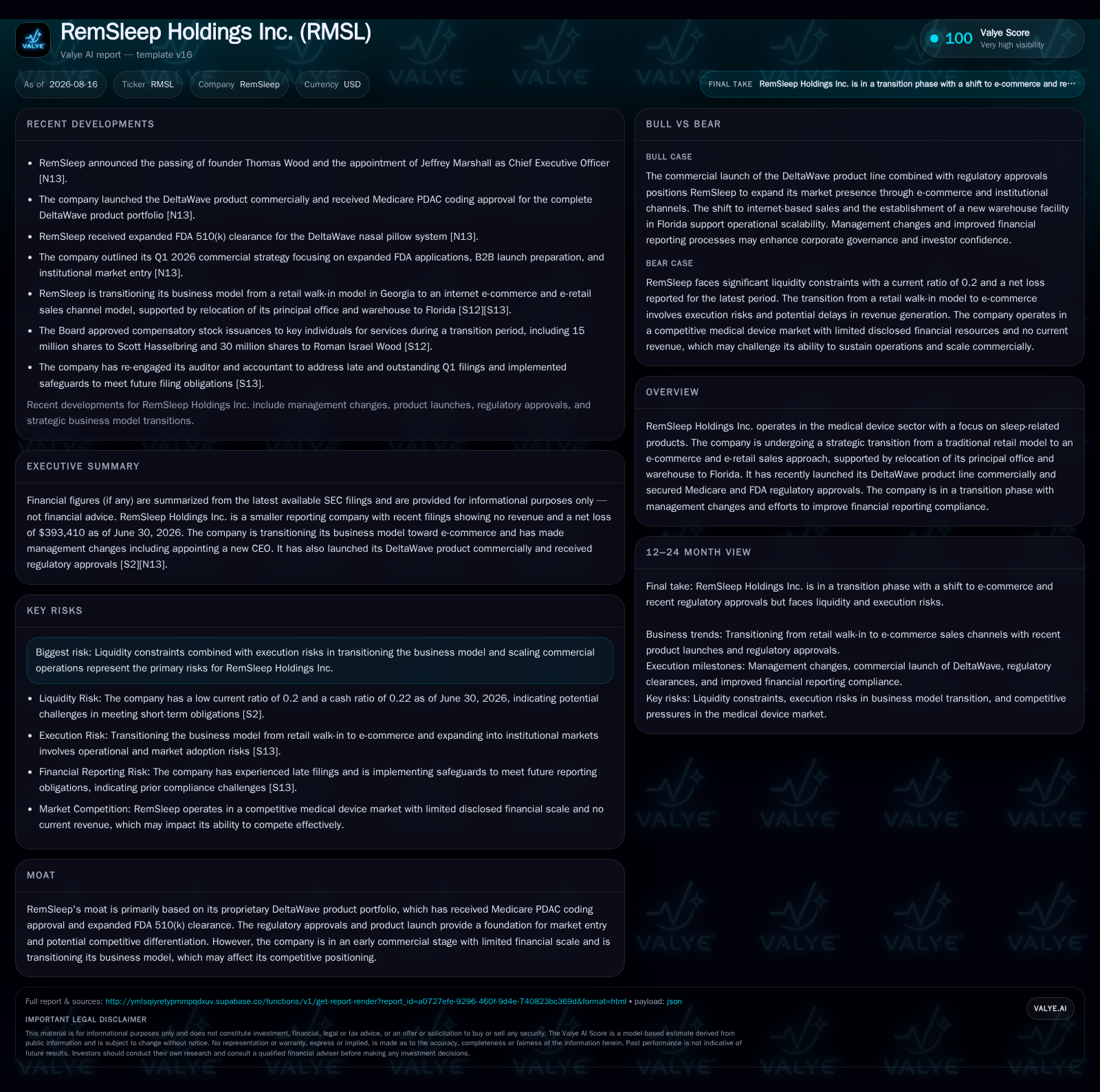
RemSleep Holdings Inc. is in a transformative phase marked by relocation, management overhaul, and commercialization efforts for its proprietary DeltaWave sleep device. The company has secured crucial FDA 510(k) clearance expansions and Medicare PDAC coding that underpin its reimbursement strategy and product launch. Transitioning from a legacy retail footprint to an e-commerce model based in Florida aims to scale sales but introduces execution risks amid liquidity constraints. RemSleep’s competitive positioning hinges on regulatory milestones against dominant peers, with growth opportunities tied to increasing sleep disorder prevalence and expanded insurance coverage.
Contents of the Latest Quarterly Filing Reflect Shifts in Control and Operations
RemSleep Holdings’ latest quarterly report dated August 14, 2026, highlights significant corporate restructuring alongside critical operational shifts. A pivotal event was the off-market sale of approximately 80% of preferred shares from Roman Israel Wood to an Ontario-based entity, consolidating control under 1000152403 ONTARIO INC [S3]. This transaction included assumption of related debts and obligations estimated at around $300,000 [S3], relieving some debt burden from the company while centralizing ownership.
Management changes accompanied this ownership realignment. The Board accepted multiple resignations including the former CEO, COO/Chairman, and President/Treasurer/Secretary positions by late May 2026 [S14]. Subsequently, new appointments occurred: Sanja Pekovic as CEO with medical research expertise focusing on translational medicine [S13,S22], Peter Downey as Interim President concentrating on corporate affairs and commercial scaling via e-commerce [S13], along with addition of Teresita Rubio as Treasurer/Chairman emphasizing financial oversight [S22]. These moves suggest a deliberate effort to blend scientific leadership with business development talent to steer transition.
Parallel to governance shifts was the strategic geographical move from a rural Georgia base to Florida for both corporate headquarters in West Palm Beach and a newly established warehouse in South Lake Worth [S8]. This relocation supports a more scalable supply chain architecture tailored for nationwide e-commerce distribution rather than localized foot traffic retail sales. The reopening of auditor relationships and steps toward compliance with overdue filings underlines management's intent to restore financial reporting discipline after prior lapses [S8]. Together these multifaceted changes position RemSleep at an inflection point poised between legacy structures and growth-driven operational models.
"DeltaWave Launch Backed by Critical Regulatory Milestones Drives Commercial Entry"
At the core of RemSleep’s commercial prospects is the DeltaWave product line—sleep apnea therapy devices utilizing proprietary technology. Regulatory progress enables this foundation: FDA 510(k) clearances have been expanded beyond initial approvals permitting broader market introduction [S1], while Medicare PDAC coding approval provides essential insurance reimbursement pathways facilitating customer affordability [S1]. This dual recognition forms a regulatory moat typical of durable medical equipment (DME) suppliers seeking payer acceptance as well as clinical validation benchmarks.
The mandatory reimbursement approval through Medicare is particularly material; it directly affects wholesale pricing power and accelerates provider adoption since patients face lower out-of-pocket costs. Securing these approvals signals that DeltaWave meets stringent safety and efficacy criteria critical for reimbursement contracts—a prerequisite not only for direct hospital or DME distributor sales but also increasingly for scaled direct-to-consumer access mediated via insurance coverage [F1]. As such, these milestones anchor RemSleep’s product launch viability in a highly regulated ecosystem where FDA clearance alone is insufficient without corresponding payer alignment.
"Transitioning Sales Model: From Legacy Retail Toward E-Commerce Distribution"
Historically reliant on a cash-and-carry walk-in retail model from its rural office in Blackshear, Georgia, RemSleep is actively pivoting toward online retail platforms such as eBay to expand both geographic reach and consumer accessibility nationwide [S8]. This channel evolution trades off close-proximity customer interaction for broader market penetration via digital storefronts.
This transition introduces several operational challenges: managing inventory turnover shifts from local replenishment cycles to centralized fulfillment requiring robust logistic capabilities; order fulfillment speed and accuracy become critical KPIs directly affecting customer satisfaction and repeat business; marketing spend dynamics shift toward digital advertising metrics such as customer acquisition cost; and customer service must adjust to remote support rather than face-to-face interactions typical in traditional retail models.
The establishment of a dedicated warehouse in Florida aligns with these demands by strategically positioning inventory closer to populous regions with superior shipping infrastructure compared to prior rural locations. Nonetheless, this scaling phase necessitates developing standardized processes for inventory management, supply chain reliability, and cost control—areas that historically pose execution risk given RemSleep’s limited operational track record at scale [S8].
"Competitive Positioning: Proprietary Technology, Regulatory Edge, but Limited Scale"
RemSleep faces entrenched competition from industry stalwarts like ResMed and Philips Respironics who dominate sleep apnea device markets due to extensive portfolios, large-scale manufacturing capacity, integrated distribution networks including strong ties to healthcare providers and insurers, plus proven reimbursement negotiation capabilities. Unlike these well-capitalized peers with diversified offerings across respiratory care segments including software-enabled solutions for patient adherence monitoring, RemSleep remains confined primarily to its nascent DeltaWave line just entering commercialization.
While the Medicare PDAC coding endorsement bolsters the company’s device credibility relative to generic competitors lacking reimbursement status, RemSleep’s small scale constrains bargaining leverage with distributors or payers generally motivated by volume discounts or long-term partnerships. In addition, its early stage means limited revenue history or margin data complicates vendor confidence.
Therefore, differentiation rests heavily on demonstrating clinical efficacy alongside efficient cost structures enabled by e-commerce direct-to-consumer channels that could circumvent traditional middleman markups over time—a strategy partially analogous but less mature than peers’ integrated ecosystem approaches combining hardware plus digital services.
"Growth Opportunities Arising from Reimbursement Approvals and Market Trends"
The sleep therapy device market benefits from structural tailwinds such as increasing global prevalence of obstructive sleep apnea driven by aging populations and rising obesity rates. Improved diagnostic rates via accessible home sleep testing create larger addressable markets for therapeutic devices. Expanded Medicare coverage amplifies economic incentives for patient uptake beyond cash-pay customers.
By executing its e-commerce push successfully post-warehouse relocation, RemSleep can harness direct-to-consumer pathways absent earlier geographic limits inherent in walk-in models. This channel shift not only widens reach but also leverages growing consumer comfort purchasing healthcare products online—a trend accelerated during pandemics.
"Navigating Execution Risks Amidst Financial Constraints and Management Overhaul"
Despite promising regulatory landmarks and strategic repositioning efforts, RemSleep remains financially strained as reflected in its latest balance sheet showing a concerning current ratio near 0.2—current assets roughly $79K versus current liabilities exceeding $397K at June-end 2026—indicating limited short-term liquidity buffer [F1]. Reported cash & equivalents stood near $88K as of March quarter end amid total long-term debt previously recorded around $152K though not formally updated recently—suggesting tight capital runway without fresh financing or substantial sales inflows [F1],[S3].
These constraints amplify risk around expanding commercial operations which generally require upfront inventory procurement capabilities plus marketing investments before revenue matures fully. Concurrently the leadership reshuffle introducing medically oriented CEO Pekovic alongside finance-strategic executives Downey/Rubio suggests internal attempts at balancing operational expertise versus governance stability during rapid transformation phases.
Moreover, Delays or missteps in product uptake due to competitive pressures or supply chain bottlenecks represent material threats given reliance on e-commerce logistics previously untested at scale within their new Florida facility. Such risks underscore the importance of disciplined capital allocation aligned tightly with execution priorities over ambitious expansion until break-even revenue levels emerge.
"Key Upcoming Milestones Defining Growth Scalability and Operational Execution"
Looking ahead critical checkpoints include timely catch-up on Q1 filings expected within granted extensions reflecting improved reporting compliance discipline manifested since auditor re-engagement last quarter [S8],[S2]. Monitoring unit sales progression during initial months post-DeltaWave launch will serve as tangible demand confirmation supporting sustainable revenue build-out versus one-off shipments.
Operational KPIs encompassing warehouse order processing efficiency—inventory turnover ratios and average order fulfillment times—will function as leading indicators whether Florida logistics setup adequately meets scalability needs.
Lastly additional regulatory or payer clearance updates extending device indications or insurance contract coverage would add incremental growth levers supporting broader commercialization beyond initial early adopters.
Financial Profile Discussion: Liquidity Strains and Capital Structure Implications
As of June 30, 2026, RemSleep reported current assets totaling approximately $79K against current liabilities near $397K resulting in an illiquid balance sheet position underscored by a low current ratio (~0.2) that constrains operating flexibility [F1]. Cash reserves were modest at around $88K three months earlier—insufficient alone to cover short-term obligations absent emergent revenues or refinance action.
Debt assumptions made during the recent preferred share transaction offload involving an Ontario-based investor may afford some relief through ownership consolidation coupled with associated debt obligations assumption (~$300K), potentially opening financing avenues while centralizing control influence [S3]. However this concentrated ownership might affect governance dynamics requiring careful monitoring.
Overall this profile emphasizes heightened execution risk necessitating sharp focus on revenue ramp pacing alongside lean expense management until sustained positive operating cash flow can be achieved. This financial backdrop corroborates earlier analysis stressing careful balancing between growth investments prompted by regulatory seeds planted versus financial prudence amidst fragile capital resources.
Disclaimer: This is research-only, informational analysis and not investment advice. It may include AI-generated interpretation and general industry context. Always verify important details using primary sources.

Comments