
Mag Mile Capital Advances Niche Real Estate Finance Amid Industry Headwinds
Mag Mile Capital’s latest quarterly report highlights strengths in specialized real estate lending alongside liquidity and cyclical market risks common in the sector.
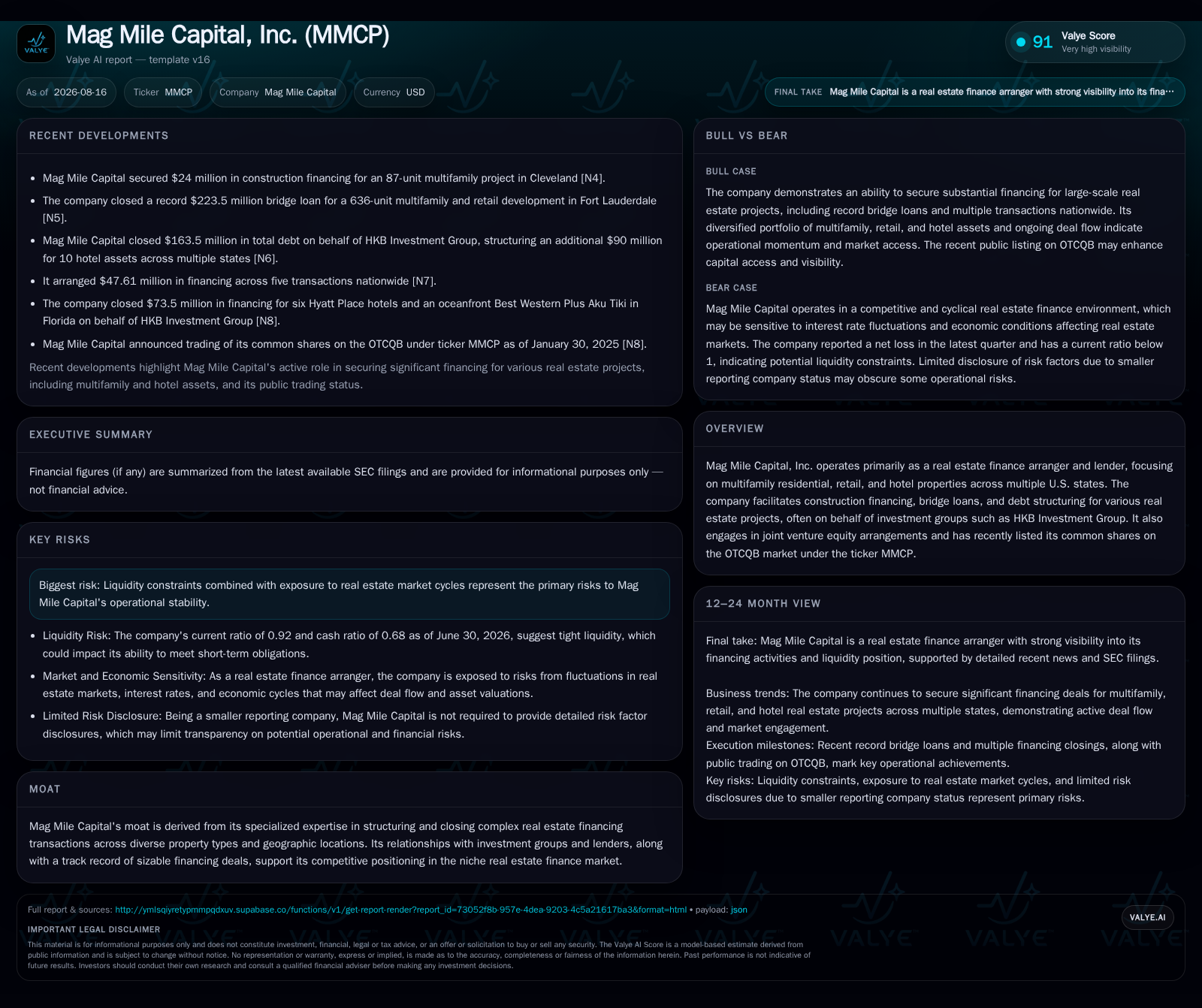
In its Q2 2026 filing, Mag Mile Capital, Inc. reaffirmed its focused business model as a niche real estate finance arranger and lender specializing in multifamily residential, retail, and hotel properties. The company’s value proposition centers on complex loan origination, bridge financing, and joint venture equity arrangements that differentiate it from broader commercial lender peers. However, liquidity constraints and exposure to real estate cycles remain key operational risks amid an uneven macro environment. Monitoring loan origination volume, credit quality, and funding capacity will be crucial to gauge execution going forward.
2026 Q2 Operating Report: What Changed for Mag Mile Capital?
Mag Mile Capital’s August 14, 2026 10-Q filing offers a relatively muted quarterly update without notable inflections in core operating metrics or legal contingencies [S2][S1][S3]. The company continues to position itself as a smaller reporting entity exempt from extensive disclosure requirements and confirms no outstanding material claims or litigation [S1][S3]. While no explicit figures were disclosed for quarterly loan origination volumes or portfolio credit quality shifts, the filing suggests ongoing activity consistent with its prior business trajectory. This limited but clean operating update indicates stable near-term performance but also underscores the relatively opaque nature of Mag Mile’s public financial communications.
The absence of regulatory or legal headwinds removes a common external risk variable, allowing focus on the company's fundamental lending operations during a period when real estate finance markets are cautious due to persistent rate fluctuations. The filing neither signals acceleration nor contraction in deal flow but serves as a foundational checkpoint to assess the business against industry dynamics.
Specialized Loan Origination in Real Estate Finance: MMCP’s Core Value Proposition
Mag Mile Capital operates at the intersection of lending facilitation and capital structuring primarily for multifamily residential, retail, and hotel property types spread across diverse U.S. states [S1]. Its business model relies heavily on originating construction financing and bridge loans that typically serve as short-to-medium duration capital injections needed during project development or repositioning phases. The company complements these debt-oriented services with joint venture equity arrangements where it participates directly in ownership stakes to enhance profitability beyond traditional interest yields.
Revenue streams accrue principally through interest income on originated loans alongside ancillary fees derived from loan origination and servicing activities [F1][S1]. This dual income source aligns with sector best practices seen among specialty finance companies that blend spread capture with fee generation to bolster overall margins. Importantly, Mag Mile’s underwriting approach emphasizes debt structuring complexity—engineering layered financing deals tailored for real estate investment groups aiming to optimize leverage while navigating heterogeneous market conditions.
This specialization cultivates barriers to entry given the demand for nuanced risk assessment and structural flexibility inherent in multifamily and hospitality asset classes. However, this niche positioning can expose the company to cyclical sensitivities particular to these property sectors which are vulnerable to economic shifts impacting rental incomes and occupancy rates.
Competitive Nuance: Mag Mile’s Position Among Specialty Lenders and Capital Providers
Within the broader industry ecosystem that includes specialty finance firms like Starwood Property Trust or Apollo Commercial Real Estate Finance, Mag Mile Capital occupies a smaller-scale intermediary role focused on bespoke deal execution rather than high-volume lending. Such peers benefit from greater capital base diversification and broader geographic coverage allowing enhanced pricing power and better absorption of credit shocks.
Mag Mile's competitive edge lies in its ability to close complex deals involving construction financing bridges coupled with joint venture equity stakes—activities less commoditized than conventional mortgage lending. Nonetheless, compared to major commercial bank lending arms with substantial deposits fueling real estate portfolios or larger mortgage REITs with public capital market access, Mag Mile confronts funding flexibility limitations that may restrain rapid growth or scale economics.
The relatively modest balance sheet size implies tighter scrutiny on underwriting discipline and prudential maintenance of liquidity buffers since any material credit misstep could strain operational continuity more acutely than for larger peers.
Prospects for Growth: Demand Drivers in Multifamily, Retail, and Hotel Financing Markets
Key growth catalysts stem from urbanization trends driving increased demand for multifamily housing units where affordability constraints favor transitional financing solutions such as those offered by Mag Mile [S1]. Additionally, revitalization of retail spaces post-pandemic combined with continued expansion of experiential hospitality properties fuels need for construction loans and bridge financing structures adapted to evolving tenant profiles.
The company's focus on geographic diversification mitigates concentration risk endemic to single-market operators, helping sustain deal pipeline volume amid regional economic variances. Moreover, innovative financing structures through joint venture equity deepen client relationships by aligning interests over project success horizons longer than typical lending tenors.
Liquidity Constraints and Market Cyclicality: Key Risks for Future Stability
As of June 30, 2026, Mag Mile reported current assets totaling approximately $703 thousand against nearly $760 thousand in current liabilities yielding a current ratio of around 0.92—a tight position signaling constrained near-term liquidity [F1]. Additionally, total debt recorded at approximately $150 thousand contrasts with cash & equivalents of about $514 thousand resulting in a net cash-positive stance near $364 thousand but without significant surplus cushion [F1].
This modest liquidity band underscores potential challenges for scaling loan origination activity or absorbing unexpected credit impairments without timely capital infusions. The sensitivity of the company’s portfolio mix—multifamily residential, retail properties, hotel projects—to economic cycles heightens vulnerability to reduced borrower demand during slowdowns or tightened borrowing conditions.
Credit risk pressure from non-performing loans mandates vigilant underwriting standards; any upward trend would necessitate provisioning impacting earnings stability. Unlike large diversified lenders buffered by scale or secured funding sources like repos or securitizations, Mag Mile depends critically on maintaining working capital adequacy supported by its balance sheet health.
What Investors Should Monitor Next: Pipeline, Credit Quality, Funding Conditions, Guidance Signals
Given the limited granularity currently available via public disclosures [S2], focus should rest on seeing explicit updates regarding:
- Loan origination volumes reflecting deal pipeline conversion rates,
- Non-performing loan ratios indicating credit risk trends,
- Progress on joint venture equity transactions showing deeper integration into project economics,
- Any shifts in funding sources or capital availability impacting liquidity posture.
Additional clarity through earnings guidance could enhance visibility around management's outlook amidst evolving market environments. Tracking these operational KPIs will allow stakeholders to assess whether Mag Mile sustains its niche specialization while adapting prudently to financial headwinds common within real estate finance sectors.
Financial Profile Discussion
Disclaimer: This is research-only, informational analysis and not investment advice. It may include AI-generated interpretation and general industry context. Always verify important details using primary sources.

Comments