
Lithium Corp’s Exploration Milestones Highlight Financing and Regulatory Challenges
Latest quarterly disclosures underscore Lithium Corp’s steady exploration in Nevada and British Columbia amid capital constraints and regulatory hurdles common to early-stage critical mineral miners.
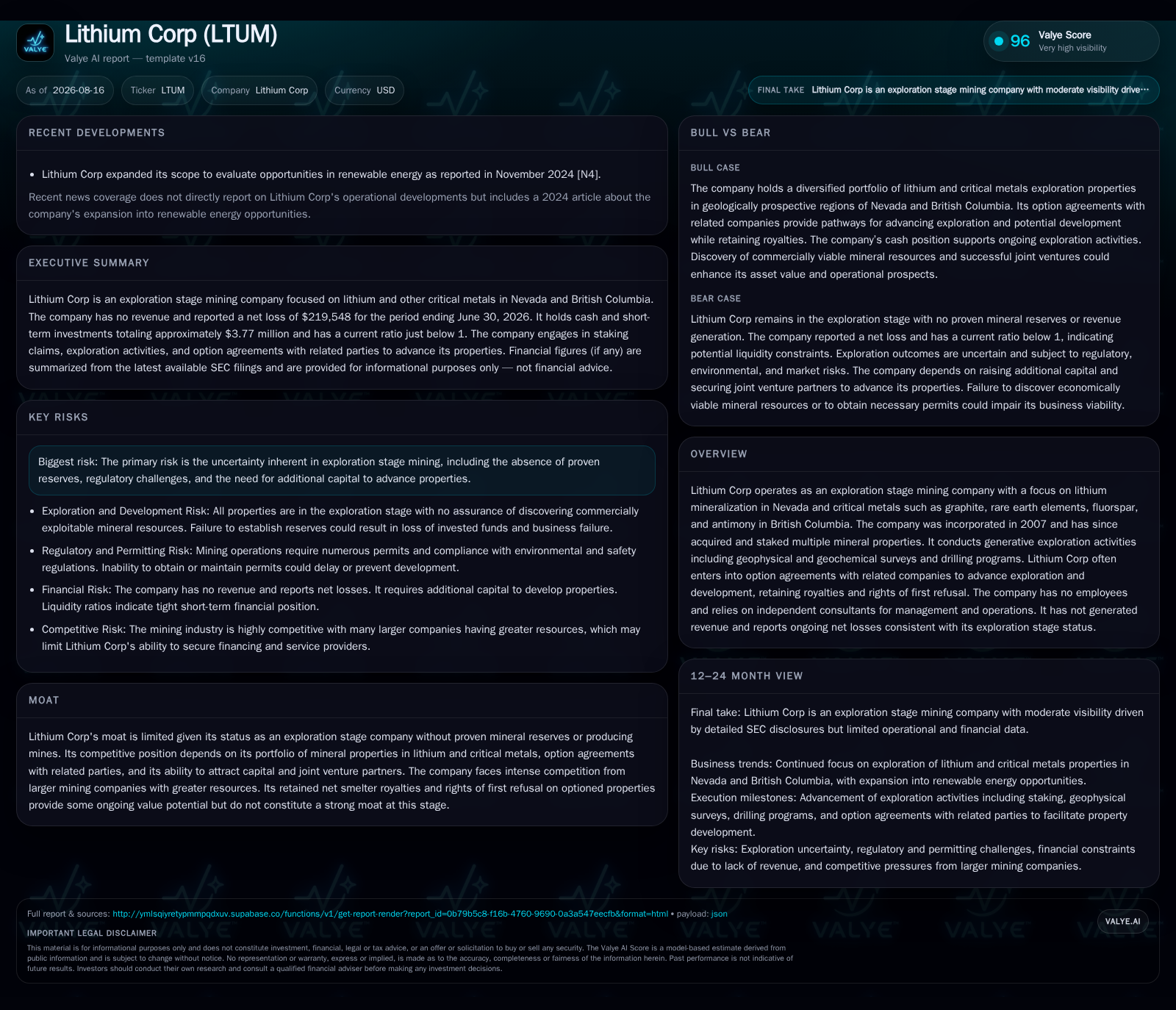
Lithium Corp remains an explorer focused on lithium and other critical metal properties in Nevada and British Columbia, advancing through drilling programs and geophysical surveys with no proven reserves or producing mines yet. The company's core monetization strategy involves option agreements that transfer operational advancement risks to partners while preserving royalty and right-of-first-refusal income potential. Despite steady exploration activities reported in its August 2026 10-Q, the firm faces typical risks such as financing challenges, regulatory permit dependencies, and competition from better-capitalized lithium producers. Key near-term markers include securing new option deals, regulatory approvals, and further exploratory results. Its financial profile reflects a tight liquidity position common among juniors, emphasizing need for continued capital access.
Quarterly Exploration Progress Signals Asset Development Trajectory but Reflects Enduring Early-Stage Nature
In its latest 10-Q filing dated August 14, 2026, Lithium Corp reported ongoing mineral exploration activities anchored in lithium mineralization prospects within Nevada’s Fish Lake Valley and critical metals projects in British Columbia [S2][S1]. The company continues to deploy geophysical surveys, geochemical sampling techniques, and drilling programs aimed at expanding its understanding of subsurface deposits. While these steps represent essential progression milestones typically required to advance an exploration property toward resource delineation, Lithium Corp remains devoid of SEC-defined mineral reserves or resources indicative of commercially exploitable quantities [S1]. This characteristic maintains its classification as an exploration-stage entity without producing mines or revenues.
The number of mineral properties held includes multiple optioned sites that diversify geographic and commodity exposure into lithium as well as graphite, rare earths, fluorspar, and antimony—critical metals presently benefiting from increasing market interest due to electrification trends [S1]. Drilling meters completed and exploration expenditure figures—though not detailed explicitly in the filing—are implicitly reflected in ongoing capital consumption patterns typical for similar juniors focused on early-stage discovery phases.
Monetization Through Option Agreements Drives LTUM’s Capital-Efficient Growth Model Amid Resource Uncertainty
A defining aspect of Lithium Corp’s business model is its reliance on option agreements with related parties to advance mineral properties through generative phases toward potential development [S1]. Rather than fully internalizing the capital-intensive risks associated with mine construction or production ramp-up, Lithium Corp strategically opts to option out these rights in exchange for cash payments or shares from counterparties undertaking operational responsibilities. This approach preserves a royalty interest—specifically net smelter return royalties—and rights of first refusal on those properties to capture residual upside potential without direct developmental execution risk.
This strategy offers a more sustainable path given the company’s limited internal operations infrastructure; it has no employees and outsources all management and technical work through third-party consultants [S1]. In contrast to some peers such as Lithium Americas Corp that pursue project development internally leveraging substantial financing rounds or joint ventures for advancement, Lithium Corp maintains an asset-light stance contingent on attracting counterparties willing to invest larger sums post-exploration stage.
Competitive Environment Highlights Financing Challenges Versus Major Producers and Junior Peers
Operating principally within Nevada and British Columbia—jurisdictions hosting significant mining activity—Lithium Corp contends with competition beyond geology alone. Larger lithium producers like Albemarle Corporation present formidable peers able to secure capital at scale while accessing advanced regulatory compliance capabilities that reduce permitting cycle risks [S1]. This competitive pressure complicates the company’s access to financing given its smaller scale, absence of production cash flow, and status as a smaller reporting company exempt from full risk factor disclosures under SEC rules.
Additionally, these larger players command stronger relationships with specialized service providers essential for timely drilling campaigns or environmental studies. Such dynamics heighten operational risk for Lithium Corp by potentially elongating project timelines or inflating costs relative to competitors with deeper pockets. The company acknowledges in regulatory disclosures that competitor presence may adversely impact its ability to compete effectively for both financial resources and technical services necessary for property advancement [S1].
Key Growth Catalysts: Demand Tailwinds for Lithium, Expansion of Critical Metals Portfolio, and Strategic Partnerships
While Lithium Corp’s near-term value hinges on uncertain exploratory outcomes, it operates within an industry growing structurally due to accelerating demand for battery-grade lithium underpinning electric vehicles (EVs) and energy storage solutions globally. Government incentives targeting critical mineral supply chain diversification support this trend by enhancing project economics via grants or permitting facilitation across Canada and the U.S.—regions where LTUM holds assets [S1]
Moreover, LTUM’s diversified portfolio including graphite and rare earth elements broadens optionality beyond lithium alone. Positive drill results or discovery announcements could catalyze renewed interest from strategic investors or major mining companies seeking access points into critical minerals mining beyond their current footprints. Execution of new option agreements further serves as concrete indicators of asset de-risking paired with external confidence in geological prospects.
Operational Risks: Regulatory Hurdles, Capital Access Constraints, Commodity Price Volatility
Lithium Corp explicitly recognizes the substantial operational risks inherent in exploration-centric enterprises. Chief among these are obtaining necessary permits required by numerous federal, state/provincial, local regulators governing land use, environmental protection standards, occupational safety norms, waste disposal requirements, mine safety provisions, export controls, taxation frameworks, labor laws, and hazardous materials handling—all noted jurisdictional regimes applicable in Nevada (U.S.) and British Columbia (Canada) [S1]. Failure or delay in any stage of permitting can stall or prohibit mining advancement regardless of deposit quality.
Concurrently, absence of revenue generation necessitates continuous capital raises to fund costly exploration expenditures; failure to secure adequate funding could halt promising projects mid-cycle leading to value erosion. Commodity prices remain volatile influenced by global economic demand-supply shifts; declining lithium pricing would adversely affect the feasibility calculations even if mineral resources were identified.
These factors collectively mandate cautious management oversight emphasizing prudent cash management strategies alongside active pursuit of non-dilutive partnership structures embedded in option agreements.
Near-Term Milestones: Regulatory Approvals, Exploration Results, and Financing Activities to Monitor
Investors monitoring Lithium Corp should prioritize several upcoming indicators reflecting operational progress or risk mitigation. Foremost are updates concerning regulatory permit acquisition statuses particularly those enabling expanded drilling or environmental assessments vital for preliminary feasibility studies [S2]. Further scheduled releases of drilling results providing insights into grade continuity or new target zones will directly influence asset valuation perceptions.
Equally important will be announcements detailing newly executed option agreements with related parties signaling external validation of property value alongside increments in secured exploration funding.[S2] Such deals reduce balance sheet burden while maintaining upside via retained royalties.
Finally, given the liquidity profile detailed below and absence of cash flow generation sources inherent at this stage; close attention should be paid to additional financing rounds potentially forthcoming disclosed in subsequent SEC filings or press releases.
Financial Profile Discussion: Sufficient Liquidity Offset by Tight Working Capital Position Reflects Typical Explorer Risk
Lithium Corp’s financial snapshot reveals current assets marginally below current liabilities with a current ratio near unity at 0.98 as of June 30th 2026 indicating a tight working capital position common among junior explorers reliant on external funding cycles [F1][S2]. Cash equivalents totaled approximately $3.4 million at last comparable reporting from September 2022 suggesting ongoing reliance upon equity raises or option agreement receipts to sustain exploration outlays.
Absence of employees aligns with industry norms at this phase minimizing fixed overhead but introducing dependence on consultants whose contracts must be managed prudently within budget constraints.
In essence, LTUM’s financial health typifies many small-cap resource explorers balancing progressing asset bases against finite cash resources amidst uncertain path-to-production timelines requiring vigilant financial stewardship paired with successful capital alliance formations.
Disclaimer: This is research-only, informational analysis and not investment advice. It may include AI-generated interpretation and general industry context. Always verify important details using primary sources.

Comments