
Versus Systems Secures Licensing Revenue but Faces Financial and Competitive Challenges
Latest quarter highlights stabilized licensing income amid ongoing liquidity constraints and intensifying industry competition.
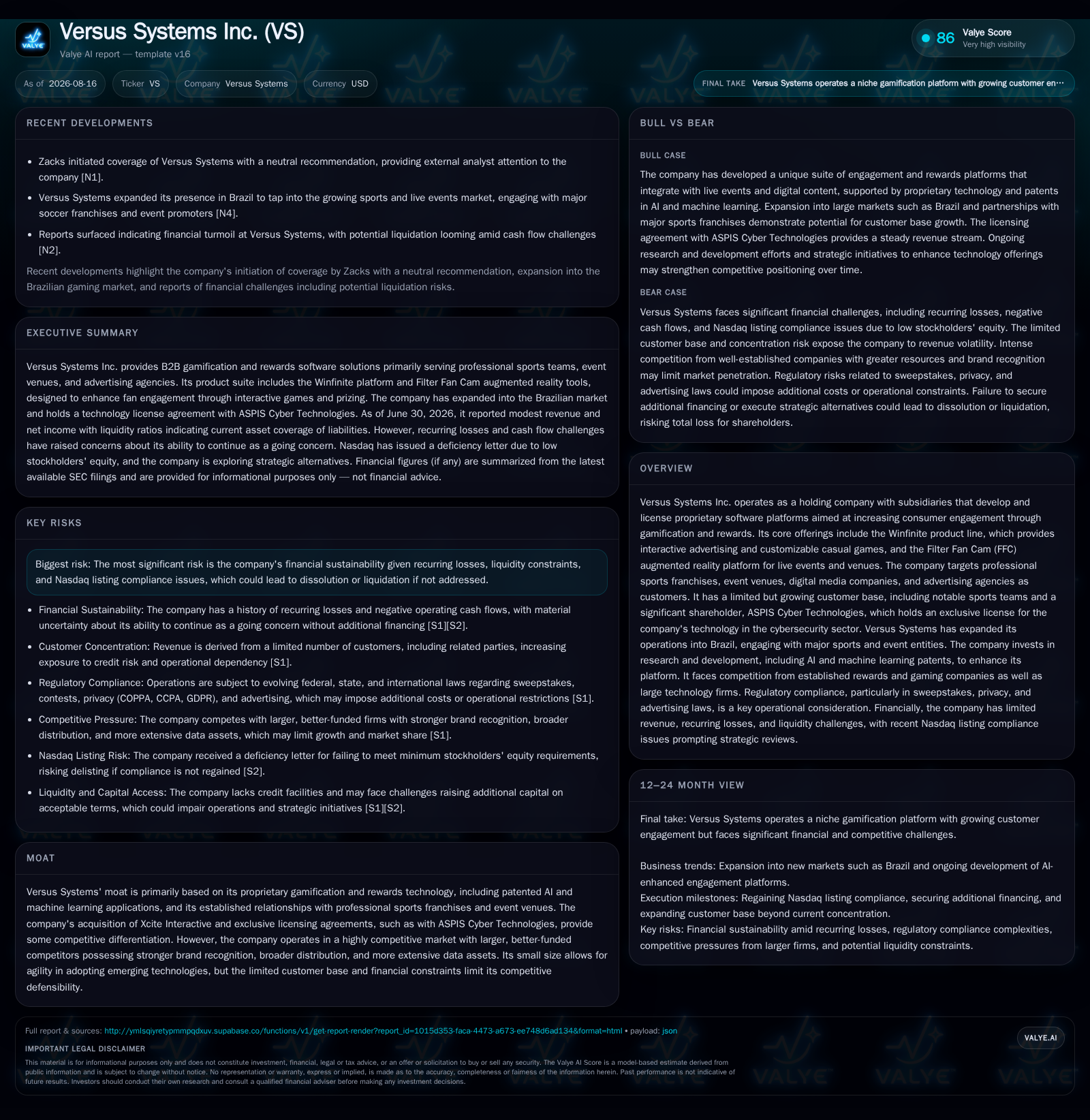
Versus Systems Inc. reported recognition of a substantial license fee from a major cybersecurity partner in Q2 2026, providing a near-term revenue boost derived from its proprietary gamification and engagement technology. The company operates B2B SaaS platforms including the Winfinite interactive advertising suite and the Filter Fan Cam augmented reality product, targeting sports franchises, event venues, and agencies with customized consumer engagement solutions. While Versus benefits from patented AI/ML innovations and exclusive licensing agreements, its small scale, limited active customer base, and recurring losses raise concerns over financial sustainability. Recent actions to regain Nasdaq listing compliance and expand geographically into Brazil underscore attempts to stabilize operations amidst stiff competition from much larger marketing tech firms.
Recent Operating Update
In Q2 2026, Versus Systems recognized $1.485 million in license fee revenue associated with a renewed Technology License and Software Development Agreement with ASPIS Cyber Technologies (ACT), a significant shareholder holding an exclusive license for Versus’ gamification technology in cybersecurity. This payment was recognized upfront because the license was functional and delivered entirely within the quarter ended June 30, 2026 [S3]. This transaction materially boosted sequential revenue streams for a company that historically has had limited sales volume. Additionally, this infusion contributed to restoring Nasdaq’s minimum stockholders' equity listing requirement after prior deficiency notification earlier in the year [S3], mitigating immediate delisting risks while underscoring ongoing fragility of financial health.
Business Model Analysis
Versus Systems pursues a B2B software-as-a-service model centered on enhancing consumer engagement through proprietary gamification platforms packaged primarily under the Winfinite brand and the Filter Fan Cam (FFC) augmented reality tool. Target customers include professional sports franchises (e.g., Texas Rangers, San Jose Sharks), event venues such as stadiums or arenas, digital media companies, advertising agencies, and specialized entities like ASPIS Cyber Technologies within cybersecurity [S1][S24]. Revenue is principally generated via software licensing fees paid by customers for access to integrated casual games, interactive ads, QR code campaigns, and AR experiences designed to boost fan engagement both remotely (mobile devices) and in-venue during live events.
The monetization mechanics rely on monthly or contractually defined license fees that often entail usage of customizable web-based games (Winfinite Games) incentivized through in-game prizing such as merchandise or digital goods funded by advertisers or sponsors [S24][S10]. This framework differentiates Versus slightly amid competitors by embedding sweepstakes-style rewards directly into entertainment experiences aimed at increasing consented first-party data collection—a critical asset increasingly valued within marketing technology ecosystems.
Despite intellectual property assets that include recently allowed AI/ML-related patent claims directed at optimizing user experience personalization and advertiser targeting [S1][S7], Versus operates within a crowded market facing pressure from larger players with more extensive technology portfolios (Apple, Google, Microsoft) that can integrate advanced AI-driven advertising mechanisms at scale [S11]. These giants also boast stronger branding power and deeper pockets for R&D investment.
The company aims to diversify clientele partly through geographic expansion into Brazil’s prominent sports ecosystem via contractor-led sales efforts focusing on soccer teams and leagues with large local followings [S7]. Such moves could underpin incremental growth if they generate stable recurring license revenues.
Industry Structure and Competitive Position
The gamification and engagement software industry is highly dynamic with rapid innovation cycles driven by evolving user expectations around interactivity coupled with advertiser demand for measurable consumer analytics. Companies like Braze or Kahoot! exemplify SaaS providers boasting broad digital marketing integration capabilities. Larger fan engagement platforms serving professional sports such as Socios.com or Fanatics capitalize on extensive league partnerships often combined with massive data resources.
Versus occupies a niche at the intersection of live event AR activation (FFC) and multi-channel interactive advertising (Winfinite). This dual-focus offers some platform versatility; however, it lacks scale advantages of major marketing tech firms who control vast digital ad inventories or streaming platform integrations. Moreover, while Versus emphasizes AI/machine learning patent protections to differentiate its offerings [S7][S11], competing enterprises deploy such technologies not only for engagement but also for large-scale campaign optimization backed by sophisticated data warehouses.
The dependence on high-profile franchise relationships provides customer credibility but also exposes revenue volatility risk if any key partner reduces spending or terminates contracts abruptly [S4][S7]. The company's customer concentration risk is compounded by significant reliance on ACT both as a subscription/license payer and strategic shareholder benefiting exclusivity rights in specialized markets like cybersecurity
Growth Drivers
Key demand drivers for Versus rest on several structural factors: increasing brand emphasis on personalized interactive experiences across live events; sponsor willingness to allocate budgets toward innovative audience activation methods; growth in mobile/digital platform consumption aligning well with Winfinite’s casual gaming approach; advancing use cases for AI-generated content personalization enhancing player retention; rising importance of first-party data amid privacy regulation changes limiting third-party data use; and expansion into emerging markets such as Brazil offering sizable sports fan bases seeking modern engagement tools [S7]
Furthermore, Versus’ ability to offer turnkey integration of interactive ads tied to in-game prizing presents potential upsell opportunities within existing accounts through layered campaign sophistication. Continued product enhancements driven by agile R&D processes also support competitive relevance despite resource limitations relative to larger peers [S10]. Strategic partnerships—particularly licensing deals generating upfront fees plus ongoing service contracts—could underpin scaled revenue if broadened beyond current clients.
Risks & Growth Constraints
The most pressing risks stem from financial sustainability challenges: consistent net losses since inception have led to liquidity constraints requiring frequent capital raises or equity issuances which dilute shareholders [(net loss $1.79M, operating loss $2.16M in CY2025)][F1][S2][S22]. The absence of credit facilities means limited access to alternative funding sources tightening operational flexibility [S25]. Nascent commercial history with only four active customers signals difficulty scaling engagements fast enough to offset cash burn. Additionally, intense competition from multinational marketing technology firms possessing entrenched customer relationships limits pricing power potential.
Technological risks include rapid obsolescence if AI/ML capabilities fail to advance at pace or if larger players bundle engaging features into more comprehensive offerings overshadowing standalone gamification solutions [S11]. Furthermore, customer concentration presents business continuity threats if major contracts lapse unexpectedly or payment delays occur given no diversified contract base presently [S4]. Regulatory risks attached to sweepstakes compliance and user data protection create operational complexity potentially increasing legal costs or hindering rollouts.
Cybersecurity vulnerabilities represent another concern given rising attack sophistication; although ACT currently implements cyber defense measures within Versus’ infrastructure, any breach could damage reputation or interrupt services critically impacting client trust [S7]. Lastly, prior workforce reductions may hamper ability to swiftly ramp up development capacity should market conditions necessitate heavier product innovation investment [S4].
What to Watch Next
Key milestones include monitoring renewal rates beyond ASPIS’ current license term ending January 31, 2027—without which near-term revenue visibility diminishes substantially [S3]. Progress in expanding active customer count beyond four sustained clients will be critical as it directly correlates with improving recurring revenue stability. Execution success in Brazil through contractor sales activation offers an early indicator of international scalability potential.
Operationally, updates around enhanced AI patent-driven feature launches may lift competitive positioning if successfully commercialized alongside integration partnerships with larger media platforms. Financially, quarterly updates evidencing improvement in cash flow metrics or additional fundraising completed under reasonable terms would alleviate existential funding risk flagged repeatedly in filings [S22][F1]. Finally, observance of Nasdaq compliance status remains pivotal since any renewed deficiency could trigger delisting consequences thereby constraining capital market access.
Financial Profile Discussion
Versus Systems’ balance sheet as of June 30, 2026 showed $1.36 million in cash and equivalents against current liabilities under $0.77 million resulting in a favorable current ratio near 4:1 signaling short-term liquidity adequacy despite ongoing losses [F1]. The company does not hold any credit facilities limiting leverage options but has raised capital through equity issuance evidenced by common stock issued for $1.7 million consideration related to the ASPIS agreement enhancing solvency pro forma for mid-2026 periods [S3][F1]. Management openly acknowledges the uncertainty surrounding continued financing availability noting material doubt about going concern without additional funds raising or improved earnings trajectory forthcoming over next fiscal periods [S22]. This precise setup places significant execution pressure on management’s ability to convert pipeline prospects into recurring licensing contracts quickly while controlling burn rate.
In summary, Versus Systems illustrates typical traits of an emerging engagement software SaaS player confronting scale challenges: promising technology IP infused with ongoing innovation efforts offset by limited active customers requiring higher order wins; reliance on few large customers elevating credit risk; nascent profitability undermined by fixed overheads; yet proactive licensing transactions create pathways toward improving top-line stability pending successful expansions both domestically and internationally.
Disclaimer: This analysis is based solely on publicly available regulatory filings through August 2026 combined with industry knowledge frameworks developmentally aligned with Versus Systems' sector profile. It does not constitute investment advice nor endorsement of securities described herein.
Disclaimer: This is research-only, informational analysis and not investment advice. It may include AI-generated interpretation and general industry context. Always verify important details using primary sources.

Comments