
HCM III ACQUISITION CORP. Advances De-SPAC Path with Murano PV Combination Amid Redemption and Capital Constraints
HCM III ACQUISITION CORP., a Cayman Islands-based SPAC, progresses toward business combination with Murano PV while managing shareholder redemption rights and capital structure challenges.
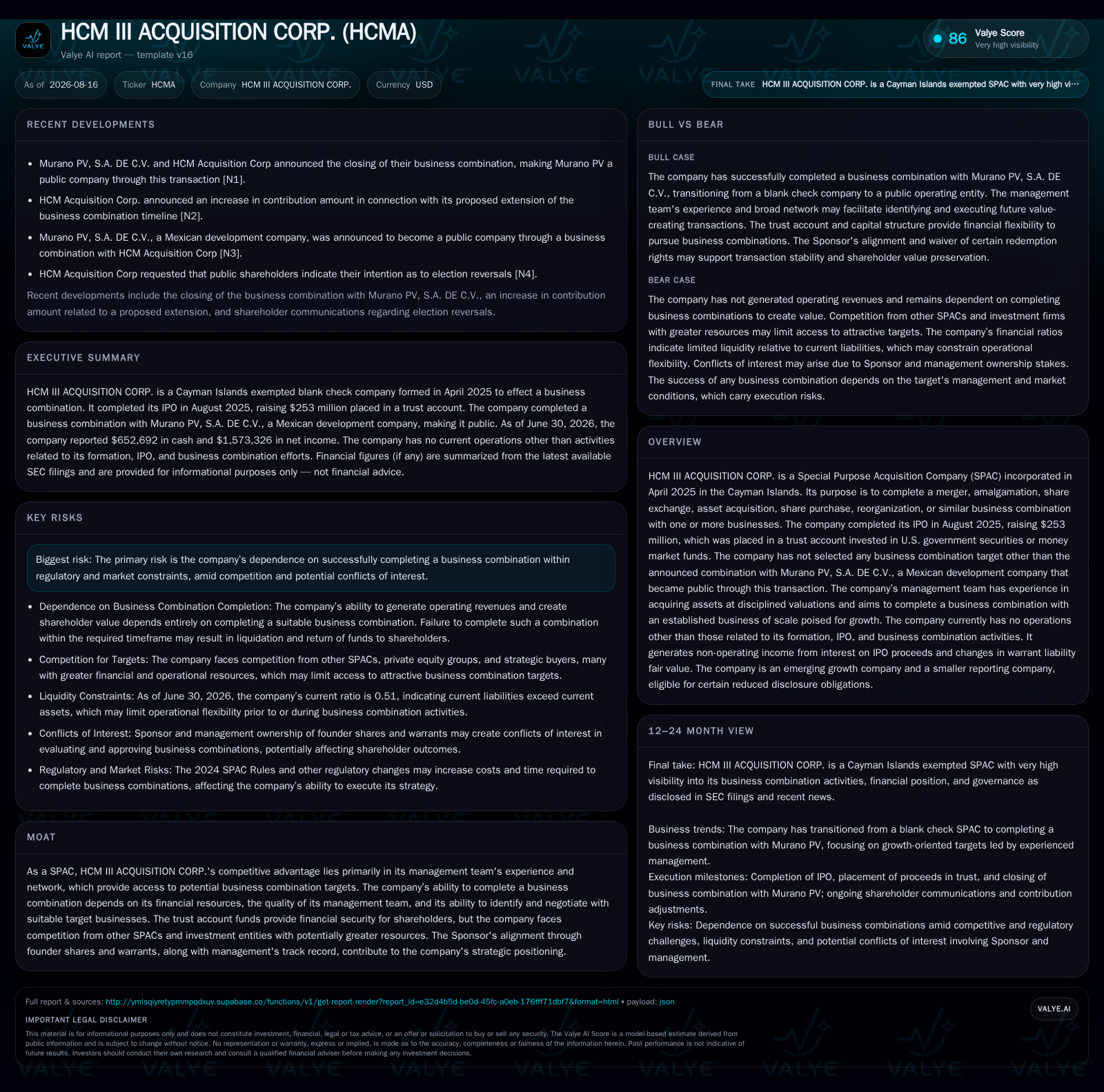
HCM III ACQUISITION CORP., launched in April 2025, completed its IPO raising $253 million placed in a trust account for acquiring an established growth-oriented target. The company has announced an initial business combination with Murano PV, a Mexican development firm, marking its transition from a blank check entity to an operating public company. The SPAC faces typical industry risks such as shareholder redemptions potentially limiting available acquisition capital and the regulatory pressure to finalize the deal within prescribed timelines. Management's extensive experience and a structured sponsor alignment act as key competitive advantages amidst a crowded SPAC market. Financially, the company holds approximately $653,000 in cash equivalent assets outside the trust account and shows limited operating income due to pre-combination status.
Recent Operating Update
HCM III ACQUISITION CORP. (HCMA) reported its latest quarterly results on August 14, 2026, highlighting ongoing preparations to consummate its initial business combination following its IPO in August 2025. The company’s most significant near-term milestone is the announced merger with Murano PV, S.A. DE C.V., marking its first definitive de-SPAC transaction and transition from a blank-check vehicle to an operating public entity [S2]. This deal symbolizes management's strategic focus on acquiring an established growth-oriented business in Mexico’s development sector, consistent with their stated investment philosophy.
Liquidity outside the trust account remains constrained; as of June 30, 2026, HCMA reported approximately $653,000 in cash and equivalents and total current assets of about $780,000 versus current liabilities exceeding $1.5 million, yielding a current ratio of just 0.51 [F1]. This limited liquidity highlights typical pre-combination operating expenses funded aside from the primary trust account set aside for acquisition. HCMA maintains no revenues or operating income given it has not yet commenced substantive operations beyond administrative setup and merger preparation [F1],[S2].
Notably, risk disclosures remained consistent with the prior annual filing in March 2026 without material changes, emphasizing shareholder redemption rights risks and operational liquidity concerns as critical variables influencing deal feasibility and timing [S2]
Business Model Specificity
As a Special Purpose Acquisition Company (SPAC), HCMA’s business model centers on raising capital via an IPO — executed in August 2025 with gross proceeds of $253 million placed into a trust account invested conservatively in U.S. government securities or money market funds — to finance acquisition(s) of private companies seeking public market access without undergoing a traditional IPO process [S1],[S24]. Monetization occurs only upon successfully consummating one or more business combinations that meet requisite regulatory criteria typically involving at least 80% deployment of trust assets.
The company generates nominal non-operating income from interest earned on the trust account funds but lacks any commercial operations before de-SPAC completion [S8]. The revenue mechanics post-merger will depend entirely on the target’s operational performance.
HCMA’s monetization incentives are aligned through founder shares (approximately 8.4 million issued at nominal cost) granting substantial equity participation post-business combination alongside warrants exercisable at predetermined strike prices ($11.50 per share) accessible upon reaching certain milestones or after the combination closes [S10],[S14]. These instruments provide dilution risk to public shareholders but serve to motivate sponsor diligence and execution success.
Critically, shareholder redemption rights afford public investors the option to redeem their shares for cash equal to their pro rata share of funds held in trust if they oppose the proposed merger terms or target selection. Redemptions reduce liquidity available for acquisition consideration and may necessitate alternative financing strategies such as PIPE investments or debt arrangements — adding complexity and potential cost overruns to deal structures [S1],[S25],[S28]. HCMA explicitly limits voluntary redemptions by individual shareholders holding over 15% without prior consent to mitigate hostile block-induced disruptions.
Industry Structure and Competitive Positioning
Within the broader SPAC ecosystem, HCMA operates as a mid-sized player completing an IPO during a more regulated phase marked by post-2024 SEC updates increasing disclosure demands around target financials, shareholder protections, and extended due diligence requirements [S1],[S7]. Its incorporation in the Cayman Islands positions it among many offshore entities facilitating flexible corporate governance frameworks aligned with international investor preferences.
HCMA competes not only against other SPACs targeting similar mid-market private firms but also faces competition from traditional IPO underwriters facilitating direct listings and private equity firms executing buyouts or secondary transactions. Institutional investors scrutinize such vehicles based on sponsor reputation, track record, deal execution speed, redemption rates observed post-announcement (indicative of investor confidence), and capital structure efficiency.
HCMA’s management team draws strength from prior experience investing across macroeconomic themes emphasizing disciplined valuation approaches balanced by growth opportunities coupled with active governance engagement [S8],[S22]. This experience might confer sourcing advantages sourcing proprietary deals not broadly auctioned.
Nonetheless, financial resource limitations relative to larger peers like Pershing Square Tontine Holdings pose constraints on deal size maximizing potential synergy capture or market presence expansion post-merger. Further competitive pressure arises from potential high redemption rates which would erode deal financing flexibility.
Growth Drivers
HCMA’s path to growth hinges primarily on successfully closing its initial business combination with Murano PV — completing the transition from capital-raising shell entity to operational platform that can generate revenues and earnings. Favorable market conditions supporting alternative public listing mechanisms underpin demand for SPAC vehicles.
Experienced sponsors equipped with broad networks facilitate access to proprietary opportunities providing differentiated transaction flow compared with standard auctions dominated by buyout giants or publicly listed strategics [S22]. The capacity to tailor deal financing through a mix of cash from trusts plus equity issuance or PIPE placements expands potential deal structuring capabilities.
HCMA disclosed signs of going concern doubt if external funding sources fail for transaction costs given limited liquidity outside trusts outlining acute sensitivity around operational burn rates pre-deal closure [S1]
Sponsor-public shareholder conflicts pose governance risks particularly since founder shareholders retain voting leverage potentially overriding dissenting smaller investors during combination approval votes using Class B ordinary shares absent public shareholder majority support exercising redemption options fully might undermine deal economics negatively impacting remaining public ownership value [S1],.
Dilution risk tied to warrant exercise offers additional complexity where subsequent share issuances could depress long-term per-share metrics post-merger if warrants are deeply in-the-money.
Regulatory evolution continues influencing SPAC practices; changes could further increase compliance costs or restrict some previously common transaction structures creating execution cost inflation beyond current forecasts. Lastly is legal risk from possible litigation initiated by disaffected shareholders contesting proxy votes or alleging inadequate disclosures — often manifesting post-combination.
What to Watch Next
Key near-term catalysts include finalizing definitive documentation for the Murano PV acquisition encompassing negotiated valuation terms meeting Nasdaq minimum fair value tests requiring at least 80% utilization of trust assets excluding deferred fees [S17]. Monitoring redemption election rates following proxy disseminations will signal retail/institutional shareholder sentiment toward the proposed transaction structure.
Subsequent shareholder vote outcomes will be pivotal—confirming whether founder-aligned interests successfully navigate potential opposition mitigated by redemption rights limitations set forth prior will influence deal closure probability. Any announcements concerning PIPE financing backstops or debt arrangements would impact capital adequacy assessments related to cash conditions post-merger.
Operational integration plans post-close including governance composition decisions regarding continued sponsor/management roles provide indications on combined company outlooks. Finally, ongoing SEC developments affecting SPAC structural rules may alter compliance landscapes thus affecting timelines or expense forecasts indirectly relevant for all pending deals within this cohort.
Financial Profile Discussion
Disclaimer: This is research-only, informational analysis and not investment advice. It may include AI-generated interpretation and general industry context. Always verify important details using primary sources.

Comments