
Jasper Therapeutics Advances Mast Cell Disease Pipeline Amid Financial and Integration Challenges
Clinical progress for briquilimab supports Jasper's niche therapeutic focus, but financing and acquisition risks persist.
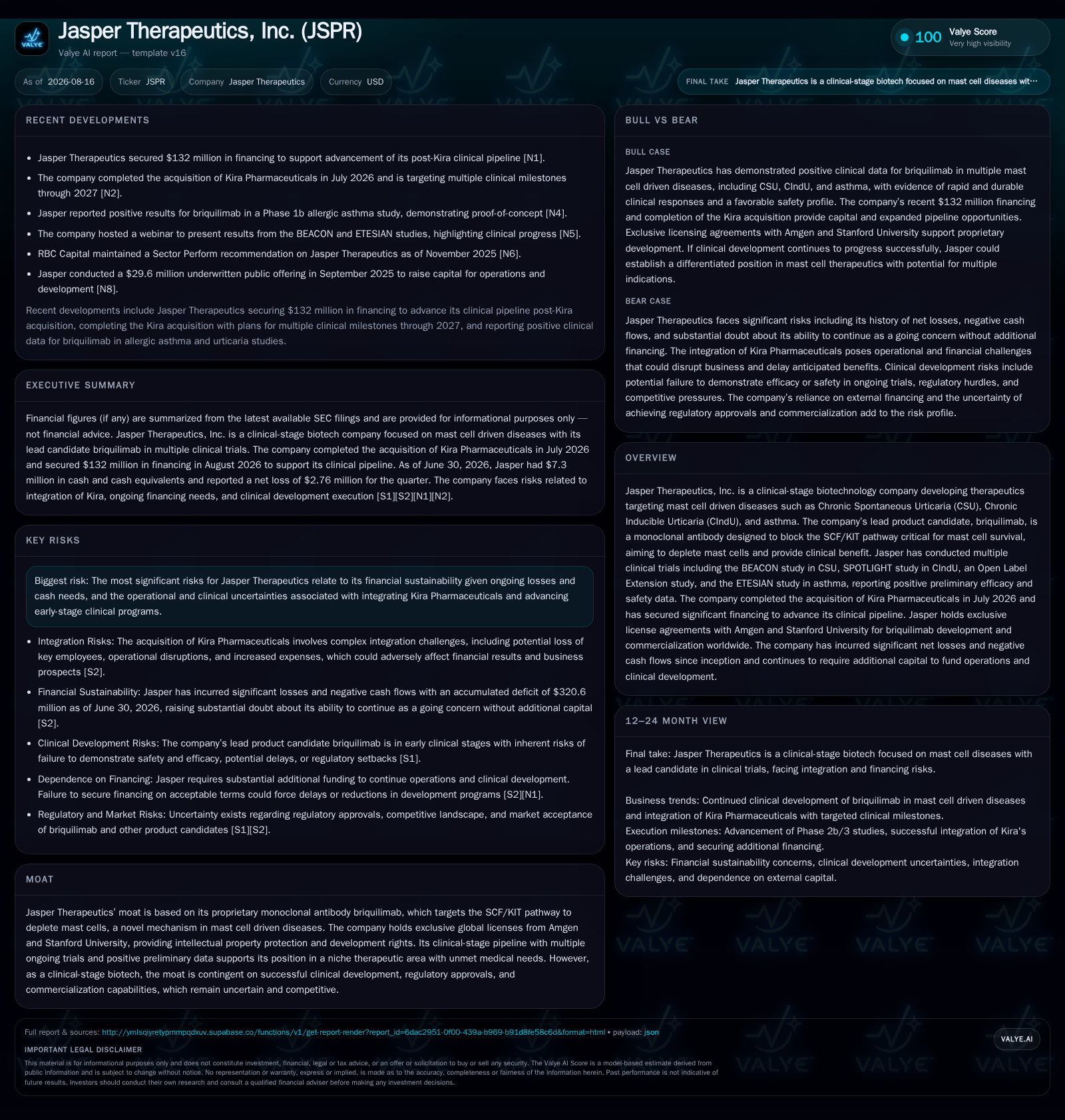
Jasper Therapeutics, a clinical-stage biotech targeting mast cell driven diseases, reported continued advancement of its lead candidate briquilimab with positive early clinical data. The recent acquisition of Kira Pharmaceuticals expands its pipeline but introduces integration complexities during an extended capital raise. Despite $7.3 million cash on hand as of June 2026, the company faces substantial going concern risks given its ongoing losses and financing requirements. Jasper’s competitive position hinges on its proprietary monoclonal antibody targeting the SCF/KIT pathway and exclusive licensing agreements, though successful regulatory approval and further clinical milestones remain critical to validate its moat.
Recent Operating Update: Clinical Progress during Acquisition and Financing
Jasper Therapeutics’ latest quarterly filing dated August 14, 2026 [S2] highlights ongoing development of its lead monoclonal antibody briquilimab targeting the SCF/KIT pathway implicated in mast cell driven diseases such as Chronic Spontaneous Urticaria (CSU), Chronic Inducible Urticaria (CIndU), and asthma. The Phase 1b/2a BEACON trial has generated encouraging preliminary efficacy signals characterized by rapid onset—responses seen within one week—and a favorable safety profile marked by mostly mild, transient adverse events related to KIT blockade [S1]. These data suggest promising dose-dependent clinical activity that could underpin future pivotal trial designs.
In mid-July 2026, Jasper completed the acquisition of Kira Pharmaceuticals [N1][S22], expanding its biologic portfolio into complement system therapies for immune-mediated diseases. This strategic move diversifies Jasper’s pipeline beyond mast cell targeting monoclonal antibodies, potentially enhancing long-term value through complementary mechanisms. The transaction was simultaneously supported by a $132 million private placement equity financing [N2][S10], providing essential capital to fund multiple investigational new drug (IND)-enabling studies across the combined pipeline.
Despite this capital infusion, management disclosed substantial doubt about continuing as a going concern beyond one year due to persistent net losses, limited cash reserves of approximately $7.3 million as of June 30, 2026, and ongoing operating cash burn tied to R&D-intensive clinical activities [F1][S10]. This underscores an urgent need for further financing to sustain product development until regulatory milestones or commercial revenues can be realized.
Business Model Specifics: Focused Biologic Development Supported by Exclusive Licensing
Jasper operates as a clinical-stage biotech developing biologics aimed at depleting mast cells via inhibition of the SCF/KIT survival pathway—a novel approach in treating chronic urticarias and asthma. Its lead candidate briquilimab is protected by exclusive global licenses from Amgen and Stanford University [S1], providing a defensible intellectual property position crucial for limiting biosimilar competition during early development stages.
Revenue generation remains pre-commercial; near-term value depends heavily on advancing briquilimab through dose escalation cohorts with robust safety and efficacy endpoints. Success in pivotal trials could unlock milestone payments from potential partnerships or licensing agreements before transitioning toward product sales post-approval. Key operating variables include patient enrollment rates, dose optimization outcomes, and adverse event profiles.
The integration of Kira Pharmaceuticals adds complement-targeting biologics addressing immune-mediated conditions adjacent to mast cell diseases. While this broadens the therapeutic scope and potential market reach, it also increases operational complexity requiring effective resource allocation across distinct scientific platforms and regulatory pathways.
Industry Structure and Competitive Positioning
The clinical-stage biotech sector is characterized by prolonged development timelines with high uncertainty around trial outcomes and regulatory approvals. Jasper's strategy leverages a differentiated mechanism—targeting mast cell survival via SCF/KIT blockade—positioning it distinctly among immunology peers focused more commonly on cytokine modulation or receptor antagonism.
Exclusive licensing from prominent academic institutions enhances competitive barriers by protecting proprietary assets essential for future commercialization. However, success depends critically on demonstrating consistent safety and efficacy in larger randomized controlled trials amid competitive pressure from alternative biologic platforms.
Growth Drivers: Clinical Milestones and Pipeline Diversification
Primary growth drivers include progression through BEACON trial dosing cohorts with demonstration of sustained complete responses at doses 60;180mg, which would strengthen regulatory submission prospects. Expansion into additional indications like CIndU and asthma further enlarges addressable patient populations where unmet medical needs persist.
The addition of Kira’s complement-focused assets offers pipeline diversification that may attract strategic partnerships or licensing deals, supporting non-dilutive funding avenues ahead of commercialization. Maintaining enrollment momentum without significant adverse safety events remains critical for validating clinical hypotheses and sustaining investor confidence.
Risks and Watchpoints: Financial Sustainability and Integration Challenges
Notwithstanding promising clinical data, Jasper faces material risks typical for pre-revenue biotechs compounded by financial constraints. With only $7.3 million in cash as of Q2 2026 [F1], ongoing R&D expenses necessitate additional capital raises that risk shareholder dilution [S10][S16]. Failure to obtain stockholder approval for preferred stock conversions linked to the Kira merger could trigger costly cash redemptions impairing liquidity [S2].
Operational risks include integrating Kira’s workforce accustomed to private company environments into public company compliance frameworks—a process prone to governance challenges during transition periods [S11]. Regulatory uncertainties around KIT pathway inhibition safety require vigilant monitoring; any serious adverse events could delay filings or damage commercial prospects.
Market pressures from Nasdaq’s minimum bid price rule also present challenges, with potential reverse stock split considerations that may affect shareholder composition negatively [S12]. Additionally, ongoing litigation related to prior disclosures on clinical progress could impose financial and reputational costs.
What To Watch Next: Clinical Data Readouts and Stockholder Approvals
Upcoming BEACON trial data releases will be pivotal in assessing briquilimab’s efficacy durability across dosing regimens [S1]. Parallel updates from other mast cell disease programs such as SPOTLIGHT (CIndU) or ETESIAN (asthma) will indicate Jasper’s ability to extend clinical benefits across indications.
Stockholder votes scheduled no later than November 13, 2026 regarding conversion approvals for preferred stock issued in the Kira acquisition are critical; failure may force redemptions restricting financial flexibility [S2]. Progress toward IND filings or trial initiations involving Kira assets will also demonstrate integration effectiveness.
Regulatory dialogue concerning pivotal trial designs or expedited review pathways merits close attention as it impacts commercialization timing.
Financial Profile Discussion
At quarter-end June 30, 2026, Jasper held $7.3 million in cash and equivalents with current assets totaling $11.6 million against current liabilities near $7.8 million—a current ratio of approximately 1.47 indicating a modest short-term liquidity cushion [F1]
The July 2026 $132 million private placement financing linked to the Kira acquisition temporarily extends runway; however management acknowledges substantial doubt about sustaining operations absent further financing rounds or collaborations [S10][S16]. Given the capital-intensive nature of late-stage trials compounded by costs of public company compliance post-merger integration [S11], effective burn rate management aligned with achieving inflection points in development milestones is essential to preserve shareholder value.
Overall liquidity dynamics emphasize reliance on equity markets or partnership arrangements until regulatory approval enables revenue generation consistent with industry peers transitioning out of pre-commercial stages.
This analysis synthesizes information available as of August 16, 2026 from SEC filings including latest quarterly reports and event disclosures without offering investment advice.
Disclaimer: This is research-only, informational analysis and not investment advice. It may include AI-generated interpretation and general industry context. Always verify important details using primary sources.

Comments