
iWallet Corp Pursues Titanium Biometric Wallets with Sales Launch Targeted in Late 2026
iWallet advances prototype development and manufacturing readiness of biometric luxury wallets amid financial and competitive challenges.
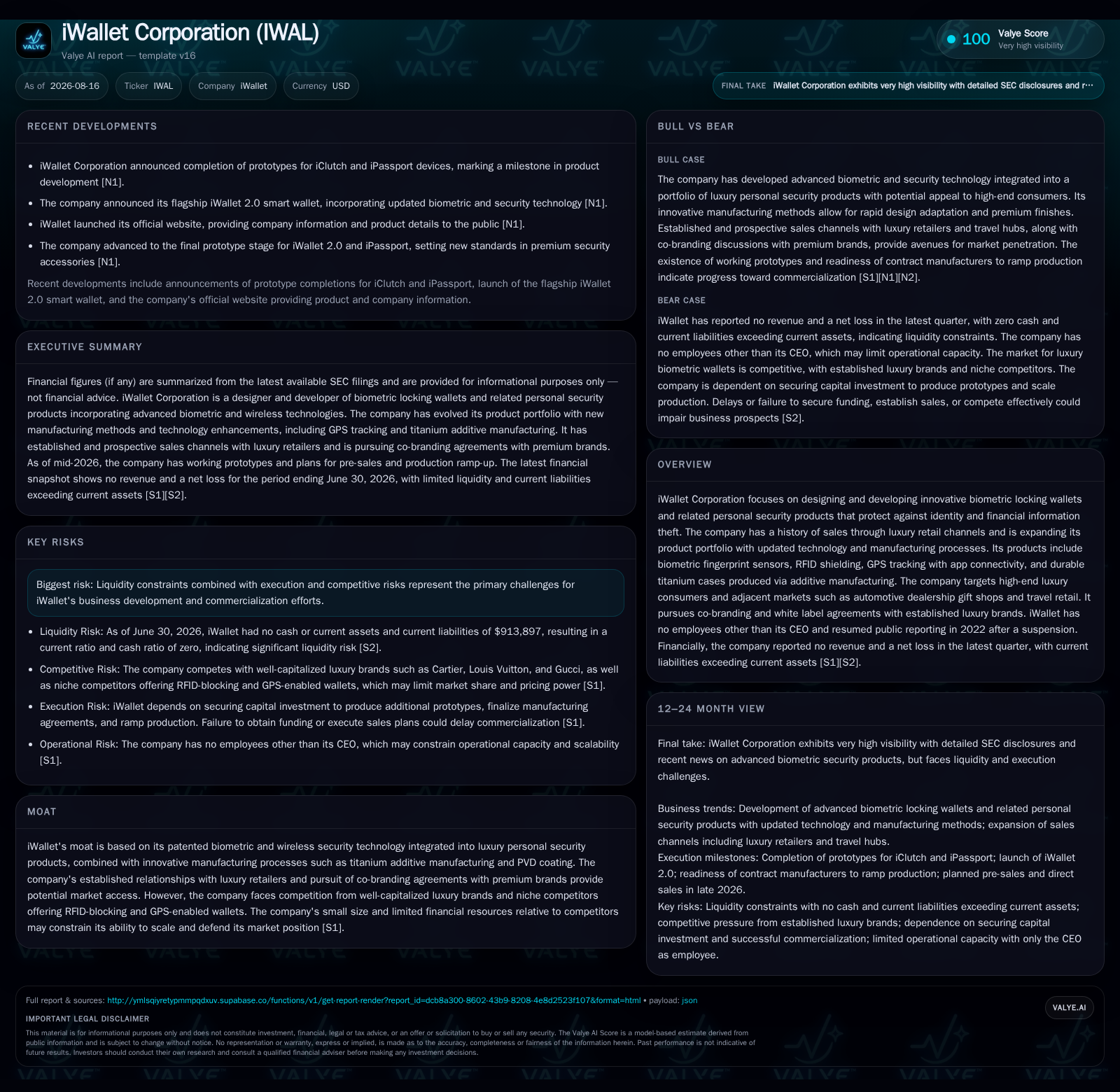
iWallet Corp, a small public company specializing in biometric locking wallets and personal security devices, reported no revenue for 2025 but continues to develop next-generation products leveraging patented technology and advanced materials like titanium additive manufacturing. The company plans to initiate pre-sales in the third quarter of 2026 and deliveries by year-end, targeting luxury retail and adjacent channels including automotive dealership gift shops and travel retail. While innovative features such as capacitive fingerprint sensors, improved RFID shielding, GPS tracking, and durable titanium cases differentiate its product portfolio, limited financial resources and absence of scale remain significant hurdles, especially against well-capitalized luxury brands and established niche competitors.
Recent Operating Update
The updated product lineup features significant technological enhancements: an improved capacitive touch fingerprint sensor offering higher sensitivity and reliability; advanced RFID shielding materials designed to enhance identity theft protection; integrated GPS tracking functionality linked to a proprietary smartphone app; Physical Vapor Deposition (PVD) coating delivering durable finishes resistant to wear; and notably an exclusive titanium additive manufacturing process enabling lightweight yet hardened outer cases without traditional costly tooling or molds [S1][S10]. This manufacturing innovation not only differentiates iWallet’s products aesthetically and functionally but also allows agile customization for co-branding opportunities.
Contract manufacturing partners have been identified and are reportedly prepared to finalize production agreements based on sales volume commitments; however, these contracts remain unsigned pending capital infusion to support prototype-to-production scale-up [S1]. The company’s engagement with Trafton Manufacturing Group exemplifies this dynamic—prototyping services are underway under agreements partially compensated through equity issuance as a cash preservation measure [S14].
Business Model and Product Strategy
iWallet designs patented "smart containers"—high-tech personal security devices such as biometric locking wallets (iWallet 2.0), passport holders (iPassport), attache cases (iClutch), and concepts for secure mobile pharmaceutical safes. These products integrate biometric authentication technologies with wireless communication features including RFID shielding against electronic theft and GPS tracking for asset recovery [S1][S10].
The company’s monetization strategy anticipates revenue from multiple channels: direct-to-consumer online sales enabling capture of higher average selling prices by bypassing intermediaries; wholesale distribution through established luxury department stores like Neiman Marcus and Harrods where prior versions were sold; travel retail outlets including duty-free shops at airports; automotive dealership gift shops catering to affluent buyers as evidenced by interest from General Motors, Mercedes-Benz, Porsche; along with co-branding or white label partnerships with premium lifestyle brands such as Montblanc, Gucci, Ducati, Bugatti, Dunhill [S1][S10]
This multi-channel approach leverages intellectual property embedded in patented biometric technologies combined with differentiated industrial design using premium materials like carbon fiber or titanium cases finished with PVD coatings. These features justify premium pricing above conventional wallet categories—management targets price points exceeding $200 per unit aligned with their upscale consumer segment [S15]
Outsourcing production to contract manufacturers mitigates fixed cost burdens while additive titanium manufacturing reduces upfront tooling investments relative to traditional molding processes. This flexibility supports custom co-branding adaptations critical for penetrating diverse luxury retail segments.
Industry Structure and Competitive Position
iWallet operates within a niche consumer electronics segment combining biometric security innovation with luxury accessory branding. Competitors range from well-capitalized global luxury brands such as Cartier and Louis Vuitton to specialized RFID-blocking wallet makers like Ekster or Nomad who emphasize slim profiles coupled with GPS tracking add-ons [S16].
iWallet’s integrated approach—merging biometric locking mechanisms with GPS tracking plus rugged yet elegant materials—constitutes its competitive moat. However, it faces challenges competing against rivals with greater brand recognition, marketing budgets, and established distribution networks.
Success in this industry demands significant investment in R&D alongside marketing efforts to educate consumers on novel biometric authentication benefits embedded in everyday carry goods. Robust retail penetration across upscale department stores (Neiman Marcus), specialty travel retailers (Dufry), online platforms (Touch of Modern), luggage specialists (Heys) is essential for scaling revenue.
Material innovation such as titanium additive manufacturing is uncommon among peers; this provides differentiation but introduces supply chain risks requiring reliable contract manufacturers capable of consistent quality at scale [S14]. Continuous upgrades in sensor modules and electronics are necessary to maintain technological relevance.
Growth Drivers
Growth prospects are supported by rising global consumer awareness regarding identity theft risks paired with growing demand for tech-enabled personal accessories that blend security features with lifestyle appeal. The recovery of global travel boosts opportunity within duty-free shops and cruise ship boutiques aligned with iWallet’s strategic channel priorities [S1]. Expansion into automotive dealership gift shops leverages aspirational branding increasingly adopted by luxury automakers.
Advancements in biometric sensors coupled with wireless communication technologies underpin product differentiation. The company’s plan to accelerate conversion of prototypes into volume production depends heavily on securing capital investment alongside signing formal manufacturing agreements.
Co-branding deals provide a pathway to leverage partner brand equity while expanding market reach beyond direct sales channels.
Risks and Watchpoints
iWallet’s financial position reveals acute liquidity constraints highlighted by zero cash balances at June 30, 2026 alongside current liabilities surpassing current assets—a current ratio approximating zero—indicating limited working capital availability [F1]. This constrains procurement capabilities and investments necessary for scaling production.
Execution risks include dependence on contract manufacturers who have yet to enter binding agreements pending clarity on sales volumes [S14]. Supply chain disruptions affecting critical components such as titanium materials or biometric sensors could delay product launches or escalate costs.
Market adoption risk persists given consumer expectations for seamless integration of advanced technology without compromising premium design aesthetics or battery life—requiring ongoing R&D commitment.
Retail channel concentration risk exists due to reliance on select luxury retailers alongside nascent direct-to-consumer platforms amid fierce competition.
Operational capacity is limited by a minimal employee base consisting solely of the CEO which may impede scaling efforts.
What to Watch Next
Key near-term developments include securing capital funding adequate to transition from prototyping to volume production; formalizing manufacturing contracts particularly with Trafton Manufacturing Group; launching pre-sale campaigns starting Q3 2026; progress on co-branding negotiations with marquee partners such as Montblanc or Ducati; early demand validation through customer orders; expansion into travel retail venues; potential rebranding initiatives addressing the outdated "i" product naming convention noted previously.
Tracking product development cycle times alongside prototype-to-production conversion rates will be crucial indicators of commercial viability within constrained resource parameters.
Financial Profile Discussion
As of June 30, 2026, companyfacts data shows zero USD in cash and equivalents, with current liabilities exceeding current assets, resulting in a current ratio near zero [F1]. This indicates acute liquidity constraints that may impact the company’s ability to fund inventory build-out and scale production.
Overall cash burn remains tightly linked to prototype development outlays plus legal/IP maintenance expenses, limiting runway until revenue generation materializes potentially late 2026 or early 2027 contingent on successful market entry.
This analysis synthesizes information from SEC filings through August 14, 2026 [S2][S1][S14][F1], providing an informed perspective on iWallet Corp’s trajectory within the biometric-enabled personal security device segment targeting premium consumer markets.
Disclaimer: This is research-only, informational analysis and not investment advice. It may include AI-generated interpretation and general industry context. Always verify important details using primary sources.

Comments