
Curanex Pharmaceuticals Advances Botanical Drug Development Amid Capital and Regulatory Challenges
Focused quarterly update details preclinical progress for Phyto-N, while capital and clinical risks remain primary headwinds.
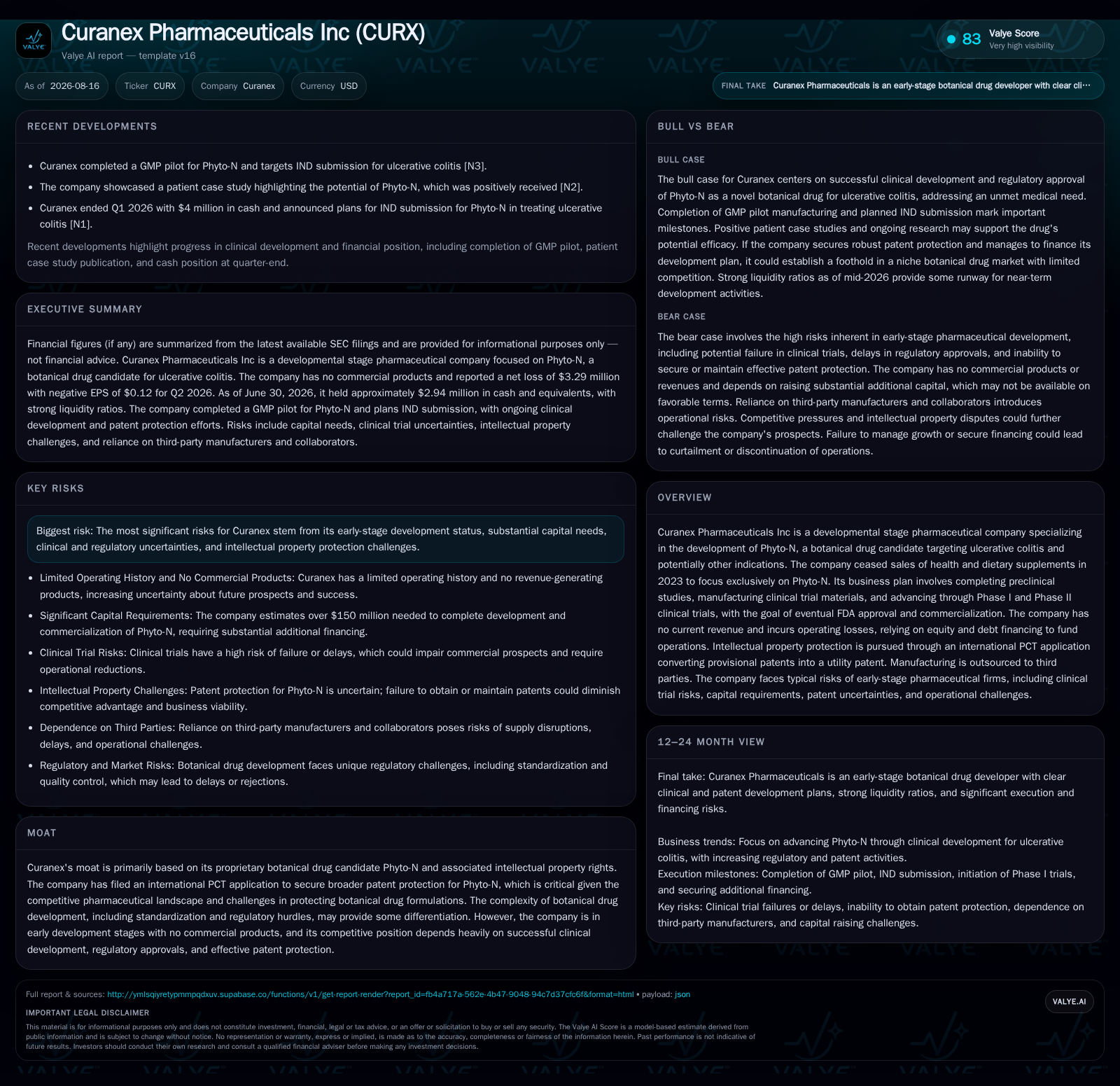
Curanex Pharmaceuticals remains a developmental-stage biotech company concentrated on advancing its botanical drug candidate Phyto-N, targeting ulcerative colitis. The latest quarterly filing reveals ongoing preclinical activities preparing for an IND submission and Phase I trial initiation, although no revenue or commercial products exist yet. The company’s strategic pivot away from dietary supplements to exclusive drug development underscores a high-risk, high-capital model reliant on successful clinical milestones and patent protection. Manufacturing is outsourced, and substantial funding needs ahead pose execution risks common in early-stage biopharmaceuticals.
Latest Operating Update Highlights Clinical Development Focus
Curanex Pharmaceuticals’ latest quarterly filing dated August 14, 2026 ([S2]) confirms the company’s progression as a pure-play developmental-stage biotechnology firm focused exclusively on its lead botanical therapeutic candidate, Phyto-N. Notably, Curanex ceased sales of its legacy health and dietary supplements in 2023 to concentrate efforts on pharmaceutical-grade drug development ([S1]). The current operating narrative centers around completing Good Laboratory Practice (GLP) toxicology studies that are prerequisites before submitting an Investigational New Drug (IND) application to the U.S. Food and Drug Administration (FDA). Once approved by the FDA, this will enable initiation of Phase I clinical trials targeting ulcerative colitis.
While financial disclosures show no product revenues nor commercial activities as of June 30, 2026 ([F1]), the operational focus moves towards achieving significant clinical milestones in preclinical validation and ensuing human trials. This transitional stage reflects typical early-stage biotech dynamics where proof-of-concept data generation is paramount to securing subsequent development funding.
Business Model: Botanical Drug Development with Outsourced Manufacturing
Curanex’s business model follows a classic developmental biotech archetype: discover or acquire an innovative drug candidate (in this case botanical-based), conduct rigorous preclinical work including safety pharmacology studies, navigate regulatory approvals for clinical testing, then advance through phased human trials culminating in potential market authorization ([S1]). Unique within the pharmaceutical landscape is the botanical nature of Phyto-N — plant-derived complexes with multiple active components rather than single-molecule agents typical of conventional small-molecule drugs. This introduces considerable complexity around standardization of active ingredients, batch-to-batch consistency in manufacturing by contract manufacturing organizations (CMOs), and intellectual property protection strategies ([S27]).
Monetization depends upon eventual FDA approval followed by possible proprietary commercialization or out-licensing deals.
Industry Structure and Competitive Position
Botanical drugs occupy a niche within the broader biotechnology sector characterized by heightened regulatory scrutiny due to inherent complexity of herbal extracts. Only a handful of botanical products have achieved FDA approval historically (e.g., Veregen® and Mytesi®), underscoring the challenges in demonstrating uniform efficacy and safety profiles required by regulators ([S27]).
Curanex’s competitive moat hinges primarily on its intellectual property portfolio protecting Phyto-N’s formulation which was strengthened via international Patent Cooperation Treaty (PCT) applications converting prior provisional filings before expiration ([S22]). Successful patent grants would carve out exclusivity critical against established pharmaceutical entities focusing on inflammatory bowel diseases who generally pursue small molecule or biologic therapies.
The reliance on third-party CMOs parallels peer early-stage firms like Vertex Pharmaceuticals during trial supply phases but exposes Curanex to risk if suppliers fail quality tests or continuity is disrupted ([S4]).
Growth Drivers: Clinical Milestones and Pipeline Expansion
The principal near-term growth driver is advancement through regulatory checkpoints starting with IND submission followed by Phase I trial initiation in ulcerative colitis — a chronic inflammatory disorder with sizeable unmet medical need. Completion of these stages will generate pivotal data validating Phyto-N’s safety profile and dosing parameters.
Another growth vector emerged recently with expansion into cancer cachexia indication — a debilitating syndrome lacking effective treatments — broadening opportunity set beyond initial core six indications including autoimmune conditions and metabolic diseases ([S25]).
Securing robust intellectual property protection remains vital; patent grants would enhance competitive barriers and enable partnership discussions enhancing capital access. Furthermore, raising sufficient funds remains essential given the estimated requirement exceeding $150 million to progress through later Phase II/III stages toward commercialization ([S1]).
Strategic collaborations with pharma companies or CROs/CBOs could accelerate timelines or reduce capital intensity but none are currently disclosed.
Risks and Constraints: Early Stage Complexity Meets Capital Intensity
Curanex is exposed to multi-dimensional risk typical of pre-revenue biotechs but exacerbated by botanical drug-specific hurdles:
- Clinical Risk: High failure rate possibility in progressing from preclinical to confirmatory human trials; preclinical results may not predict clinical efficacy or safety adequately ([S26]).
- Regulatory Uncertainty: Botanical drugs face more nuanced FDA requirements concerning compositional uniformity; evolving standards could result in delayed approvals or requests for additional costly studies ([S27]).
- Capital Requirements: Operating losses persist with no earned revenues; company documents estimate over $150 million needed to execute full plan — inability to timely raise capital threatens program continuation ([S1]).
- Intellectual Property: Challenges securing strong patent protection may erode exclusivity periods; risk of patent infringement claims or licensing disputes adds financial uncertainty ([S12],[S7]).
- Manufacturing Dependence: Outsourced production creates vulnerability if CMOs cannot meet quality standards or volume needs timely impacting trial schedules ([S4],[S24]).
- Operational Scale: As development progresses, scaling up organizational capabilities including regulatory compliance infrastructure will strain limited current resources ([S24]).
- Market Acceptance: Beyond approval hurdles lie uncertainties related to reimbursement landscapes for botanical drugs which have less precedent among payors.
What To Watch Next
Investors and analysts should prioritize monitoring several material execution markers:
- Successful completion of GLP toxicology studies enabling formal IND submission.
- FDA clearance of IND allowing commencement of Phase I trials targeted for ulcerative colitis.
- Additional updates regarding intellectual property status particularly granting of utility patents derived from PCT filings.
- Announcements related to financing transactions ensuring adequate cash runway beyond current ~$2.9 million balance reported at end Q2 2026 ([F1]).
- Progress updates on cancer cachexia indication pipeline expansion including study designs or partnerships.
- Any strategic collaborations that might mitigate financing burden or provide operational support.
Financial Profile Discussion
As of June 30, 2026, Curanex held approximately $2.9 million in cash and equivalents with total current assets around $4.8 million versus minimal current liabilities near $104 thousand implying an exceptionally strong current ratio (~46) indicating short-term liquidity sufficiency but reflecting low overall liabilities consistent with stage nature ([F1]).
The financial profile underscores reliance on fresh equity or debt infusions as operational needs continue into costly clinical phases without commercial inflows. Given the magnitude of capital estimated necessary — $150 million+— bridging capital needs through grants or partnerships will be crucial alongside public/private offerings for sustainable advancement [S1]. Any delays in fundraising could materially disrupt planned clinical timelines.
In summary, Curanex Pharmaceuticals embodies characteristics typical of an early-stage biotech enterprise grappling with complex botanical drug development challenges amid intense capital demands. The coming quarters will be decisive in validating Phyto-N’s path forward via regulatory milestones while managing execution risks inherent in its outsourced manufacturing model and patent protection strategy.
Disclaimer: This is research-only, informational analysis and not investment advice. It may include AI-generated interpretation and general industry context. Always verify important details using primary sources.

Comments