
Adia Nutrition Advances Regenerative Medicine with FDA-Registered Biologics Amid Cash Constraints
Latest quarterly results highlight operational progress in clinical biologic services but reveal liquidity pressures in a fragmented stem cell therapy market.
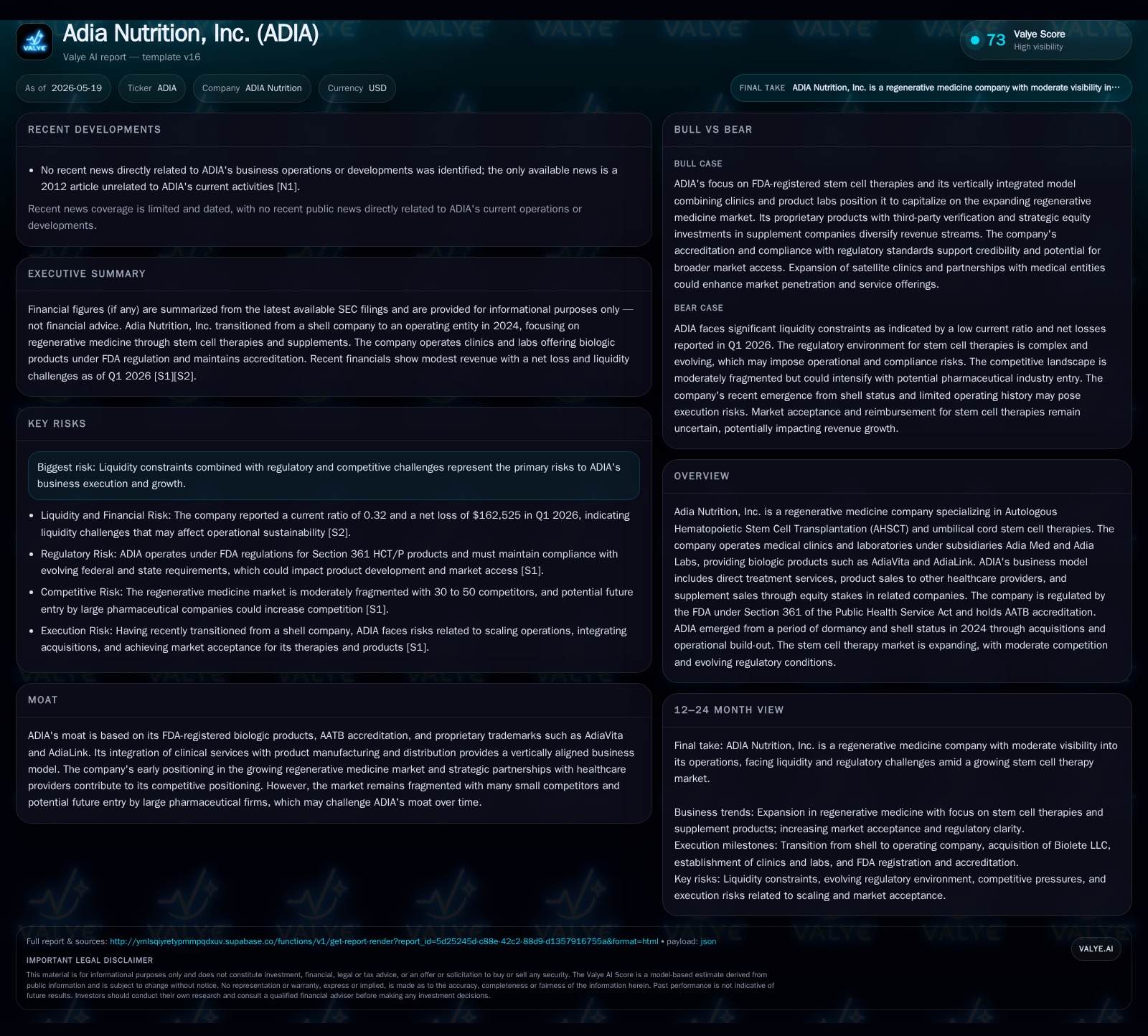
Adia Nutrition, Inc. (ADIA) reported operational updates in its May 2026 10-Q reinforcing its position as a vertically integrated regenerative medicine provider specializing in autologous hematopoietic stem cell transplantation and umbilical cord therapies. The company’s FDA Section 361-registered biologic products and AATB accreditation underpin a defensible niche, yet the latest balance sheet shows a strained liquidity profile with a current ratio of 0.32. ADIA’s growth hinges on expanding clinic presence, securing broader medical community acceptance, and navigating evolving regulatory dynamics within an industry where competition is growing from both small players and potential large pharmaceutical entrants.
Recent Operating Update
In its latest quarterly report filed May 15, 2026 ([S2]), Adia Nutrition reaffirmed its core operational activities centered on autologous hematopoietic stem cell transplantation (AHSCT) and umbilical cord stem cell therapies conducted through its subsidiary clinics under the Adia Med banner. The company continues to administer biologic products such as AdiaVita and AdiaLink directly to patients while also distributing these products to other healthcare providers. While the filing does not disclose revenue updates for the quarter explicitly beyond the December 2025 annual figure of approximately $700K [F1], it underscores ongoing clinical operations scaling through word-of-mouth referrals, seminar sales channels, repeat customer bases, and targeted advertising measures [S1].
However, liquidity concerns emerge as a prominent near-term issue. As of March 31, 2026, current liabilities stood at roughly $1.11 million compared to current assets of $359K yielding a current ratio of only 0.32 [F1]. This imbalance signals cash flow challenges requiring either operational cash generation improvements or external financing to sustain growth initiatives.
Business Model Overview
Adia Nutrition's business model integrates three principal revenue streams: direct patient treatment services delivered via branded clinics (Adia Med), sale of proprietary biologic products to other healthcare entities through laboratory operations (Adia Labs), and strategic investments in related supplement ventures providing ancillary income [S1]. This vertical integration—from manufacturing advanced cellular biologics to clinical administration—aims to ensure control over product quality, cost efficiencies, and customer engagement.
The company's leading product lines—AdiaVita and AdiaLink—are marketed as FDA Section 361 human cells, tissues, and cellular and tissue-based products (HCT/Ps), which do not require pre-market approval like Section 351 biological drugs but must adhere to specific manufacturing standards enforced by the Public Health Service Act [S1]. This regulatory status reduces development time-to-market compared to conventional pharmaceuticals while maintaining rigorous safety controls.
Pricing primarily targets patients seeking alternative regenerative medical treatments often outside traditional insurance coverage frameworks. Customer acquisition relies heavily on practitioner trust-building via clinical efficacy demonstrations alongside educational initiatives such as seminars. Repeat treatments generate volume stability but overall market adoption is still developing given the newness of stem-cell based therapeutics.
Industry Structure & Competitive Position
The regenerative medicine sector remains highly fragmented with many small specialized clinics offering autologous or allogeneic stem cell technologies. ADIA's moat is grounded in being one of relatively few holders of both FDA Section 361 registration for its HCT/P products and AATB accreditation that certifies tissue bank quality standards. This combination provides a defensible compliance edge and brand trust among practitioners.
Nonetheless, competitive threats are significant given the absence of substantial scale barriers or exclusive intellectual property rights preventing new entrants. Larger pharmaceutical firms eyeing advanced regenerative therapies could leverage superior R&D resources or established distribution infrastructure to enter this niche aggressively [S1]. Additionally, competitors offering lower-cost or clinically superior alternatives could erode ADIA's market share.
Growth Drivers
Key growth vectors identified include replicating the Adia Med clinic operational model across multiple U.S. regions leveraging proven treatment protocols. Scaling clinic count should drive more consistent patient volumes and increase recurring revenue streams.
Further clinical validation of efficacy/safety will be critical to expand uptake among skeptical medical practitioners resistant due to familiarity with conventional therapeutics. Enhancing practitioner education combined with patient testimonials could improve word-of-mouth effectivity beyond existing referral pathways.
Regulatory developments represent both opportunities and uncertainties; favorable policy changes easing HCT/P commercialization or reimbursement by insurance would materially boost demand. Conversely, stricter classification redefining ADIA's products as Section 351 biological drugs subject to costly approvals could stall expansion plans.
Risks / Watchpoints / Growth Constraints
Financially constrained liquidity remains one of the most pressing risks given current liabilities markedly exceeding liquid assets as of early 2026 [F1]. Difficulty raising sufficient capital could force growth slowdowns or scaling delays.
Competitive pressure from better-funded rivals offering innovative cell therapy approaches or more aggressive pricing strategies threatens ADIA's niche positioning [S1]. Its relatively modest footprint compared to entrenched biopharma players heightens vulnerability.
Market acceptance challenges persist given that regenerative cell therapies still face skepticism among some segments of the medical community and lack broad insurance coverage leading to out-of-pocket payment burdens for patients [S1]. Failure to broaden payer acceptance limits addressable market size.
Regulatory risk is salient: if FDA rules evolve tightening controls over HCT/P categorization requiring pre-market licensure/approval under Section 351 rather than Section 361 exemptions, this would intensify development timelines and costs significantly [S1]
What To Watch Next
- Quarterly reporting update on patient volumes treated per clinic location as indicators of adoption momentum.
- Announcements regarding rollout of additional Adia Med facilities or new geographic markets targeted for expansion.
- FDA communications or audit reports related to compliance with Section 361 regulations or AATB accreditation renewals impacting manufacturing license status.
- Progress toward integrating insurance reimbursement arrangements or third-party payor coverage influencing pricing leverage.
- Strategic partnership deals expanding product distribution beyond current healthcare provider network.
Financial Profile Summary
As detailed by the March quarter-end figures reported on May 15 ([S2], [F1]), ADIA holds cash & equivalents totaling approximately $137K against total current liabilities exceeding $1.1M—a challenging liquidity profile reflected by a current ratio of just 0.32. Revenue recorded for December 2025 was near $701K while operating losses exceeded $366K over the same period [F1], illustrating ongoing investment phase losses typical of emerging biotechs focused on clinical validation and scale-up.
Capital efficiency will be essential moving forward given limited working capital headroom. Maintaining expense discipline without compromising clinical trial execution or regulatory compliance is critical during this growth inflection phase.
This analysis synthesizes publicly filed regulatory disclosures as of May 2026 combined with industry context insights pertinent to early-stage regenerative medicine companies specializing in stem cell therapies. It does not constitute investment advice but aims to provide an informed operating outlook grounded in recent evidence about Adia Nutrition’s strategies, positioning, opportunities, and challenges.
Disclaimer: This is research-only, informational analysis and not investment advice. It may include AI-generated interpretation and general industry context. Always verify important details using primary sources.

Comments