
Autodesk Inc. (ADSK) Equity Analysis: Navigating AI Integration and Subscription Transitions
Autodesk’s strategic investments in AI, expansion through MaintainX acquisition, and evolution toward cloud subscription models position the company at a crossroads of growth and integration risk amid competitive and geopolitical pressures.
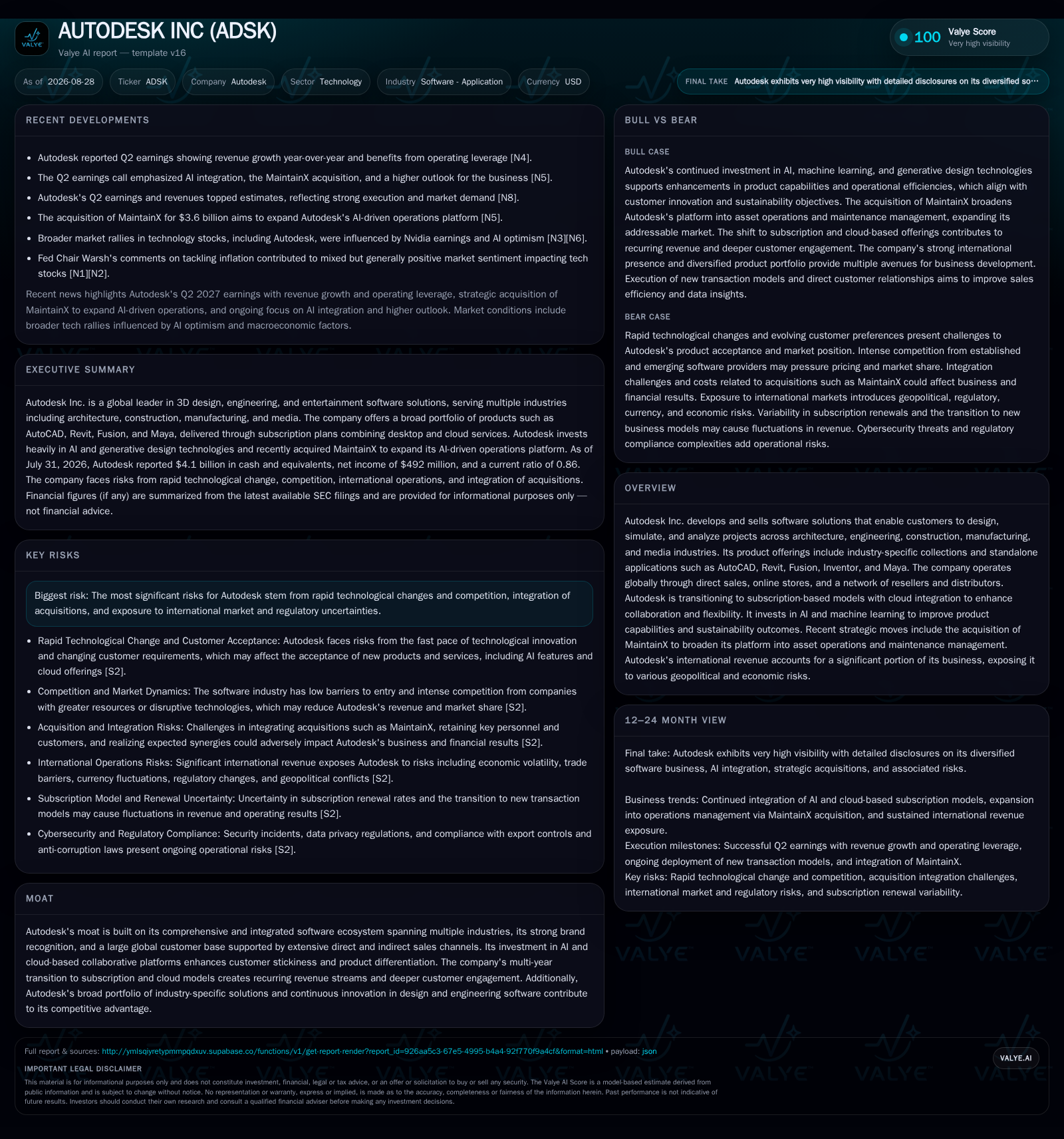
Autodesk’s robust software portfolio and global reach underpin a durable competitive position enhanced by AI and cloud transitions. However, execution risks around acquisition integration, international exposure, and subscription renewal variability temper near-term predictability. The evolving AI-driven product capabilities alongside expanding operations management solutions offer a compelling growth vector if customer adoption and technology integration succeed.
Autodesk stands at a pivotal juncture as it leverages a broad, industry-spanning software portfolio enhanced by AI and cloud integration to meet evolving customer demands. The recent acquisition of MaintainX signals a strategic expansion beyond traditional design software into operational asset management, potentially unlocking new revenue streams. While Q2 2027 earnings reflect positive momentum from these initiatives, the company must navigate integration complexities, subscription model transitions, and global economic uncertainties to fully realize its growth potential. This analysis explores Autodesk's business model dynamics, competitive positioning, and key risks shaping its medium-term trajectory.
Latest Operating Snapshot
Autodesk's Q2 2027 earnings demonstrated solid year-over-year revenue growth accompanied by operating leverage, underscoring improved efficiency as AI integrations and the MaintainX acquisition contributed to performance [N4][N5]. The company’s cash position remains strong with $4.1 billion in cash and equivalents as of July 31, 2026, supporting ongoing investments and acquisition financing [S2].
Approximately 65% of Autodesk’s net revenue derives from international markets, highlighting its significant global footprint but also exposing it to risks from economic volatility, regulatory shifts, and currency fluctuations [S1][S2]. The business model transition towards subscription-based plans combining desktop and cloud services continues to evolve, with new transaction models involving Solution Providers aimed at deepening direct customer relationships [S1].
Business Model and Unit Economics
Autodesk generates revenue primarily through subscription plans that bundle desktop software with cloud-enabled collaborative capabilities, shifting away from perpetual licenses to recurring revenues. This subscription model enhances predictability and customer lifetime value, assuming stable renewal rates, while enabling device-independent workflows increasing user stickiness [S1]. Pricing dynamics are influenced by product mix across industry verticals—architecture, manufacturing, media—and by the level of cloud integration and AI features offered.
Fixed costs include sustained R&D investments in AI, generative design, and platform development, alongside sales and marketing required to manage a hybrid sales channel with approximately 1,170 reseller and distributor partners plus direct sales [S1]. Operating leverage emerges as incremental subscription revenue scales faster than fixed R&D and infrastructure costs. However, capital intensity increases with strategic acquisitions like MaintainX ($3.6 billion), which adds complexity and integration costs, potentially delaying margin expansion if synergies are slower to materialize [N5][S2].
Moat, Competition and Counterforces
Autodesk’s moat stems from its integrated software ecosystem that spans multiple industries and workflow stages—design, engineering, construction, manufacturing, and media—combined with a recognized brand and extensive global distribution. The shift to cloud-enabled, AI-enhanced subscription offerings strengthens customer lock-in through collaborative workflows and continuous innovation, raising switching costs for enterprise users [S1].
However, the software market's low barriers to entry and intense competition from both established incumbents and emerging AI-enabled startups challenge Autodesk’s pricing power and market share. Competitors with disruptive technologies or more agile cloud-native platforms could erode Autodesk’s position, especially if customer adoption of new subscription models falters. Additionally, geopolitical and regulatory risks related to Autodesk’s international exposure may complicate market access and compliance [S2].
Bull Case
In the bull scenario, Autodesk successfully integrates MaintainX, unlocking cross-selling opportunities that broaden its addressable market into asset operations and maintenance management, leveraging AI to deliver differentiated platform value. Continued AI and machine learning advancements lead to enhanced product capabilities that boost customer productivity, sustainability, and innovation, reinforcing Autodesk’s leadership in design and operational software [N5][S1].
The subscription and cloud transition achieves high renewal rates and customer expansion, generating meaningful operating leverage as fixed costs amortize over a growing recurring revenue base. Direct sales and new transaction models deepen customer relationships and data insights, enabling more effective upselling and retention. International markets continue to grow despite geopolitical headwinds, supported by diversified product portfolios and localized go-to-market strategies. Confirmation would come from sustained double-digit revenue growth, margin expansion, and MaintainX synergy realization. Failure to meet these markers or declining renewal rates would falsify this view.
Base Case
Under the base case, Autodesk attains steady but moderate growth driven by ongoing AI integration and subscription adoption offset by competitive pricing pressures and moderate churn. MaintainX integration proceeds as planned but synergies materialize gradually, contributing incrementally to revenue without substantially accelerating margin expansion in the near term [N5][S2].
International revenue growth continues, but volatility from currency and regulatory factors causes some unevenness. The mix of products and customer segments stabilizes, with cloud and AI-enhanced features steadily adopted but not yet transformative. Operating leverage benefits occur but are constrained by investments in sales channels and platform development. This scenario expects Autodesk to maintain its market position and financial health without dramatic share gains or losses, providing a stable base for future innovation.
Bear Case
In the downside scenario, rapid technological shifts and evolving customer preferences undermine Autodesk’s product relevance, especially if competitors introduce superior AI or cloud-native solutions that accelerate customer defection. MaintainX acquisition integration struggles, with higher-than-expected costs, customer attrition, and failure to realize anticipated synergies, impairing profitability and cash flow [S2][N5].
Subscription renewal rates decline due to customer dissatisfaction with new pricing models or product complexity, leading to revenue volatility. International exposure exacerbates risks amid geopolitical tensions, regulatory barriers, and currency headwinds, slowing global expansion and compressing margins. Cybersecurity incidents or compliance failures could add operational disruptions. Evidence supporting this case would include declining revenue, margin contraction, and increased churn, while stabilization or improvement in these metrics would invalidate it.
What Matters Next
Key performance indicators to watch include subscription renewal rates and net retention metrics, which directly reflect customer satisfaction and revenue visibility. Progress on MaintainX integration—such as cross-selling success, customer retention, and cost synergy realization—is critical to validating the acquisition’s strategic value.
Monitoring AI feature adoption rates and their impact on product differentiation will indicate Autodesk’s ability to sustain competitive advantage. Revenue growth rates and margin trends across core and new business lines reveal operating leverage dynamics. International revenue growth and currency impact disclosures will signal geopolitical risk exposure. Lastly, updates on the evolution of the new transaction models and direct sales effectiveness will provide insight into Autodesk’s channel transformation success.
Disclaimer: This is research-only, informational analysis and not investment advice. It may include AI-generated interpretation and general industry context. Always verify important details using primary sources.

Comments