
Addus HomeCare's Strategic Expansion and Earnings Growth Under Regulatory Pressure
Addus HomeCare leverages integrated care services and acquisitions to fuel growth despite complex regulations.
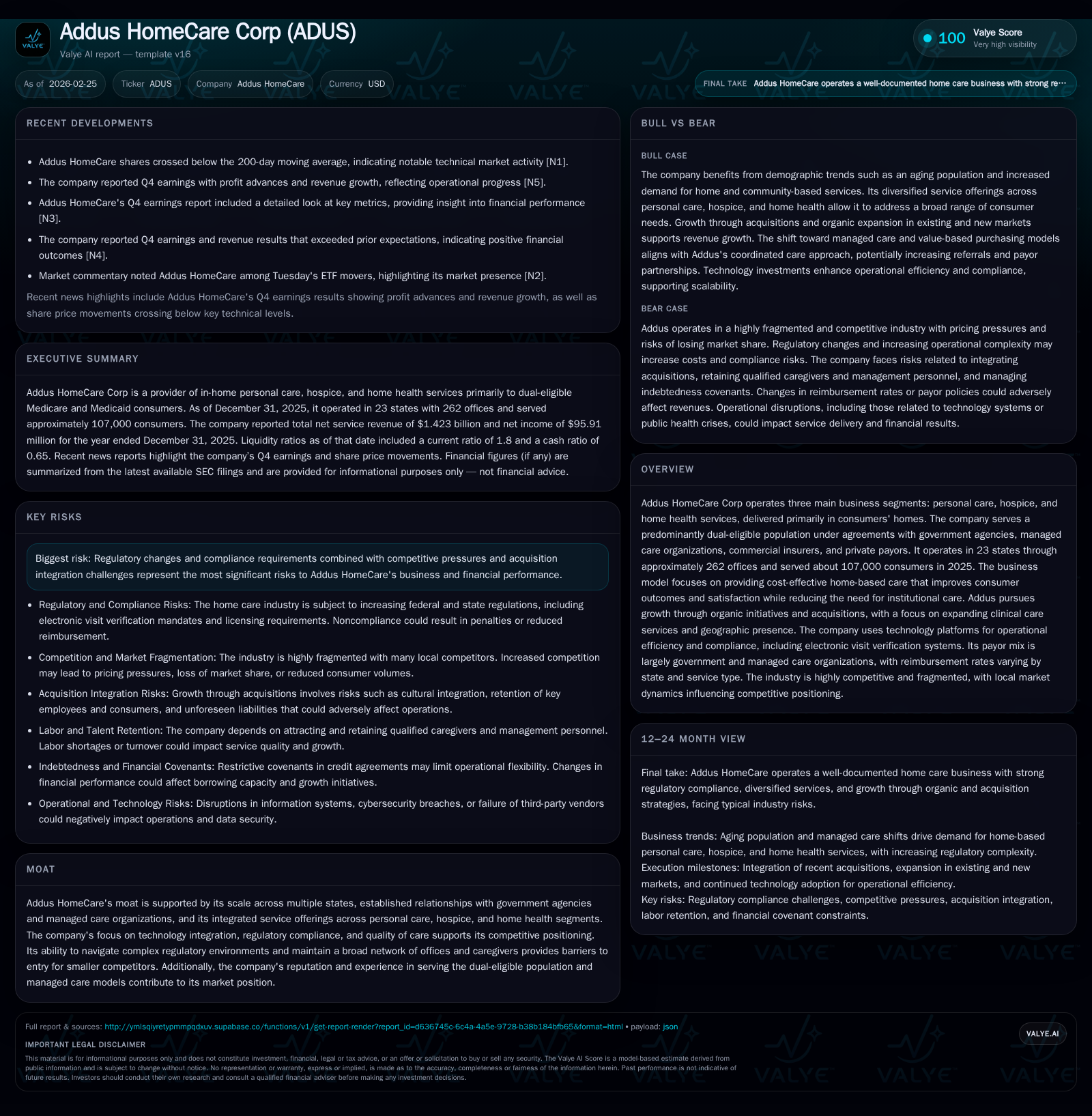
Addus HomeCare has demonstrated robust revenue and earnings growth driven primarily by its personal care segment and geographical expansion across 23 states. Its operational efficiency benefits from technology adoption such as electronic visit verification systems and a stable dual-eligible payor mix. The company balances organic growth with acquisitions, though regulatory challenges and compliance costs pose ongoing risks. Capital structure analysis reveals moderate leverage with substantial borrowing capacity, supporting strategic flexibility. Investors should monitor reimbursement rates, margin trends, acquisition integration progress, and regulatory developments in upcoming reports.
Robust Revenue Growth Fueled by Integrated Care Services
Addus HomeCare Corp's financial performance through the year ended December 31, 2025 evidences significant top-line and profitability expansions primarily anchored in its personal care segment. In 2025, total net service revenue reached $1.423 billion across personal care ($1.089 billion), hospice ($263 million), and home health services ($71 million), representing a ~23% year-over-year increase from $1.155 billion in 2024 [F1][S1]. This surge notably stems from broadening consumer base coverage to approximately 107,000 discrete consumers serviced via roughly 262 offices spanning 23 states [S1].
Operating income increased sharply by 35% to $138.6 million in FY2025 from $102.7 million in FY2024 [F1], underscoring improved operational leverage primarily due to scale gains in the high-margin personal care business segment. This breadth across integrated services—encompassing personal care, hospice, and home health—provides Addus with diversified revenue streams within the evolving homecare landscape. The model emphasizes cost-effective delivery in-home to predominantly dual-eligible beneficiaries under contracts with government agencies and managed care entities [S1], driving value-based outcomes while reducing institutional care dependency.
Historical performance (annual)
| FY | Net ($mm) | CFO ($mm) | OpInc ($mm) | Capex ($mm) | Net YoY |
|---|---|---|---|---|---|
| 2025 | 96 | 112 | 139 | 8 | +30.3% |
| 2024 | 74 | 116 | 103 | 6 | +17.7% |
| 2023 | 63 | 112 | 91 | 9 | +35.8% |
| 2022 | 46 | 105 | 69 | 8 |
Note: Omitted columns lack sufficient annual XBRL coverage in the provided tags (need ≥2 annual points): Rev, Div, Buybacks. Source: SEC companyfacts cache [F1].
Capital returns and efficiency (annual)
| FY | FCF ($mm) | ROE% |
|---|---|---|
| 2025 | 104 | 8.8 |
| 2024 | 110 | 7.6 |
| 2023 | 103 | 8.8 |
| 2022 | 97 | 7.3 |
Source: SEC companyfacts cache [F1].
Note: Revenue data prior to FY2024 is not consistently reported; ROE calculated as Net Income divided by Stockholders’ Equity for FY2025 only.
Operational Efficiency Through Technology and Payor Mix Optimization
A key competitive advantage for Addus lies in its sophisticated operational infrastructure aimed at ensuring regulatory compliance while maximizing caregiver productivity. Electronic Visit Verification (EVV) systems mandated by Medicaid programs nationally exemplify such technological integration; states have personalized EVV implementation models requiring vendors like Addus to invest heavily in compliance-capable IT systems [S28]. These systems facilitate real-time verification of caregiver visits essential for audit defense and prompt reimbursement.
The company’s predominant service delivery model targets dual-eligible individuals eligible for both Medicare and Medicaid coverage—a population segment with complex medical needs but relatively stable reimbursement arrangements through government contracts [S1]. This payor mix significantly stabilizes revenue flows but entails continuous navigation of multifaceted federal-state healthcare regulations amid evolving benefit structures.
In-home care’s cost efficiency compared to institutional alternatives underpins Addus’ value proposition; caregivers provide assistance with daily living activities along with early intervention reporting that helps reduce costly emergency room visits or hospitalization recurrences [S1]. Efficient coordination with managed care organizations enables value-based contracting which increasingly impacts reimbursement terms and risk-sharing dynamics within the industry.
Balancing Organic Expansion and Acquisitions: Growth Strategy Insights
Addus pursues a hybrid growth strategy that combines organic geographic expansion—often via opening de novo offices—and strategic acquisitions of local providers to quickly scale service footprint [S1][S4]. As of year-end fiscal 2025, presence spans 23 states where it provides all three levels of care—personal care, home health, hospice—in select states such as Ohio and Illinois with ongoing market development efforts [S1].
Key milestones include establishing fully integrated service offerings within these states while continuing to expand geographically through both internal development and acquisitions [S1]. However, integrating acquired entities poses challenges including cultural assimilation issues, retention of key personnel and clients, licensing hurdles, regulatory approvals, and harmonization of operational practices [S1][S4]. Managing this complexity demands robust management bandwidth; failure can adversely impact projected synergies or growth rates.
Financially, expansion could be constrained by debt covenant limits under its revolving credit facility governed by Adjusted EBITDA multiple covenants [S4]. Current borrowings stand at $124 million against liquidity availability over $517 million reflecting significant runway but subject to leverage caps especially as acquisitions accumulate debt obligations [F1][S4]. Facility constraints necessitate careful capital planning aligned with growth initiatives.
Regulatory and Compliance Challenges Impacting the Business Outlook
The regulatory environment presents one of the most material risks confronting Addus HomeCare’s operations and financial stability [N1]. Federal fraud and abuse statutes such as the False Claims Act (FCA), Anti-Kickback Statute, Stark Law impose stringent requirements on billing accuracy, referral arrangements, documentation adequacy, overpayment handling, among others [S27]. Non-compliance can trigger severe administrative penalties including exclusion from major federal programs like Medicare/Medicaid.
Healthcare policy dynamics remain volatile post-2024 elections with restructuring efforts within agencies like HHS affecting participation rules and payment methodologies possibly altering cash flow predictability [S6]. Notably CMS’s new WISeR model introduces enhanced AI-driven pre-payment claim reviews which may increase administrative burden or delay payments [S19]. Emerging state-specific laws on AI usage in healthcare communications add compliance dimensions needing continuous monitoring [S17]. Data security vulnerabilities also pose operational risk given dependence on IT platforms handling protected health information subject to HIPAA regulations [S6][S19].
These challenges necessitate sustained investment in legal compliance infrastructures and quality control mechanisms inherently increasing operating costs yet critical to safeguarding reimbursement streams.
Capital Structure, Liquidity, and Acquisition Financing Dynamics
At December 31, 2025 Addus held cash reserves totaling $81.6 million against outstanding credit facility borrowings of approximately $124.3 million [F1][S4]. While net current assets support liquidity initiatives (current ratio ~1.8), indebtedness exposes the company to covenant restrictions centered on Total Net Leverage Ratios tied to Adjusted EBITDA metrics.
Credit facility availability stood near $518 million as of fiscal year-end providing ample capacity to fund acquisition strategies or opportunistic geographic expansions but constrained by leverage limits requiring lender consent beyond certain thresholds [S4][F1]. The ability to raise incremental debt is contingent on maintaining strong EBITDA performance—a challenge amid fluctuating reimbursement trends.
No recent disclosures indicate dividend payments or share repurchases; related data is not available in provided tags or filings suggesting prioritization of reinvestment or deleveraging over distributions at present [F1]. Optimizing debt levels while retaining operational agility represents a balancing act fundamental to sustaining growth momentum.
Returns to Shareholders: Evaluating Cash Flow Generation and Capital Allocation
Financial returns illustrate solid profitability improvements alongside steady cash flow generation for operational reinvestment purposes [F1]. Net income surged around +30% year-over-year reaching $95.9 million in FY2025 supported by operating margin enhancement evidenced through a +35% increase in operating income to $138.6 million.
Operating cash flows displayed slight contraction (-4%) versus prior year at approximately $111 million still comfortably covering capital expenditures which rose about +27%, reflecting investments in infrastructure ($7.7 million) yielding free cash flow near $104 million annually—a healthy buffer for strategic initiatives or debt servicing needs.
Future Growth Catalysts and Market Expansion Opportunities
Multiple avenues exist for future revenue acceleration driven by persistent demographic tailwinds including rising elderly population necessitating home-based long-term care solutions [N3][S1]. Organic growth prospects remain viable through expansion into underserved states while enhancing penetration where full service integration exists across personal care, hospice and home health offerings.
Broadening clinical service lines aligning with managed care expectations provides an additional layer of differentiation potentially increasing referral volumes from network partners seeking comprehensive population health management solutions.
Acquisitive activities targeting local providers complement organic expansion albeit execution risk remains; successful scaling depends on effective integration frameworks mitigating client attrition or cost overruns.
Monitoring industry consolidation trends is prudent given intensified payor bargaining power exerted through managed care organization dominance affecting contract negotiation leverage ultimately impacting margins over time.
Key Metrics to Monitor in Upcoming Earnings Reports
Investors should keep vigilant focus on several performance indicators including:
- Changes in reimbursement rates from Medicare/Medicaid impacting segment margins particularly around labor cost inflation;
- Operational efficiency gains attributable to advanced technology deployment such as EVV system enhancements affecting cost structure;
- Progress on new office openings versus acquisition completions balancing organic versus inorganic growth;
- Leverage ratios relative to credit facility covenants signaling capital flexibility constraints;
- Quality metrics impacting pay-for-performance reimbursements underpinning managed care relations;
- Macro factors influencing consumer demand patterns amidst broader economic conditions.
Recent Q4 earnings results beating estimates affirm underlying operational momentum although share price softness below technical moving averages reflects some caution over macro uncertainties warranting close observation [N1][N2][N5].
This analysis is based solely on publicly available information as cited without offering investment recommendations.
Disclaimer: This is research-only, informational analysis and not investment advice. It may include AI-generated interpretation and general industry context. Always verify important details using primary sources.

Comments