
Advanced Biomed’s Shift to AI Financial Verification: Proprietary Tech and Early Market Traction
After a full exit from biomedical operations, Advanced Biomed Inc. now bets on FinTruth—an AI-powered financial verification platform. Early revenue and a lean cost base show the model’s potential, but success hinges on customer adoption, execution in regulated markets, and proving sustainable commercial value amid competition from larger AI and fintech incumbents.
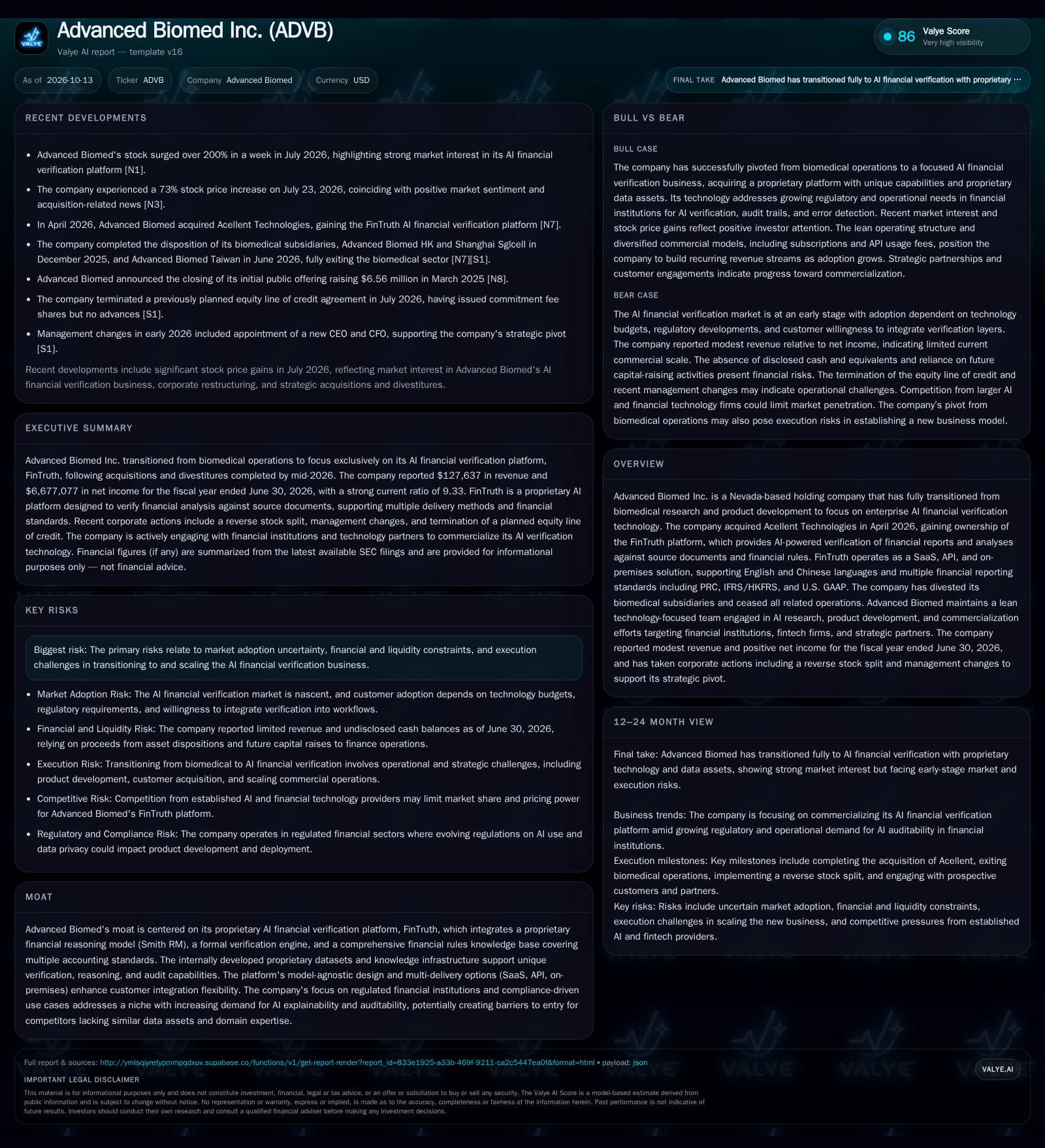
Advanced Biomed has transitioned entirely from biomedical R&D to focus on its proprietary AI financial verification platform, FinTruth, following the acquisition of Acellent Technologies in April 2026. While the company reported modest revenue and a positive net income for the year ending June 2026, its future now depends on scaling customer adoption among financial institutions and navigating execution and competitive risks in a nascent but increasingly regulated AI verification market. [S1] [N7]
Advanced Biomed Inc. has undergone a radical transformation, shedding its legacy biomedical operations to become a focused player in the emerging field of AI-powered financial verification. Through the acquisition of Acellent Technologies, it now owns FinTruth—a proprietary platform designed to verify financial analyses and reports against source documents and regulatory standards. While the company’s lean structure and early revenue generation hint at potential, the stakes are high: customer adoption, commercial scale, and defensible differentiation are all up for grabs in a market where regulatory scrutiny and competitive intensity are likely to increase.
Strategic Shift to AI Financial Verification Opens New Opportunities
Advanced Biomed Inc. has fully exited its biomedical legacy, selling all related subsidiaries by June 2026 and acquiring Acellent Technologies in April 2026. This acquisition delivered the FinTruth platform—a proprietary AI system for verifying financial analyses against source documents and accounting rules. The company reported $127,637 in revenue and $6,677,077 in net income for the fiscal year ended June 30, 2026, and maintained a reported current ratio of 9.33, though its cash position was not disclosed. The reverse stock split and management changes, including a new CEO and CFO, underscore a complete strategic reset focused on AI-driven solutions for regulated financial institutions. The recent surge in stock price during July 2026 signals strong investor interest, but actual commercial traction and revenue scale remain modest. [S1] [N1] [N3] [N7]
Monetization Pathways for FinTruth in Regulated Financial Sectors
Advanced Biomed’s new business model is centered on monetizing FinTruth through a mix of enterprise subscriptions, usage-based API fees, integrated solutions, and partnerships with financial IT and AI platform providers. The economics of this model depend on FinTruth’s ability to become a critical layer in the compliance and audit infrastructure of financial institutions—a segment with recurring needs and high willingness to pay for regulatory-grade verification, provided the solution is robust and trusted.
If FinTruth can establish itself as a must-have for banks, fintechs, and auditors, recurring SaaS and API revenue could lend itself to high gross margins, especially given the company’s lean R&D and engineering-focused cost structure. The proprietary Smith RM reasoning model, internally developed datasets, and multilingual, multi-standard support could enable premium pricing if customers perceive clear regulatory or operational value.
However, the size of the addressable market will be shaped by evolving regulations, actual integration into financial institution workflows, and the speed at which verification layers become essential rather than optional. Upfront capital requirements appear modest given the company’s focus on software and data, but scaling will likely require targeted sales, customer support, and possibly additional investment in infrastructure or customer success functions.
Proprietary Data and Auditability Strengthen Competitive Moat
FinTruth’s competitive positioning is built on three pillars: proprietary datasets and financial rules infrastructure, a formal verification engine with consistency and traceability features, and flexibility in integration (SaaS, API, on-premises). This gives Advanced Biomed a potential edge in regulated environments where explainability, audit trails, and source-level verification are not just preferences but requirements.
Nevertheless, competitive threats loom large. Established AI and financial technology firms with existing customer bases, deeper resources, and strong distribution capabilities could rapidly build or acquire similar verification capabilities. In addition, open-source or foundation model providers may enter the verification layer, eroding differentiation if proprietary datasets or algorithms are not demonstrably superior.
Switching costs for customers are likely to be moderate to high if FinTruth becomes embedded in compliance workflows, but until widespread adoption is achieved, procurement cycles and proof-of-value requirements could slow growth. The question is whether Advanced Biomed can leverage its early mover status and technical strengths to build lasting customer relationships before larger players crowd the field.
Regulatory Tailwinds Propel Rapid Uptake and Revenue Expansion
The bull case rests on a scenario where regulatory mandates for AI explainability, auditability, and error detection accelerate adoption among financial institutions and fintechs. If FinTruth demonstrates clear, defensible value—such as reducing compliance risk, preventing costly errors, or passing third-party audits—it could become a standard layer in risk and compliance infrastructure.
Confirmation would come from material increases in contracted enterprise customers, growth in recurring SaaS/API revenue, and evidence of multi-year or multi-product customer relationships. Announcements of integrations with major financial IT platforms, or endorsements from regulators or large audit firms, would also signal traction. If the company can show high retention rates and low churn, this would indicate that switching costs are meaningful and the product is sticky.
The upside could be amplified if Advanced Biomed forms strategic partnerships with foundation model providers or secures reference clients in highly regulated markets, establishing itself as a category leader in AI financial verification.
Commercial Adoption Progresses with Proof-of-Value and Integration Challenges
The most plausible scenario is a period of gradual customer engagement, with pilot programs and small-scale deployments as financial institutions test the FinTruth platform. Adoption is likely to be gated by procurement cycles, integration complexity, and the need to validate the platform’s efficacy in real-world regulatory audits.
Revenue growth may be lumpy, with initial deals being smaller in size and scope, and customer feedback driving iterative improvements to the platform. The company’s lean structure should help manage burn, but customer acquisition costs could rise if sales cycles are long or require bespoke integrations.
Confirmation of this scenario would be a steady but modest increase in revenue, a growing pipeline of proof-of-concept projects, and incremental progress in converting pilots to paying, renewing customers. Evidence of repeat business or cross-sell into adjacent compliance or risk use cases would support the base case.
Competitive Dynamics and Adoption Risks Could Restrict Growth
The bear case unfolds if financial institutions are slow to adopt third-party AI verification solutions, either due to budget constraints, regulatory uncertainty, or preference for internal solutions. Larger AI or financial technology firms could respond by integrating similar verification features into their platforms, leveraging scale and existing customer relationships to outcompete FinTruth.
Execution risk is heightened by the company’s pivot from biomedical to fintech, with potential for missteps in product-market fit, sales execution, or customer support. If recurring revenue fails to materialize and customer wins are sparse, the company may need to raise additional capital, with dilution risk or balance-sheet pressure if internal cash flows are insufficient.
This scenario would be confirmed by stagnant or declining revenue, lack of new customer announcements, or evidence of price competition and commoditization of AI verification features. High customer churn or negative feedback from pilot programs would reinforce the downside case.
Critical Milestones Shaping Advanced Biomed’s AI Verification Journey
Growth in contracted enterprise customers using FinTruth, especially in regulated financial institutions or large fintechs, would demonstrate commercial traction.
If disclosed, the breakdown of recurring SaaS or API revenue versus pilot or one-off project revenue would clarify the durability of the business model.
Evidence of integrations or partnerships with major financial IT platforms, core banking software providers, or foundation model partners would support network effects.
Customer retention and renewal rates, if disclosed, would indicate switching costs and product stickiness.
Updates on regulatory developments requiring AI verification, explainability, or auditability in financial reporting would expand the addressable market.
Gross margin and R&D spending trends would help test the scalability and operating leverage of the platform business.
Any disclosure of competitive wins or reference customers, especially where Advanced Biomed displaces incumbent verification solutions, would signal differentiation.
Progress in international expansion, such as contracts in non-Chinese/English markets or with multinational banks, would validate the platform’s global relevance.
Disclaimer: This is research-only, informational analysis and not investment advice. It may include AI-generated interpretation and general industry context. Always verify important details using primary sources.

Comments