
Eagle Nuclear Energy: Resource Leverage and Execution Hurdles in a Shifting Nuclear Landscape
With reported liquidity position and recent net profitability, Eagle Nuclear Energy is positioned to participate in the nuclear sector’s resurgence. Yet, the company’s future will hinge on project execution, regulatory navigation, and its ability to translate mineral assets into sustained cash flows.
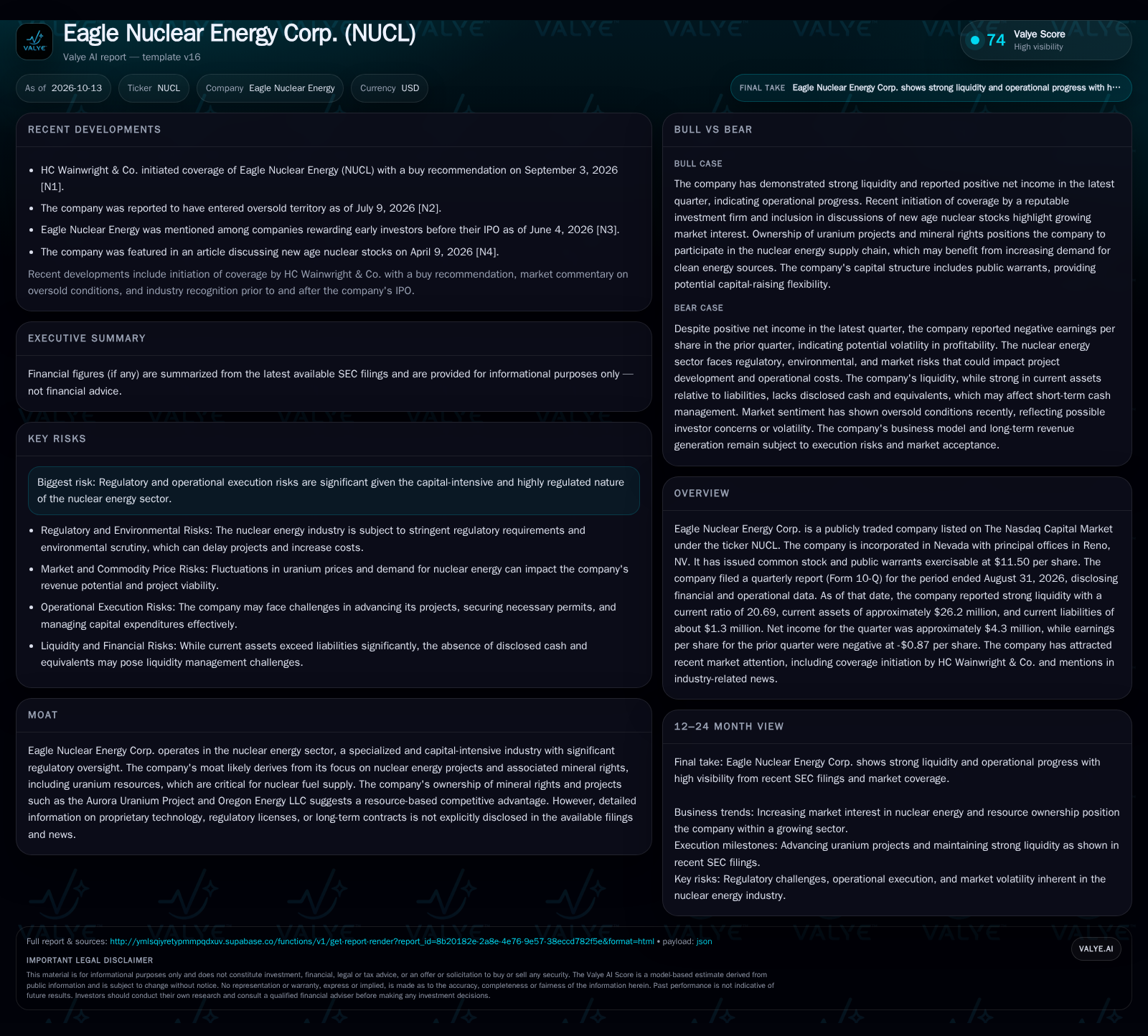
Eagle Nuclear Energy (NUCL) reported a substantial current asset base and positive net income for the August 2026 quarter, drawing new analyst coverage and sector attention. The company’s prospects depend on advancing uranium projects and navigating the nuclear industry’s complex regulatory and market environment. [S1] [N1] [N2] [N4]
Eagle Nuclear Energy Corp. (NASDAQ: NUCL) stands at a pivotal point as nuclear energy regains favor in global clean-energy discourse. The company’s robust current ratio and recent net profitability signal operational progress and attract investor attention, as reflected in recent analyst coverage. Yet, Eagle’s true value proposition depends on its ability to advance uranium projects amidst volatile earnings and the sector’s formidable regulatory hurdles. The next phases will test whether resource ownership and reported liquidity position can be translated into durable, scalable cash flows.
Recent Financial Performance and Market Attention
The company reported cash and liquidity metrics for the period; these figures do not by themselves establish operating runway, investment capacity, financial flexibility, or financing capacity. [S1] The company posted net income of $4.3 million for the quarter, contrasting with negative earnings per share (-$0.87) in the previous quarter—highlighting a rebound but also underlying earnings volatility [S1]. Meanwhile, the company has attracted attention from institutional analysts, evidenced by HC Wainwright & Co. initiating coverage with a buy recommendation in September 2026, and its inclusion in discussions about the new wave of nuclear energy stocks this year [N1] [N4]. These developments underscore both operational progress and heightened market scrutiny.
Translating Mineral Assets into Cash Flow: The Economic Model
Eagle Nuclear Energy’s business model appears to be anchored in the development and monetization of uranium projects and associated mineral rights. In the nuclear value chain, upstream resource holders can generate revenue through direct uranium sales, long-term supply agreements, or asset monetization (such as joint ventures or royalties). The actual economics depend on resource quality, extraction costs, permitting status, and the ability to secure offtake agreements with nuclear utilities or intermediaries. The company’s current asset-heavy balance sheet suggests it is still in a capital deployment or early monetization phase, with the potential for substantial operating leverage if production scales up. However, the lack of detailed disclosure on cash flows from operations, capital expenditure requirements, and contract structure means that the predictability of future earnings is not yet clear. Fixed costs related to regulatory compliance, environmental remediation, and project development are likely significant, and variable costs will be driven by the scale and timing of resource extraction or project advancement. Capital intensity and funding needs are inherently high in this sector, and the existence of public warrants may provide a conditional capital-raising mechanism if new equity is needed.
A key factor influencing the economic viability of Eagle Nuclear Energy’s projects is the sensitivity of uranium prices to global supply-demand imbalances and geopolitical developments. Since uranium markets are relatively illiquid compared to other commodities, price volatility can be pronounced, affecting project economics and investment decisions. If uranium prices remain elevated or trend upward due to increased nuclear capacity additions or supply constraints, the company’s resource monetization potential improves significantly. Conversely, prolonged price weakness could compress margins and delay project feasibility. Additionally, the timing of capital expenditures relative to market cycles is critical; deploying capital during a price trough could strain liquidity, whereas well-timed investments aligned with price upswings enhance returns and reduce financing risk.
Another dimension is the company’s ability to manage operational and regulatory fixed costs while scaling production. Regulatory compliance, environmental monitoring, and community relations impose ongoing expenses that may not scale linearly with production volumes. Therefore, achieving a minimum efficient scale is essential to dilute these fixed costs and improve operating margins. If Eagle Nuclear Energy can leverage existing infrastructure or enter into partnerships to share regulatory burdens, it may accelerate reaching this scale. However, failure to control overhead or delays in scaling could result in persistent negative cash flows despite resource ownership, underscoring the importance of disciplined project management and cost control frameworks.
Resource Ownership and Sector Positioning: Potential Advantages and Structural Hurdles
Eagle Nuclear Energy’s competitive edge is likely rooted in its ownership of uranium mineral rights and projects, which are critical assets in the nuclear fuel supply chain. In an environment where global interest in carbon-free baseload power is rising, control of uranium resources can confer strategic value, especially if supply tightens or geopolitical risks disrupt global flows. However, the competitive landscape includes established uranium miners, vertically integrated nuclear fuel companies, and new entrants leveraging advanced extraction or enrichment technologies. The sector is also shaped by regulatory and political forces, where permitting timelines, community engagement, and environmental standards create barriers to entry but also slow project realization. The absence of disclosed proprietary technology, long-term contracts, or regulatory licenses in the current filings means Eagle’s moat is primarily resource-based rather than process- or relationship-driven. Substitution risk remains low in nuclear fuel supply, but project delays, regulatory setbacks, or cost overruns are persistent threats.
If Project Execution Aligns with Sector Tailwinds, Value Could Accrue Rapidly
In a favorable scenario, Eagle Nuclear Energy successfully advances its uranium projects, secures necessary permits, and enters into offtake agreements with utilities or downstream partners as nuclear demand accelerates. This could enable the company to convert mineral resources into recurring revenue streams, unlocking operating leverage and potentially supporting sustained profitability. Additional upside could come from higher uranium prices, sector consolidation, or strategic partnerships that provide capital and technical expertise. Confirmation of this scenario would require announcements of major project milestones (e.g., permitting approvals, production start, or signed supply contracts), positive cash flow from operations, and evidence of cost discipline. An expanding project pipeline or new resource discoveries would further validate the company’s growth prospects.
Navigating the Long Road from Resource Holder to Producer
The most plausible trajectory is that Eagle Nuclear Energy continues to progress its uranium projects through regulatory and technical milestones, but at a measured pace characteristic of the sector. The company may experience intermittent earnings due to development-stage revenue recognition, fluctuating uranium prices, and ongoing capital requirements. Execution risk remains elevated, with delays or additional permitting hurdles likely to extend timelines. The business could demonstrate lumpy financial results, punctuated by periods of positive net income and quarters of losses, until stable production or long-term contracts are achieved. Evidence supporting this scenario would include incremental project updates, periodic capital raises or warrant exercises, and ongoing cost management without major setbacks. Conversely, persistent negative earnings, inability to advance projects, or capital constraints would challenge the base case.
Failure to Advance Projects or Secure Funding Could Erode Value
A negative outcome could result if Eagle Nuclear Energy encounters regulatory, technical, or financial roadblocks that stall project advancement. Extended permitting delays, environmental opposition, or cost overruns could deplete current assets without generating sustainable revenue. If uranium prices weaken or access to additional capital tightens, the company’s ability to bridge the gap between resource ownership and production could be impaired. This scenario would be confirmed by repeated negative net income, declining current assets, inability to secure project financing, or disclosures of project impairments. A lack of progress on strategic partnerships or supply agreements would further signal difficulty in monetizing the asset base.
Milestones and Metrics Shaping Eagle Nuclear Energy’s Outlook
Announcements of new or advanced project milestones (such as permitting approvals, resource updates, or production readiness) would provide evidence of execution progress.
Disclosure of long-term offtake agreements or supply contracts with nuclear utilities, if secured, would indicate revenue visibility and project viability.
Updates on cash flow from operations, if disclosed, would help assess the transition from resource holder to cash-generating operator.
Trends in net income and earnings per share across future quarters will reveal whether recent profitability is sustainable or episodic.
Any strategic partnerships, joint ventures, or asset sales could shift the risk/reward profile and affect capital needs.
Sector-wide developments in uranium pricing, regulatory policy, or nuclear energy adoption rates could materially impact project economics and investor sentiment.
If disclosed, project-specific cost estimates and timelines would help gauge the likelihood of on-budget, on-time execution.
Disclaimer: This is research-only, informational analysis and not investment advice. It may include AI-generated interpretation and general industry context. Always verify important details using primary sources.

Comments